Detailed Explanation of the Methods and Steps for Making Rock-Clinging Bonsai
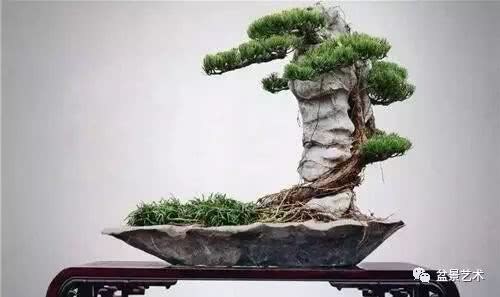
Rock-clinging bonsai can organically blend stump bonsai with landscape bonsai, and is a miniature and close-up of the image of trees tenaciously growing in crevices of sheer cliffs or on the peaks and rocky summits. The tree body is embedded in the rock wall, winding around stone caves; the trunk has support, the fantastic rock has a dangerous momentum, the tree posture is lush, the roots are exposed and embrace the rock, threading through the stone with visible form, the momentum is continuous, forming a seamless whole, with varied expressions and elegant charm.
Stone material selection: The form of the stone material should strive for "thin, wrinkled, leaky, transparent." "Thin" means the stone material has edges and corners, suitable for configuring arc-shaped peaks; "wrinkled" means the texture is clear, wrinkled but not chaotic, like the folds of mountain ridges; "leaky" means the stone has pores and can ventilate and drain water; "transparent" means the stone has interconnected passages inside, like natural mountain rock caves, giving a sense of quiet seclusion. Commonly used are soft stones with loose texture; another type is harder stone, including Yingde stone, stalactite, sandstone egg stone, turtle-vein stone, yellow wax stone, etc. Most Lingnan rock-clinging bonsai use Yingde stone as the stone material, which is blue-gray in color, has relatively deep textures or caves, many stone crevices, and large and small holes in the middle, with stone patterns following nature, expressing the beauty of ugly, strange, and fantastic forms. It can be processed by cutting, sawing, carving, and cement bonding.
Tree shaping: The proportions of tree and stone should be coordinated, unified, and harmonious. Stone is rigid, tree is soft. Rigidity and softness complement each other. The roots coiled over the stone vary from thick to thin, some exposed and some hidden, with clear distinction between curved and straight. The cliff-hanging tree scene and the sheer-cliff stone scene, one strange and one dangerous, reflect each other. In shaping, it varies according to the stone, and the tree is delicate and bends its body on the stone. The forms include: first, the roots are exposed, clinging to and growing on the mountain stone, with the trunk upright; second, the roots are rooted in cracks of the rocky mountain, and the main trunk slants and drifts, dancing in the wind; third, the roots grow through the stone between sheer cliffs, and the trunk is gnarled and twisted, directly reaching toward the cliff, with majestic momentum. For rock-clinging trees, choose those with soft and well-developed roots, strong vitality, and easy, fast growth, with elm, Fujian tea, and Buddhist pine being superior, followed by snowbush, small-leaf banyan, bougainvillea, and acacia. The planting posture of the tree can be straight or slanting, mostly single-trunk. The production time is March to June or September to October. For planting, a shallow-mouthed pot is suitable.
Root-embracing-rock style: Tree species can be elm, Fujian tea, or small-leaf banyan. First, plant the selected trees with 3-5 well-developed lateral roots in a relatively deep and tall pot, using loose soil made of half mud and coarse sand. After determining the theme and layout, carve several grooves according to the natural texture and the number of thick roots. Correspondingly, embrace the mountain stone, with branches and supports distributed evenly. Place in half shade for maintenance.
Method of roots rooting into the stone top and threading through stone caves: Fujian tea, elm, and small-leaf banyan can be selected. First carve relatively deep stone crevices, caves, and through-holes in the stone. After filling with mud, extend the root system directly onto the sandy mud below the stone material. It can also be coated with mud slurry; if the stone patterns are relatively deep, the tree roots can be hung down along the stone, and the stone material and roots tied firmly together with aluminum wire or plastic rope. The tree, stone material, and pot soil should be frequently sprayed with water to maintain moisture, so as to benefit the growth of moss and the tree. Let the long roots be hidden and exposed, making stone and tree a seamless whole.
After the rock-clinging bonsai is made and formed, its maintenance and management are the same as those for stump bonsai.