A Detailed Guide to Bonsai Creation and Daily Care Methods
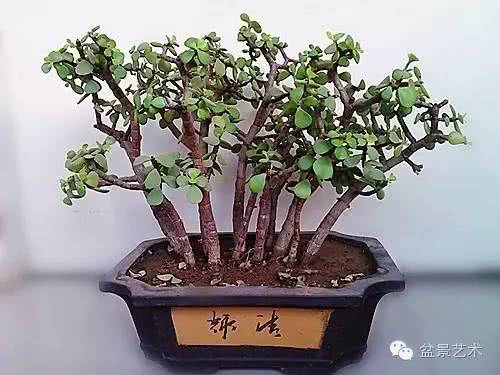
Jade leaf, also known as purslane tree, or silver ginkgo tree, commonly called "golden branch jade leaf", scientific name Portulacaria afra Jacq (the purslane tree from Africa), English name Elephant Bush (the useless shrub from Africa), is a succulent evergreen shrub of the purslane family, purslane genus. The trunk is firm and thick, with tangled node rings; the branches are soft outside but firm inside, densely growing upright or spreading; the leaves are small and thick, clustered at the tips of the branches. In appearance, it can both reveal the tall, upright, aged look of an old tree's dry trunk, and lack nothing of the vitality of dense branches and abundant leaves. Moreover, it has strong adaptability, likes light, tolerates drought, tolerates pruning, and sprouts readily, making it especially suitable for growing on terraces. It is an ideal plant material variety for creating single-trunk or combined-planting bonsai.
I. Preparation of Leaf Bonsai Plant Material
Jade leaf generally does not readily produce seeds, and is mostly propagated by layering. Layering can be carried out in spring, summer, and autumn, but spring layering gives the best results. This is because the air temperature in spring is moderate, the cut surface of the succulent stem segment is not prone to bacterial rot, and it is also most helpful for the healing of the cut and the sprouting of new roots. Generally, thick, straight 2~3-year-old stems or branches can be cut, and it is best to take into account the ornamental effect of the plant shape after survival. For a single-plant bonsai, a straight stem or branch can be selected as the cutting; for plants to be used in combined planting, stems or branches with special forms can be selected as cuttings. After appropriate trimming of the stem segment, the lower cut is best located 0.2CM~0.3CM below a node. Let it dry slightly until the cut has dried, then insert it into clean fine sand, vermiculite, perlite, or another substrate, inserting it to a depth of about 1/4~1/3 of the length of the stem segment. Just keep the substrate moist; never water too much, otherwise it easily causes rot and leads to layering failure. Usually after 3 weeks, a complete root system will grow. To make it easier to cultivate plants suitable for bonsai creation, the surviving plants can first be transplanted into clay pots, with enhanced water and fertilizer management. According to the needs of future bonsai creation, the plants should first be pruned into shape, generally once a month. After about one year of cultivation, when they have a certain plant form, they can be used for bonsai creation.
II. Creation of Jade Leaf Bonsai
When plants propagated by layering have basically taken shape after one year of cultivation, they enter the bonsai creation stage. Bonsai creation can be carried out in all four seasons of the year. Based on the thickness of the plant material's stem, its shape, the unevenness of the branches, and their growing positions, one can decide whether to create a single-trunk style or a two-plant or multi-plant combined planting style, and then select a suitable pot for it.
Generally, for a plant with an upright, dignified, thick main trunk, densely arranged nodes, no branches on the middle and lower parts, and more branches on the middle and upper parts distributed evenly in all directions, a single plant can be used to create an upright single-trunk bonsai with a tall, straight trunk. For the pot, based on the shape of the plant, one can choose a round or rectangular blue or green shallow pot. For a plant whose stem bends to one side but whose overall lines are smooth, one can choose a blue or light yellow tall cylindrical pot for planting, making a cliff-style bonsai, but the pot should be lined with more stones and coarse sand to reduce root rot caused by water accumulation in the pot. For a plant with beauty on one side, 2~3 plants can be selected to achieve the best combination and matching, making host and guest appropriate, with proper slanting and mutual response, combined into a bonsai with the rustic charm of mountains and woods, which likewise has outstanding quality. For combined-planting bonsai, it is advisable to choose a rectangular or oval shallow pot, because it has a larger pot surface space, which can set off the ancient, tenacious tree body and create a unique imagery, and is also easy to decorate with small stones and accessories.
A newly completed jade leaf bonsai may not be very satisfying. Subsequent pruning is the most important means of achieving its tree-form greening and gradually perfecting its composition. For parts that need to form crown pads, repeated pruning can be carried out to promote the sprouting of lower lateral buds and produce new branches to form dense crown pads. For parts that are too dense, sparse pruning can be done to reveal a plant shape with a pleasing balance of density and openness. It is worth noting that the pruning time should avoid the hottest season and rainy days, and within 1~2 days after pruning, do not water or spray, lest its succulent new wounds become infected with bacteria and then rot, causing the opposite result. Because its stem is aged and full of wrinkled nodes, its branches are relatively sparse, and its leaves are rather small, compared with common ficus bonsai, it has even more of a simple, straightforward air, and is especially suitable for expressing the spiritual style of evergreen large trees in the region south of the Yangtze River.
III. Maintenance and Management of Jade Leaf Bonsai
Jade leaf is native to tropical Africa. Its bonsai relatively likes light. Because its branches and leaves are rich in nutrients and it is a succulent plant, it can accept more light. In summer, receiving full light on a terrace is safe. If it is excessively shaded, it will cause the branches and leaves to become slender and the leaves to become thin, reducing its proper ornamental value. The soil for bonsai should be loose and fertile, and especially watering should not be excessive, otherwise it easily causes the plant's root system to rot and affects its normal growth. Jade leaf has poor cold resistance. Generally, in cold winter it should be moved indoors to a bright place, and a room temperature of no less than 5oC should be maintained to survive the winter safely. Small young shoots growing from the main trunk of jade leaf should be wiped off early, so as not to affect ventilation and light penetration in its inner space, and they can also form scars on the main trunk, further increasing its sense of vicissitudes. Jade leaf bonsai can be repotted once every 2~3 years. After taking the plant out, break off some aged roots and old soil, replant it with a fresh, well-aerated, satisfactory fertile soil, and just keep the pot soil moist, so as to promote the production of new roots and strengthen the plant's growth vigor. For topdressing bonsai jade tree, fully decomposed thin cake fertilizer water is best. During the growing season, topdress once a month; stop topdressing during the hottest season; after autumn begins, reduce the supply of water and fertilizer. Only in this way can it both benefit its growth and help it safely pass the winter and summer.