Preliminary Study Report on the Characteristics of Anlu Golden-leaf Ginkgo
Preliminary Report on the Characteristics of Anlu Golden-leaf Ginkgo
The Ginkgoaceae family contains only one genus and one species, a relict plant left over from the Quaternary glacial period [1], endemic to China and known as a living fossil of the plant world. It has edible, medicinal, timber and ornamental uses and is an important deciduous tree species for special economic forest production and garden cultivation and ornament. Anlu City is located in the northeastern part of Hubei Province, at the junction between the remnants of the Dahong Mountains and the northern edge of the Jianghan Plain. Within its territory there are both naturally distributed ginkgo (Ginkgo biloba Linn) communities and abundant secondary ginkgo woodland; there are 29,000 large ginkgo trees, 59 ancient ginkgo trees over a thousand years old, 1,468 ancient ginkgo trees over 500 years old and 4,683 ancient ginkgo trees over a hundred years old, earning it the reputation of the Home of Ginkgo. In November 2009, the country's first national forest park named after a single tree species was established in Anlu City. In 1987, in the town of Wangyizhen in that city, a ginkgo was found in which the leaves on one large rooted branch showed pale yellow-yellow-pale green-yellow during the growing season, while the leaves on the other branches were all pale green-green-yellow. Follow-up surveys were therefore carried out continuously for many years, and it was found that from bud break and leaf expansion this branch remained yellow until the end of May; after June the newly sprouted leaves were pale yellow, the mature leaves gradually turned pale green, and after mid-October they turned yellow. This trait is stable, and its characteristics of golden yellow leaves in spring and autumn, pale yellow to pale green in summer, and high total flavonoid content can be used to propagate and promote it in production as a garden ornamental foliage variety and a leaf-harvesting raw material variety.
1 Materials and Methods
1.1 Propagation Methods
The mother tree is 16 m tall, with a diameter at breast height of 110 cm and a crown spread of 13 m; the yellow-leaf variant branch is 7 m long with a basal diameter of 19.5 cm. For 6 consecutive years, buds and 1- to 2-year-old branches were collected from this branch for propagation. The rootstocks used for grafting were 1- to 4-year-old ginkgo seedlings; drilling sowing was used for seed raising with a row spacing of 25 cm; the grafting operators were relatively fixed; cleft grafting and bark grafting were used in spring and budding in autumn; the nursery land was old nursery land; and conventional management was applied after grafting, with no other special care measures.
1.2 Leaf Color Comparison
From spring to early summer, leaf pigment photographic sampling was carried out once a week on vegetatively propagated 3-year-old young trees and seedling rootstocks of the same year. Photography was done at 10 a.m. with a SONY P100 digital camera at an image distance of 60 cm and a fixed focal length of 35 mm (equivalent to the 60 mm focal length of a 135 full-frame camera), with programmed exposure according to the weather, using identical exposure parameters for both types of samples, to record color images of the ginkgo leaves. Using Photoshop CS software and 524-color RGB value data, the leaf colors of golden-leaf ginkgo and common ginkgo were converted into RGB values and leaf color charts were plotted to describe the leaf color of ginkgo at different times during leaf development and to compare the differences between the two.
1.3 Biochemical Analysis Comparison
(1) Determination of flavonoid content. Nanjing Forestry University was commissioned to collect leaves of golden-leaf ginkgo planted in its subordinate forest farm, and the laboratory of the College of Forestry of Nanjing Forestry University used high-performance liquid chromatography (HPLC) to detect the total flavonoid content of the leaves. The data obtained were compared with the total flavonoid content of local common ginkgo [2-3] measured by the same HPLC method and with that of ginkgo from other places such as Guangdong, Jiangxi and Gansu [4-7], to analyze the economic viability of cultivating golden-leaf ginkgo as a leaf-harvesting raw material.
(2) Leaf pigment factors. Nanjing Forestry University was commissioned to collect leaves of golden-leaf ginkgo and common ginkgo planted in its subordinate forest farm, and the laboratory of the College of Forestry of Nanjing Forestry University analyzed the carotenoid and chlorophyll contents of golden-leaf ginkgo and common ginkgo. The determination used the acetone-ethanol mixture spectrophotometric method to compare the difference in yellowing factors between golden-leaf ginkgo leaves and common ginkgo.
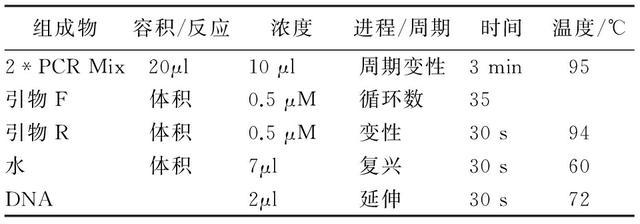
(3) DNA testing. Nanjing Forestry University was commissioned to collect leaves of golden-leaf ginkgo and common ginkgo planted in its subordinate forest farm, and the laboratory of the College of Forestry of Nanjing Forestry University used a bioer Life Express gradient PCR instrument, a TOMY MX-160 refrigerated centrifuge, a DYY-6C electrophoresis apparatus, a DYC-34A electrophoresis tank, TAKARA taq enzyme, a TAKATA DNA extraction kit and a SYNGENE GENEGenios imaging system. The detection method was SSR gene analysis with 8% PAGE gel detection. The reaction system is shown in Table 1; the loading order was, starting from the marker, common ginkgo, golden ginkgo, common ginkgo, golden ginkgo, to compare the genetic differences between golden-leaf ginkgo and common ginkgo.
Table1 Detection reaction system
(4) Observation of the yellow-leaf phenotype. Vegetatively propagated seedlings were planted in a trial base of 2 ha and 4,980 plants in Wangyizhen Town, Anlu City; a trial base of 0.4 ha and 996 plants in Xundian Town; 1 ha and 2,490 plants in Xihe Town, Xiaonan District; and 0.33 ha and 822 plants in Geputan Town, Yunmeng County, totaling 9,288 plants. After planting, from spring bud break and leaf expansion to late autumn leaf fall, observations of the stability of the yellow-leaf phenotype were made regularly every month for 4 consecutive years.
2 Results and Analysis
2.1 Grafting Propagation
Over 7 consecutive years, seedlings propagated by budding produced current-year shoot growth of 30-50 cm. Seedlings propagated by scion grafting produced current-year shoot growth of 20-40 cm. The leaves of grafted seedlings are thicker than those of common ginkgo seedlings, with a leaf width of 7-9 cm, a leaf length of 5-7 cm and a petiole length of 4-6 cm. The largest single leaf can reach a leaf width of 13-15 cm, a leaf length of about 10 cm and a petiole length of about 5 cm. The results of grafting propagation of yellow-leaf ginkgo are shown in Table 2, with more seedlings surviving from bark grafting and budding. The grafted seedlings retained their yellow color after full leaf expansion and their pale yellow characteristics in summer, as shown in Figures 1 and 2. In subsequent promotion and production, grafted vegetatively propagated seedlings were used exclusively to maintain the yellow-leaf trait.
Figure1 Yellow-leaf characteristics of grafted seedlings after full leaf expansion
Table2 Table of grafted seedling propagation of Anlu golden-leaf ginkgo
Figure2 Pale yellow leaf characteristics of grafted seedlings in summer
2.2 Color Comparison
After 4 consecutive years of fixed-point observation of 1- to 4-year-old young trees, it can be seen that the new buds of yellow-leaf ginkgo are light yellow each year, the leaves are orange-yellow to golden yellow in April, gradually turning light yellow-green in May, and yellow-green from June to October, with the green component increasing, and gradually turning yellow after mid-October. The color spectrum values from March to June are compared in Figure 3.
2.3 Biochemical Analysis
(1) Main leaf components. The results of leaf pigment sample analysis are shown in Table 3. It can be seen from the table that the total chlorophyll of yellow-leaf plants is significantly lower than that of green-leaf plants, with chlorophyll α lower by 6.5 times and chlorophyll β lower by 6.3 times, but carotenoids only lower by 2.4 times, while the carotenoid/chlorophyll ratio of yellow-leaf plants is 2.6 times that of green-leaf plants, that is, the relative proportion of carotenoids in yellow-leaf plants is higher than in green-leaf plants. At the same time, the total flavonoid content of yellow-leaf plants is also 1.7 times higher than that of green-leaf plants.
Figure3 Color spectrum of two ginkgo leaf types
Table3 Comparison table of pigment content and total flavonoid content
Table4 Comparison table of total flavonoid content
(2) Total flavonoid content. Because of differences in growing region, tree age, variety and the year of harvesting and determination, the flavonoid content of ginkgo fluctuates considerably, as shown in Table 4. However, compared with common ginkgo controls of the same year, the total flavonoid content of yellow-leaf ginkgo is 1.77 times higher. As ginkgo leaves are used as a medicinal raw material for flavonoids, the economically recoverable index for their content on the international market is ≥ 2.4%. If yellow-leaf ginkgo is used for leaf raw material production, the economic benefit advantage is significant.
(3) 8% PAGE detection results. The DNA sequence analysis by polymerase chain reaction is shown in Table 5 and Figure 4. In the test, 8 of 10 primer pairs amplified effectively, while primer No. 54 and primer No. 64 failed to amplify; judging from the results of this test, there is a certain difference between the polymorphism of golden ginkgo and that of common ginkgo.
(4) Comparison of the stability of yellow leaves in progeny. Combining the observation results from the various planting bases, yellow-leaf ginkgo buds in late March to early April, shoots emerge in mid-April, and only one spring shoot is produced each year. From bud break until the end of May, the colors of its leaves and petioles are yellow; after June, the newly emerging young leaves are light yellow, the mature leaves gradually turn pale green, and after mid-October they turn yellow again; from late October to mid-November the leaves fall and the tree enters dormancy, conforming to the characteristics of yellow-leaf ginkgo (Ginkgo biloba var. aurea Beiss) [8]. The phenological change periods at each site are shown in Table 6. After 4 consecutive years of observation, the leaf color changes were consistent with those of the parent plant, and the phenological performance was also synchronized with that of the common ginkgo control. The leaf color and phenological performance of young grafted ginkgo trees were consistent with those of the mother tree, indicating that the progeny obtained by vegetative propagation well maintained genetic stability [Jishan Huayao].
Table5 Primer sequence table
Figure4 2ginkgo speciesPAGEgel electrophoresis band patterns
Table6 Phenological table of yellow-leaf ginkgo
3 Conclusion
(1) The variety has stable traits and excellent characteristics. The results of several years of observation show that vegetatively propagated young yellow-leaf ginkgo trees grow vigorously, with annual shoot growth of about 80 cm; the new shoots are brownish-gray, the perennial branches are gray, the branch bark is relatively smooth, and the lenticels are not obvious. The standard leaf measured by Nanjing Forestry University (the fourth leaf of a short shoot) is fan-shaped, with an angle of about 105°, large and thick leaves, yellow or pale yellow in color, and irregularly deep leaf lobes. The leaf width is 9.04 cm, the leaf length is 5.83 cm, and the petiole is relatively short at only 4.51 cm. Taking into comprehensive account the leaf function, size and traits, which are basically set by mid-April, the best ornamental period of golden-leaf ginkgo is in April to May, in late spring and early summer; together with its high flavonoid content, it is an excellent greening cultivation variety with relatively high ornamental value that also serves as a leaf raw material.
(2) Passed provincial variety approval. The results of 11 years of systematic observation and trial cultivation show that the mutated yellow-leaf ginkgo has the advantages of stable genetic traits, easy propagation by grafting and relatively high total flavonoid content. After application to the competent authorities, it passed the approval of the Hubei Provincial Forest Tree Variety Approval Committee in April 2014 and was named Anlu Golden-leaf Ginkgo Ginkgo biloba 'Anlu Jinye'.
(3) Increase promotion and utilization efforts. In order to effectively utilize the local excellent ginkgo variety resources, in October 2017 the Xiaogan City Forestry Science and Technology Promotion Center obtained 1 million yuan in support funds from the central government finance forestry science and technology promotion demonstration project, to promote and plant this variety in Anlu City and Dawu County. The project plans to build 300 mu of demonstration and promotion bases by 2019, radiating out to promote 1,000 mu in the surrounding area. The project implementation will strictly follow the afforestation project design, further accelerate seedling propagation and planting, deploy management forces, and implement the technical plan, so that the variety advantage of Anlu golden-leaf ginkgo can be converted into a resource advantage as quickly as possible, generating income for forest farmers and adding beauty to the ecological environment.