What types of pests and diseases affect bayberry? Occurrence patterns and green control techniques in Zhejiang
Species and Occurrence Patterns of Bayberry Pests and Diseases in Zhejiang Province and Their Green Control Techniques
0 Introduction
[Research significance] Bayberry [Myrica rubra (Lour.) Sieb. et Zucc.] is a distinctive fruit of southern China, with a sweet-and-sour taste and unique flavor, enjoying a high reputation both domestically and internationally. Zhejiang Province is the main bayberry production area in China, with a total planting area of 86,500 ha, accounting for about one-third of the national total, an annual output of about 500,000 t, and an output value of 4.83 billion yuan, ranking first in output value among fruits in Zhejiang Province. It is the leading industry for farmers in mountainous and semi-mountainous areas of Taizhou, Wenzhou, Ningbo, Lishui, and Jinhua. In recent years, the bayberry industry in Zhejiang has developed rapidly, especially with the continuous expansion of the planting area of Dongkui bayberry, and the occurrence of pests and diseases has shown an increasingly severe trend, with heavy control tasks and great safety hazards. Therefore, identifying the main pest and disease species and their occurrence and damage patterns in Zhejiang bayberry, and proposing control strategies and green control techniques, is of great significance for ensuring the sustainable and healthy development of the bayberry industry and increasing farmers' income. [Previous research progress] To date, there have been many studies on the main pests and diseases, occurrence patterns, and control techniques of bayberry in various main production areas of Zhejiang Province. Wang Hongxiang et al. (1999), Gong Jieqiang and Wang Hongxiang (2002) reported that the main diseases damaging bayberry in Taizhou City, Zhejiang Province include brown spot disease, cancer disease, red coat disease, dieback disease, branch rot disease, and shoot blight disease, and the main insect pests include scale insects, whiteflies, oil tung geometer moths, leaf roller moths, bagworm moths, and termites. They analyzed the reasons for the increase in pest and disease occurrence and proposed corresponding control measures, but did not go deep into specific pest and disease species investigation and green control techniques. Liu Yougao et al. (2006) reported the occurrence characteristics and control techniques of bayberry cancer disease, brown spot disease, scale insects, and moths in Wenzhou City, Zhejiang Province, but there has not yet been a systematic investigation of other pest and disease species of bayberry, and most of the chemicals introduced in chemical control are not registered on bayberry, making safe pesticide use a difficult problem. Liu Gaoping et al. (2013) and Zou Xiuqin et al. (2015) reported simple net-room cultivation and green control techniques for Dongkui bayberry. Ren Haiying et al. (2014) reported the occurrence and control of bayberry wilt disease and slug moth pests. [Entry point of this study] From the overall research status, the investigation of bayberry pest and disease species and control techniques in Zhejiang is still not systematic and in-depth enough, and the various measures of agricultural, biological, physical, and chemical control still lack organic coordination and matching, thus affecting the implementation of integrated control techniques and the improvement of economic, social, and ecological benefits. [Key problems to be solved] Using a combination of systematic general survey and fixed-point monitoring, experimental research, and demonstration and extension, the main pest and disease species, distribution, and damage conditions of bayberry in the main production areas of Zhejiang Province were investigated, and the green control techniques and integrated management strategies for main bayberry pests and diseases were explored, providing a scientific basis for bayberry pest control.
1 Materials and Methods
1.1 Investigation of bayberry pest and disease species
From 2013 to 2016, 18 counties (cities, districts) in the main bayberry production areas of southeastern Zhejiang, central Zhejiang, and northwestern Zhejiang were selected. According to bayberry planting and growth conditions, bayberry stands in different regions, different age groups, and different land conditions were selected for investigation. The occurrence of bayberry pests and diseases was observed and recorded, the degree of occurrence and damage was recorded, and corresponding pest and disease specimens were collected and brought back indoors for identification to determine their family, genus, species name, and pathogen. Referring to relevant literature (Qi Xingjiang, 2014), the pest and disease species were organized and recorded, and the regional distribution and degree of damage were comprehensively analyzed.
1.2 Dynamic monitoring of the occurrence and damage of main pests and diseases
On the basis of the general survey of pests and diseases, monitoring points were set up in main bayberry production areas such as Huangyan District, Taizhou City. Two cultivars, Dongkui bayberry and Biqi bayberry, were selected. For each cultivar, 3 representative bayberry orchards were selected according to the production time of bayberry, each with an area of more than 1 ha. In each orchard, 10 bayberry trees were selected, and every 5 d the occurrence and damage of main diseases such as bayberry fruit fly, scale insects, leaf roller moths, brown spot disease, and wilt disease, as well as the population dynamics of insect pests, were observed. Their living habits and environmental influencing factors were observed, and the occurrence patterns of pests and diseases were explored and analyzed.
1.3 Integrated control experiments and demonstration application
Surveys and experiments were carried out on bayberry cultivation management, fertilization, cultivars, winter orchard cleaning, and the species and quantities of natural enemies of pests, to evaluate and analyze the control effects of agricultural and biological control on pests and diseases. In a bayberry orchard in Huangyan District, Taizhou City, experiments were conducted 20, 30, and 45 d before bayberry harvest using 60 g/L spinetoram suspension concentrate at 2000-fold dilution (produced by Dow AgroSciences, USA) to control bayberry fruit fly. At 15 d before bayberry harvest, experiments were conducted using 20% sodium abietate soluble powder (produced by Zhejiang Ruili Biotechnology Co., Ltd.) at 200, 300, and 400-fold, and 25% buprofezin wettable powder (produced by Guangdong Foshan Daxing Biological Co., Ltd.) at 1000-fold to control bayberry scale insects. The experimental plots were arranged randomly, each treatment plot consisted of 2 bayberry trees, with 4 replicates, and protective rows were set around the plots. A BP-16 sprayer was used, with 10 kg of spray solution per plot, spraying the front and back of leaves evenly. The experimental methods followed the "Guidelines for Field Efficacy Trials of Pesticides (II)" (Institute for the Control of Agrochemicals, Ministry of Agriculture, 2004). At 25 and 45 d before bayberry harvest, comparative experiments were conducted with and without insect-proof netting. Each treatment had 20 bayberry trees, with individual trees covered by 40-mesh insect-proof netting. After netting, pesticide use was stopped throughout the orchard. After bayberry matured, 80 bayberry fruits were picked from inside and outside the netting respectively, and the number of fruit fly larvae per fruit was observed to compare the control effects of netting at different times on bayberry fruit fly. Integrated control strategies and green control techniques for bayberry pests and diseases were proposed, with the aim of obtaining higher economic, social, and ecological benefits.
1.4 Statistical analysis
The experimental data were subjected to analysis of variance and significance tests (ISD) using DPS (Tang Qiyi, 2013). The population decline rate and corrected control efficacy were calculated according to the following formulas.
Population decline rate (%) = (pre-treatment insect count - post-treatment insect count) / pre-treatment insect count x 100
Corrected control efficacy (%) = (treatment population decline rate - control population decline rate) / (100 - control population decline rate) x 100
2 Results and Analysis
2.1 Species and occurrence and damage of bayberry pests and diseases in Zhejiang
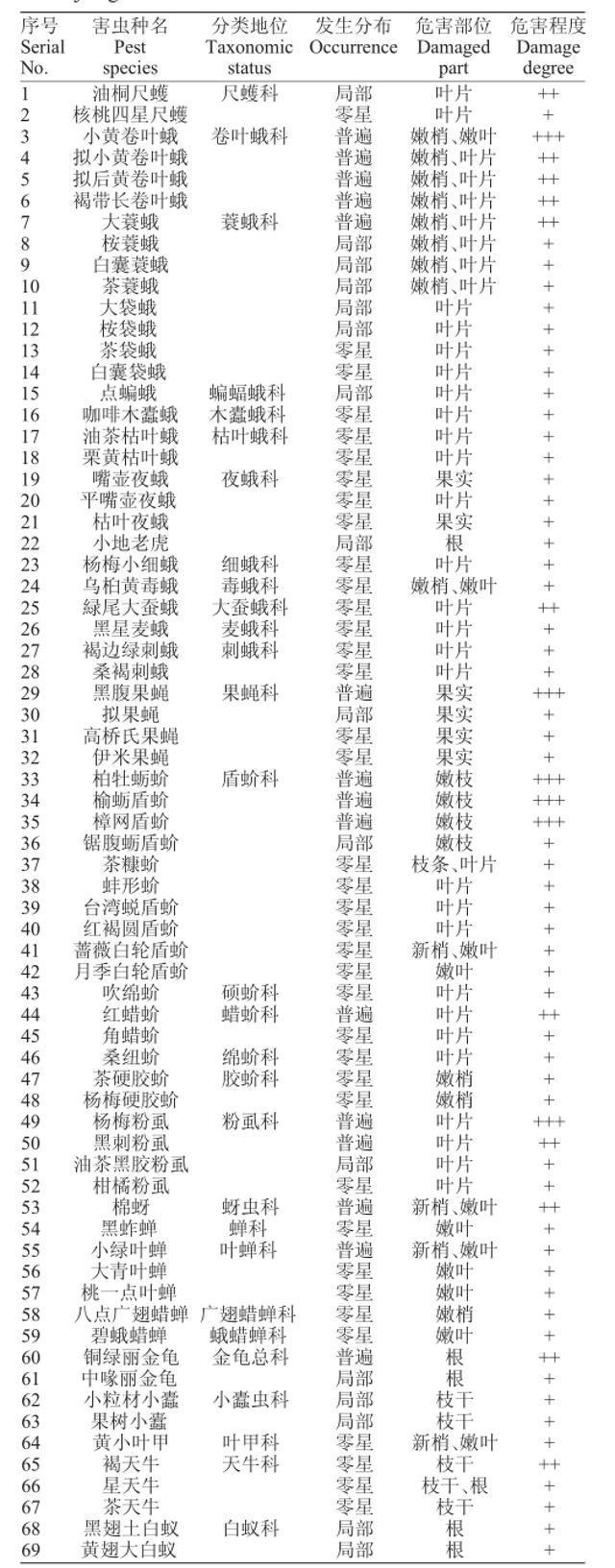
The results of the general survey and fixed-point monitoring (Table 1 and Table 2) showed that there are 69 common pest species on bayberry in Zhejiang Province, belonging to 5 orders and 29 families; there are 22 common diseases of bayberry, including 15 fungal diseases, 1 bacterial disease, 5 physiological diseases, and 1 root-knot nematode disease. The pests that occur commonly and severely on bayberry include scale insects, fruit flies, leaf roller moths, geometer moths, whiteflies, and aphids, and the infectious diseases with relatively severe occurrence and damage include bayberry brown spot disease, cancer disease, red coat disease, white rot disease, wilt disease, and shoot blight disease.
Table 1 Species and damage severity of bayberry pests in Zhejiang Province
Table 1 M.rubra pests species,occurrence and damage degree in Zhejiang
+++ indicates severe occurrence; ++ indicates moderate occurrence; + indicates light occurrence. Same for Table 2.
+++represented seriousdamage,++represented secondary serious damage,+represented mild damage.The same was applied in Table 2
Table 2 Species and damage severity of bayberry diseases in Zhejiang Province
Table 2 M.rubra diseases,occurrence and damage degree in Zhejiang
2.2 Occurrence patterns of main bayberry pests and diseases
2.2.1 Main insect pests
2.2.1.1 Scale insects Scale insects are important pests on bayberry. They pierce and suck host sap, weakening bayberry growth, and severely affected trees may even die entirely. There are many species of bayberry scale insects, including Lepidosaphes cupressi, Lepidosaphes ulmi, Pseudonidia duplex, Lepidosaphes gloverii, Parlatoria camelliae, Lecanium coryli, Pseudaonidia paeoniae, Chrysomphalus ficus, Icerya purchasi, Ceroplastes rubens, Ceroplastes ceriferus, and Takahashiia japonica. In Taizhou, Wenzhou, Lishui, and other areas of Zhejiang, Lepidosaphes cupressi is dominant.
Lepidosaphes cupressi has 2 generations per year in Zhejiang, overwintering as fertilized female adults on branches or leaves. In mid-April of the following year, female adults lay eggs, with the peak egg-laying period from late April to early May. Nymphs hatch in mid-May, with the hatching peak and nymph outbreak period from late May to early June, mainly damaging spring shoots of bayberry. Male adults first appear in early June, peak in early July, and after mating with female adults, female adults lay eggs in mid-to-late July and begin hatching. Early August is the outbreak period of the second-generation nymphs, mainly damaging summer shoots of bayberry. This pest is distributed in all main bayberry production areas of Zhejiang. Female adults mainly damage 1- to 3-year-old bayberry branches and shoots and are gregarious. Male adults mainly fix on both sides of the midvein of leaves, mainly damaging spring shoots of bayberry. After tender branches are damaged, the epidermis shrinks, and they dry up and die after autumn; after leaves are damaged, they turn brown, the petioles become brittle, and early defoliation occurs; after branches are damaged, growth is sterile, tree vigor declines, and large amounts of defoliation and dead branches appear. When damage is severe, the entire bayberry tree dies, as if burned by fire.
2.2.1.2 Bayberry fruit fly Fruit flies are the main pests during bayberry picking and storage. Female fruit flies lay eggs on mature bayberry fruits, and after larvae hatch they bore and feed inside the flesh, making damaged fruits uneven, with juice overflowing and fruit dropping, seriously affecting bayberry yield and quality. Bayberry fruit flies in Zhejiang Province include Drosophila melanogaster, Drosophila simulans, Drosophila takahashii, and Drosophila immigrans, among which Drosophila melanogaster and Drosophila simulans are dominant species and are sibling species with a very close genetic relationship. In Taizhou, Wenzhou, and other areas of Zhejiang, Drosophila melanogaster is dominant.
Drosophila melanogaster adults are relatively small, with a body length of 3.0-4.0 mm, eggs about 0.5 mm, and newly hatched larvae milky white or yellowish white, about 2.0 mm long. Bayberry fruit flies have overlapping generations in the field, making it difficult to distinguish generations. At a temperature of 20-25 degrees C and humidity of 65%-85%, one generation lasts 9-12 d. Adults lay eggs on fruits, and under suitable temperatures the eggs hatch into larvae in 1-2 d. Larvae feed on flesh, causing fruit rot and drop. Mature larvae fall to the ground with the fruit and pupate in the surface soil. After 4-5 d of metamorphic development, they break out of the pupae and become adults, and adults can lay eggs in about 2 h. Observations in Taizhou and other areas found that before mid-May, bayberry fruits are not mature and softened, and unripe fruits cannot serve as a food source, so the number of fruit flies is low; in early to mid-June, as bayberry fruits continue to mature, fruit flies have suitable food and an outbreak period of damage appears. When the maturity rate of bayberry in the entire orchard reaches 70%-80%, the number of adult fruit flies is high and damage is severe; after fruit harvest in mid-July, due to large amounts of dropped fruit and residual fruit on trees, fruit flies again show an adult peak; afterward, with the lack of food, the insect population declines. In Taizhou, Wenzhou, Lishui, and other areas, the bayberry fruit fly population shows 2 peaks throughout the year, the first in mid-to-late June and the second in mid-July, with the damage to mature bayberry fruits in mid-to-late June and the triggering of white rot disease causing relatively large economic losses.
2.2.1.3 Leaf roller moths The main leaf roller moths damaging bayberry include the small yellow leaf roller moth, the pseudo-small yellow leaf roller moth, the brown-banded long leaf roller moth, and the pseudo-rear yellow leaf roller moth. These 4 leaf roller moths have similar biological habits and occurrence patterns. On the newly sprouted tender leaves at the top of bayberry trees, they spin silk and wrap the leaves into a ball, with larvae curling inside, feeding on leaf mesophyll in the morning and evening. After larvae mature, they cocoon and pupate, causing new shoots to grow slowly and vigor to decline; larvae damage tender leaves, which curl into insect packets, and in severe cases new shoots become scorched. In Taizhou and other areas of Zhejiang, the small yellow leaf roller moth is dominant.
The small yellow leaf roller moth has 4-5 generations per year in Zhejiang, overwintering as 3rd-5th instar larvae inside rolled leaves. In spring of the following year, when the temperature rises to 7-10 degrees C, they begin activity and damage. Except for the first generation, which occurs relatively concentratedly, the other generations often have overlapping generations, with the second-generation larvae from mid-May to mid-June and the third- and fourth-generation larvae from early July to late August causing the most severe damage.
2.2.1.4 Geometer moths The oil tung geometer moth, also known as the large geometer moth or humpbacked worm, has larvae that bite and feed on leaf surfaces and is a voracious pest. Oil tung geometer moth larvae cause the most severe damage on cloudy days and in the evening. When this pest breaks out, leaves are completely eaten, and branches in bayberry orchards become bare in patches, seriously affecting yield. This pest has 2-3 generations per year in Zhejiang, overwintering as pupae in surface soil near the roots. The first-generation larval period is from mid-May to late June, the second-generation larval period is from mid-July to late August, and the third-generation larval period is from late September to mid-November.
2.2.1.5 Whiteflies Whiteflies damaging bayberry include bayberry whitefly, black spiny whitefly, oil tea black scale whitefly, and citrus whitefly. Larvae gather on the underside of leaves to suck sap and often secrete large amounts of honeydew and other excreta, thereby inducing sooty mold, affecting photosynthesis, causing branch death and leaf drop, tree vigor decline, and yield reduction. In bayberry production areas of Zhejiang, bayberry whitefly and black spiny whitefly are the main species causing occurrence and damage.
Bayberry whitefly female adults are about 1.20 mm long, male adults about 0.80 mm long, and larvae about 0.25 mm long. It has 2-3 generations per year in Zhejiang, overwintering as larvae on the underside of leaves.
Black spiny whitefly has 4 generations per year in Zhejiang, with irregular generations. It overwinters as 2nd-3rd instar larvae on the underside of leaves, generally pupating in mid-March. From late March to April, overwintering pupae emerge as adults and lay eggs immediately. The development of each stage overlaps. The outbreak periods of the 1st, 2nd, 3rd, and 4th generation larvae are respectively April-May, mid-June to mid-July, mid-August to mid-September, and late October to November. Newly emerged adults prefer to be active in relatively shaded environments in the canopy, especially preferring young tender branches and leaves. Each female adult can lay more than 10-100 eggs, mostly on the underside of leaves, with eggs scattered or clustered.
2.2.1.6 Aphids The aphids damaging bayberry are mainly cotton aphids. Adults or nymphs gather on new shoots, tender stems, or young buds of bayberry to suck sap, affecting bayberry tree vigor and inducing sooty mold. It has more than 8 generations per year in Zhejiang, overwintering as eggs on branches, hatching from mid-to-late February to mid-March. Occurrence is greater from April to June and from September to October during the year, and eggs are laid for overwintering in December.
2.2.2 Main diseases
2.2.2.1 Brown spot disease Bayberry brown spot disease, commonly known as bayberry red spot, mainly damages bayberry leaves, causing large amounts of defoliation, flower bud wilting, small branch death, tree vigor decline, and even tree death. The pathogen overwinters as ascocarps in fallen leaves or diseased leaves on trees. In late April to early May of the following year, ascospores begin to form and spread by wind and rain. When symptoms appear, pinhead-sized purplish-red spots first appear on the leaf surface, then gradually expand into circular or irregular shapes, 4-8 mm in diameter. The center of the lesion is reddish brown, and the edge is brown or grayish brown. Later, the center of the lesion becomes light brown or grayish white, with scattered small black spots on it. Most lesions connect with each other to form larger patches, causing diseased leaves to dry up and fall off. The severity of this disease is closely related to the amount of rainfall in May-June, the humidity level of the bayberry orchard, and the strength of tree vigor.
2.2.2.2 Cancer disease Bayberry cancer disease mainly damages the trunk or branches of bayberry, especially 2- to 3-year-old branches and shoots, and is the most serious disease on bayberry branches and trunks. In the early stage of the disease, small milky white protrusions are produced on diseased branches, with a smooth surface, which later gradually expand to form tumors with an uneven, rough surface, hard and corky, turning brown or dark brown. The pathogen overwinters in the tumor tissue of diseased branches. In spring of the following year, bacterial ooze overflows from the tumor surface and spreads by wind and rain, invading through host leaf scars or wounds. The latent period is 20-30 d, and after onset, bacterial ooze is produced again for continuous reinfection. Disease is likely in years with more rainfall from May to June, and orchards with extensive management and poor drainage have severe disease.
2.2.2.3 Red coat disease Bayberry red coat disease mainly damages bayberry branches and trunks, especially main branches and lateral branches, causing tree vigor decline, branch death, and even whole-plant death. The obvious characteristic after onset is that the affected area is covered with a thin pink mold layer. The pathogen overwinters as mycelium in the diseased part. In spring of the following year, as temperature rises and sap flows, it spreads and expands around, producing powdery material at the edges of old lesions, spreading by wind and rain, and invading through bayberry wounds. This disease generally begins in late March, breaks out in May-June, with peak periods from late May to early June and from early September to early October. The occurrence of the disease is closely related to temperature and rainfall. It is more severe in the warm and rainy season from April to June, and less severe in the hot and dry season from July to August.
2.2.2.4 White rot disease Bayberry white rot disease, also known as bayberry white rot or rotten bayberry, generally develops white mold-like material on the fruit surface in the middle and late stages after bayberry harvest begins. As time extends, the area of white spots gradually increases. Generally within less than 2 d, bayberry fruits with white spots fall to the ground, and affected fruits cannot be eaten. The pathogen overwinters in rotten fruits or soil, and rainstorms splash the pathogen onto fruits near the ground in the canopy, and then through rainwater splash, the entire canopy becomes infected. The more rain during the bayberry ripening period, the higher the maturity of the bayberry, the softer and more rotten the fruit, and the more the pathogen grows, usually resulting in more severe disease. If fruit fly damage occurs, bayberry white rot disease is often triggered.
2.2.2.5 Wilt disease Bayberry wilt disease is a new sudden disease of branch and leaf wilting, occurring to varying degrees in bayberry production areas such as Ruian, Huangyan, Xianju, Linhai, and Tiantai in Zhejiang. When the disease occurs, the leaves on bayberry branches and shoots first undergo acute green wilt, then gradually turn withered yellow, brownish yellow, and finally die. When symptoms first appear, leaves generally do not fall, and gradually fall after 1-2 months. For young trees, 1-2 months after onset, the aboveground part gradually dies. For large trees, branches and shoots die in the year of onset, seriously affecting tree vigor. Each year from March to September is the outbreak period of the disease. There are obvious differences in susceptibility among cultivars, with Dongkui bayberry having the most cases and other cultivars being less affected. Management measures affect the occurrence of bayberry disease, and trees with excessive fertilizer application and severe pruning are more likely to develop the disease.
2.2.2.6 Shoot blight disease Bayberry shoot blight disease is a physiological disease caused by boron deficiency in the bayberry tree. After the disease occurs, bayberry shoots wither, branches become clustered, leaves are small, and fruiting does not occur or only a small amount occurs. This disease often occurs in Lanxi, Linhai, and other areas of Zhejiang. The occurrence of this disease is closely related to the planting environment and cultivation management measures of bayberry. In addition to being closely related to shallow soil layers, no application of organic fertilizer, and excessive application of superphosphate, it is also related to factors such as lack of available boron in the soil and high contents of exchangeable calcium and potassium and available phosphorus.
2.3 Green control techniques for bayberry pests and diseases
2.3.1 Control strategies The control of bayberry pests and diseases should proceed from the overall agroforestry ecosystem, adhere to the plant protection policy of "prevention first, integrated control," give priority to agricultural, biological, and physical control techniques, supplement with necessary chemical control, and emphasize the organic cooperation and coordination of various control measures to sustainably control pests and diseases, achieving the goals of controlling pests, protecting beneficial organisms, safety, environmental protection, and efficiency improvement.
2.3.2 Green control techniques
2.3.2.1 Strengthen agricultural control (1) Select disease-resistant elite cultivars. The bayberry cultivars suitable for large-scale cultivation in Zhejiang Province include Dongkui bayberry, Biqi bayberry, Wandao bayberry, and Ding'ao bayberry. Select grafted seedlings with well-developed root systems, robust plants, and no pests or diseases for planting. (2) Reasonable close planting. Choose sloping land with fertile soil and good light conditions to establish the orchard, with red-yellow soil or yellow soil being best. Spring planting or autumn planting can be used, generally planting 300-450 bayberry trees per hectare, with row spacing of 4-5 m x 5-6 m. (3) Scientific fertilization. Apply more organic fertilizer and appropriately supplement trace elements such as calcium, magnesium, iron, boron, zinc, manganese, copper, and molybdenum to promote balanced and robust plant growth and improve disease resistance. (4) Shaping and pruning. During the bayberry growth period (except the fruiting period) and dormant period, methods such as ring cutting, branch pulling and propping, shoot tip removal, heading back, and thinning can be used for shaping and pruning to promote strong branches and trunks, increase fruiting area, and obtain high quality and high yield. (5) Winter orchard cleaning. In winter, temperatures are low, pests enter dormancy and overwinter, and disease spores and pathogens remain in the orchard with diseased leaves and branches pruned in winter. At this time, pruned dead branches, fallen leaves, weeds, and other materials can be concentrated and removed from the orchard for composting or deep burial. Scrape off old and rough bark on the trunk, and apply whitewash to the main trunk and main branches of bayberry to eliminate overwintering sites and overwintering pathogens. Lime sulfur mixture can also be sprayed on trunks, branches, and the ground, or agents such as sodium abietate, mineral oil, and machine oil can be selected for control, to reduce the base number of pests and diseases in the coming year.
2.3.2.2 Promote physical control techniques based mainly on insect-proof netting
In response to the production reality that bayberry fruits are damaged by fruit flies during harvest, leading to yield loss and quality decline, experiments and demonstrations were conducted in Huangyan District, Taizhou City, Zhejiang, on the control effect of covering individual whole bayberry trees with insect-proof netting (that is, before bayberry harvest, using 40-mesh insect-proof netting as a canopy and moso bamboo or steel bars as supports to cover individual whole trees, referred to as luoman bayberry, Figure 1) on fruit flies. The results (Table 3) showed that when insect-proof netting was installed 25 and 45 d before bayberry harvest, the rates of insect-infested fruits at the bayberry fruit maturity stage were 8.75% and 6.25%, while the rate of insect-infested fruits in the control area without insect-proof netting was 87.50%; the average number of insects per fruit in the insect-proof netting treatments was 0.08 and 0.05 respectively, while that in the control area was 6.19, and the control effects of the insect-proof netting treatments were 98.71% and 99.19% respectively. This method can block damage to bayberry by pests such as fruit flies, stop or reduce the use of chemical pesticides, and ensure the food safety of bayberry fruits. Bayberry is a crop that prefers shade and tolerates humidity. After netting, it has a shading and moisture-retaining effect on sunny days and a rain-sheltering and heat-retaining effect on rainy days, which is beneficial to the development of bayberry fruits, can appropriately delay the bayberry maturity period by 2-3 d, improve the appearance quality and yield of bayberry fruits, generally increase the market price of bayberry by more than 30%, and increase the average income per bayberry tree by 40%-50%. In addition, the use of light traps, sex pheromone traps, colored boards, and sugar-vinegar liquid for trapping and killing also has certain control effects on pests of Lepidoptera, Homoptera, Coleoptera, and Diptera.
Figure 1 Luoman coverage cultivation technique
Fig.1 Netcovering cultivation technique
Table 3 Control effect of insect-proof netting coverage on bayberry fruit fly
Table 3 Controleffects ofinsectnetcultivation technique on M.rubra fruitflies
Different lowercase letters after data in the same column indicate significant differences (P<0.05). Same for Table 4 and Table 5.
Differentlowercase letters in the same column represented significantdifference(P<0.05).The same was applied in Table 4 and Table 5
2.3.2.3 Chemical control Bayberry has many pest and disease species and severe damage, so pesticide control is unavoidable. High-efficiency, low-toxicity, low-residue pesticides that are safe for humans and livestock and do not pollute the environment should be selected, with priority given to plant-derived and biological pesticides. The experimental results of different agents on the control of bayberry fruit fly (Table 4, Table 5) showed that spraying 60 g/L spinetoram suspension concentrate at 2000-fold dilution 20, 30, and 45 d before bayberry harvest achieved control effects on bayberry fruit fly of 96.17%, 95.63%, and 93.72% respectively. Spraying 20% sodium abietate soluble powder at 200, 300, and 400-fold and 25% buprofezin wettable powder at 1000-fold 15 d before bayberry harvest achieved control effects on bayberry scale insects of 97.24%, 85.99%, 35.13%, and 76.48% respectively. This indicates that the biological pesticides spinetoram and sodium abietate have good control effects on bayberry fruit fly and scale insects. Spinetoram at 2000-fold dilution and 20% sodium abietate at 200-fold dilution are suitable for spray control and are safe to use. At present, these 2 agents have been registered on bayberry and can be promoted and applied in production.
Table 4 Control effect of 60 g/L spinetoram suspension concentrate at 2000-fold dilution on bayberry fruit fly
Table 4 Controleffects of 60 g/L spinetoram SC 2000 times liquid on M.rubra fruitflies
Table 5 Control effect of 20% sodium abietate soluble powder and 25% buprofezin wettable powder on bayberry scale insects
Table 5 Controleffects of 20%sodium pimaric acid SP and 25%buprofezin WP on M.rubra scale insects
2.3.2.4 Protect and utilize natural enemies Biological control is a method of using beneficial organisms or other organisms to suppress or eliminate harmful organisms, including the use of natural enemy insects, microorganisms, and biological agents to achieve biological control effects such as using insects to control insects, using mites to control mites, using fungi to control insects, and using fungi to control fungi. According to surveys, there are many species of natural enemies of bayberry pests in Zhejiang Province. Predatory natural enemies include Chrysopa sinica Tjeder, Chrysopa formosa Brauer, Chrysopa septempunctata Wesmael [Jishan Huayao], Harmonia axyridis Pallas, and Chilocorus rubidus Hope. Parasitic natural enemies include Encyrtidae, Aphelinidae, Tetrastichinae, and Pteromalidae that parasitize scale insects, Eulophidae and Cleonymidae Hymenoptera that parasitize leaf roller moths, and Brachymeria lasus Walker that parasitizes the sapium yellow tussock moth. Among them, Aphelinidae, Encyrtidae, and Brachymeria lasus have relatively high parasitism rates and are important natural enemies of bayberry pests. It is necessary to protect the natural ecological environment of mountain forests, maintain ecological balance, give full play to the role of natural enemies, and sustainably control the occurrence of bayberry insect pests.
3 Discussion
Bayberry is a traditional fruit in Zhejiang Province and is planted in most counties (cities). Its output value ranks first among fruit tree species in Zhejiang and it is a pillar industry for farmers in mountainous and semi-mountainous areas such as Taizhou, Wenzhou, Ningbo, and Lishui. Through systematic general survey and fixed-point monitoring in the main bayberry production areas of Zhejiang Province, and integrating the studies of Chen Zongliang (1995), Wang Hongxiang et al. (1999), Gong Jieqiang and Wang Hongxiang (2002), Lai Yanxue et al. (2003), Liu Yougao et al. (2006), Qi Xingjiang (2014), and others, it was preliminarily determined that there are 69 pest species and 22 disease species occurring on bayberry in Zhejiang Province. Among them, 12 pests and diseases, including scale insects, fruit flies, leaf roller moths, geometer moths, whiteflies, aphids, brown spot disease, cancer disease, red coat disease, white rot disease, wilt disease, and shoot blight disease, are the main pests and diseases of bayberry and are also the main targets of control. There are many cultivated bayberry cultivars in Zhejiang. In Taizhou and Lishui and other areas, Dongkui bayberry is dominant; in Wenzhou, Ding'ao bayberry is dominant; in Cixi, Yuyao, and other areas of Ningbo, Biqi bayberry is dominant; and in Zhoushan, Wandao bayberry is dominant. Due to differences in natural ecological conditions, cultivation management models, and cultivated cultivars among regions, there are also obvious differences in the species and damage severity of bayberry pests and diseases. This study only conducted a preliminary general survey of bayberry pests and diseases in Zhejiang Province. Further investigation and analysis are still needed on the occurrence dynamics of main pests and diseases in different bayberry planting regions, at different altitudes, in different orchards, and in on-year and off-year cycles.
Bayberry is a naked fruit without an exocarp, and safety issues have always attracted much attention. This study proposed control strategies for bayberry pests and diseases and green control techniques with mutual coordination and organic matching of agricultural, biological, physical, and chemical control, which has important guiding significance for scientifically guiding bayberry pest and disease control and ensuring safe production. In practice, the project unit explored and summarized a set of bayberry insect-proof netting coverage cultivation techniques. This technique can effectively block damage from pests such as fruit flies, improve fruit quality, increase the selling price of fresh fruit, and increase economic benefits. It is a cultivation management model that is simple to operate, ecologically efficient, and is also an innovative technique currently being promoted for bayberry fruit quality and safety. In addition, insect-attracting lamps and fruit fly sex attractants also have certain control effects on pests of Lepidoptera, Homoptera, Coleoptera, and Diptera, and can be used in combination with insect-proof netting to improve the overall control effect on bayberry pests.
From the situation of bayberry production in Zhejiang, there are many species of pests and diseases and severe damage, and pesticide control is commonly used for bayberry pests and diseases (Chen Zongliang, 1995; Gong Jieqiang and Wang Hongxiang, 2002; Lai Yanxue et al., 2003; Liu Yougao et al., 2006; Liang Senmiao et al., 2008). The results of this study showed that using 60 g/L spinetoram suspension concentrate at 2000-fold dilution 20, 30, and 45 d before bayberry harvest and 20% sodium abietate soluble powder at 200-fold 15 d before harvest achieved control effects of more than 90.00% on bayberry scale insects, and these 2 agents have been registered on bayberry and can be promoted and applied in production. At present, pesticides registered for use on bayberry also include buprofezin, copper quinoline, abamectin, mineral oil, and machine oil, which can be used for the control of bayberry whitefly, aphids, scale insects, and brown spot disease. However, there is still a lack of registered pesticides for bayberry leaf roller moths, geometer moths, cancer disease, red coat disease, white rot disease, and other pests and diseases. The main reason is that bayberry is a distinctive minor crop in China, with high pesticide safety requirements, and registration costs and benefits are not proportional, so pesticide enterprises lack enthusiasm for registration. Therefore, it is recommended that relevant departments increase support for pesticide registration on distinctive crops such as bayberry, accelerate the screening of safe and efficient agents, conduct field efficacy and residue experiments, accelerate the pesticide registration process and the formulation of pesticide residue control standards, ensure that pesticides are available, good pesticides are used, and they are used scientifically, and implement law-based, regulation-based, scientific, and safe pesticide use, to ensure the quality and safety of bayberry.
4 Conclusion
The results of this investigation showed that there are 69 common pest species on bayberry in Zhejiang Province, belonging to 5 orders and 29 families, and 22 common diseases, including 15 fungal diseases, 1 bacterial disease, 5 physiological diseases, and 1 root-knot nematode disease. The 12 pests and diseases, including bayberry scale insects, fruit flies, leaf roller moths, geometer moths, whiteflies, aphids, brown spot disease, cancer disease, red coat disease, white rot disease, wilt disease, and shoot blight disease, are the main pests and diseases of bayberry. Their main occurrence and epidemic patterns and influencing factors were identified, and the main control targets were clarified. In production, integrated control technical measures combining agricultural, biological, physical, and chemical control should be adopted according to the species and occurrence and damage characteristics of pests and diseases, to effectively control the occurrence of bayberry pests and diseases.