Key Techniques for Propagation and Management of Potted Cascading Chrysanthemums
Propagation and Management of Potted Cascading Chrysanthemums
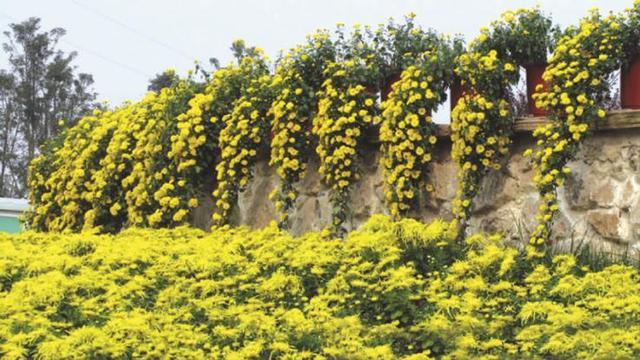
The cascading chrysanthemum is a training and planting method for chrysanthemums. It makes use of the characteristics of small chrysanthemums, such as abundant branching, slender and pliable stems, and dense flowering, to imitate the natural drooping posture of wild chrysanthemums in the mountains. The plant is trained into a pendulous, cliff-like form and guided forward with bamboo frames, with timely pinching, so that it develops a soft, curved main trunk, evenly distributed side branches, a narrow front and wide back, full blooms, and a uniform flowering period, excelling by its length, with the longest reaching more than 10 m. Due to differences in plant form, cascading chrysanthemums can be divided into two types: one is pruned into a shield shape, called the front-drooping type, also known as the Kanto type; the other is pruned into a zigzag shape [Jishan Huayao].
The cascading chrysanthemum has its branches covered with fresh flowers interspersed with green leaves; from a distance it looks like a dragon probing the sea, and up close it is just like a golden waterfall. Because of its unique plant form and elegant style, it is especially striking when placed among rockeries and small streams; the clear stream water reflects the cascading chrysanthemum, full of poetic charm.
I. Selection of Varieties and Propagation
1. Variety selection: Small chrysanthemum lines are preferable. Choose varieties with tough stems, long internodes, abundant branching, fast growth, dense flowering, vigorous growth, obvious apical dominance, and strong disease resistance; flower color depends on need, with bright colors being best, and white, yellow, and red are more commonly used; 'Button White', 'A Handful of Snow', 'Hollow Yellow', 'Baby's Breath', and 'Button Yellow' are commonly selected varieties.
2. Propagation: Cutting propagation is mostly used. The cutting material is mostly taken from the root crown area of old plants that are robust, have tough and easily extending stems, and branch readily. New basal shoots are picked off, and it is best to take two basal shoots together with their roots and plant them in pots. The cutting time often varies depending on the specification at the time of leaving the nursery; if the required crown width and drooping length at leaving the nursery is more than 3 m, cuttings are mostly taken from November to December of the previous year; for a length of 1-2 m, cuttings are taken from January to February of the current year; for a length of 0.5-1 m, cuttings are taken from April to May of the current year.
The so-called basal shoots refer to new shoots growing from the base of the mother plant. Cut 5-8 cm from their tips for cuttings, and after 10-15 days transplant them into pots with a diameter of 15 cm; if the basal shoots are shorter and stouter, they can be dug up together with their roots and planted directly in small pots; after planting, they should be placed in a ventilated and light-transmitting place, and dilute fertilizer (mainly potassium fertilizer and nitrogen fertilizer) should be applied on time to promote their growth.
II. Pot Changing and Final Planting
1. Planting: Before final planting, the plant usually needs to be moved to another pot once; especially when the length of the chrysanthemum body exceeds 1 m, it is then finally planted. The growing medium should be loam rich in organic matter, and sometimes some sawdust can be mixed in to facilitate drainage and aeration. When the propagated seedlings grow to 15-20 cm, they can be transplanted into pots with a diameter of about 20-25 cm, and an appropriate base fertilizer should be added when changing pots to increase their growth vigor.
For fertilization, a fertilizer with an N-P-K ratio of 20-10-20 is commonly used; occasionally calcium fertilizer and magnesium fertilizer are also applied to promote healthy plant growth; when the plant grows to 20-25 cm, insert a bamboo stick at its base, slanting slightly toward the sunlight direction, and gently tie the main branch along the bamboo stick, tying at every 1-3 nodes; when the plant grows to 40-50 cm, finally plant it in a pot with a diameter of 30-40 cm; at this time, first place a 4-5 cm layer of crushed stone or broken tiles at the bottom of the pot, and add appropriate base fertilizer to the bottom layer and around the sides; at the same time as final planting, insert a pre-made bamboo mat into the pot, and the length and shape of the bamboo mat depend on the intended design.
Gently tie the main branch of the cascading chrysanthemum to the bamboo strip in the middle of the bamboo mat every 4-5 nodes, so as to facilitate the growth of the main branch along the direction of the middle bamboo strip; when the crown width of the cascading chrysanthemum grows to a certain weight, wooden strips can be added below the middle of the bamboo mat for support, to prevent the bamboo mat from sinking and causing damage to the cascading chrysanthemum.
III. Management
1. Pinching and shaping: Pinching the side branches is an important step in cultivating cascading chrysanthemums. To cultivate a cascading chrysanthemum with a beautiful form, the key is to leave 6-7 leaves at the base of the plant when pinching, leave 4-5 leaves in the middle when pinching, and leave 2-3 leaves at the top when pinching; subsequently regenerated secondary side branches are all pinched after leaving 2-3 leaves; repeat this several times so that the side branches can rapidly produce small side branches. With this repeated growth, the cascading chrysanthemum can become lush and full in branches and leaves, with abundant flowers, and be fascinating.
Because the plant of the cascading chrysanthemum can reach more than 1 m in length, the flowers in the upper and lower parts do not open at the same time, which affects its ornamental value. The purpose of shaping is to make the flowers open simultaneously, neatly and beautifully. Shaping is mostly carried out in September, usually starting at the base, then the middle, and finally the tip. After the flower buds form, uneven or protruding buds on the surface should be cut off in a timely manner; when the flowers bloom, with abundant blossoms covering the branches and green leaves set off among them in due course, one can obtain an excellent cascading chrysanthemum.
2. Watering and fertilizing: Water is extremely important for the growth of cascading chrysanthemums, especially during the growth stage. Every morning, water should be applied in an appropriate amount; the amount of watering should be suitable to maintain the supply for 1 day. In the evening, use a sprayer to mist the leaf surfaces to increase air humidity and restore vigor to leaves with poor growth. After White Dew, water appropriately before evening, otherwise flower bud differentiation will be affected. Cascading chrysanthemums generally should not be watered under the scorching sun, so as not to damage the leaves and flower buds; in rainy weather, depending on the condition of the potting soil, water less or not at all; if there is continuous rain, promptly drain the accumulated water in the pot. [Jishan Huayao]
Fertilization should follow the key principles of frequent, little, refined, and ample; each time the pot is changed, an appropriate base fertilizer should be applied to strengthen the foundation. After the Mid-Autumn Festival, topdressing should use an aqueous solution of nitrogen fertilizer and potassium fertilizer to facilitate absorption. After each pinching, nitrogen fertilizer at a concentration of 0.3%-0.6% should be applied to promote the formation of leaf buds and flower buds; after the flower buds form, a mixed solution of potassium fertilizer and phosphorus fertilizer at the same concentration should be applied, sprayed on the leaf surfaces once every 5 days for 3-5 consecutive times; after the flower buds show color, no more fertilizer should be applied, and it is sufficient to keep the potting soil moist.
3. Light and ventilation: The cascading chrysanthemum is a sun-loving positive plant; therefore, the pot should be placed in a place with ample sunlight and good ventilation, otherwise it will not only grow poorly but also be prone to pests and diseases.
Sometimes, from August of the planting year to March of the following year, light should be increased to more than 14 hours per day to inhibit the appearance of flower buds in the current year and allow the flowering time to be uniform; if natural light cannot reach 14 hours, artificial supplementary lighting should be used to strongly supplement the insufficiency of natural light. Except for the afternoon when the scorching sun is directly overhead in midsummer, cascading chrysanthemums do not need shading.
4. Pest and disease control: Common diseases of cascading chrysanthemums include black spot, rust, and leaf spot, etc. When disease occurs, 75% chlorothalonil 50-800 times solution and 50% thiophanate-methyl 1000 times solution can be used alternately, once a week, to achieve good control results.
Pests include leaf rollers, aphids, red spiders, cabbage caterpillars, etc., which can also be killed by spraying 1500-2000 times solution of beta-cypermethrin and 1500-2000 times solution of omethoate.