Detailed Explanation of Propagation Methods and Care Techniques for the Succulent Echeveria peacockii
SucculentPropagation and Care Techniques for Echeveria peacockii
1 Introduction
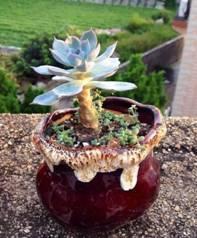
Echeveria peacockii "desmetiana", also known as Peacock's Echeveria, is a succulent plant in the Crassulaceae family, genus Echeveria. Because its rosette-shaped leaf disc closely resembles a blooming lotus flower, it is praised as "the flower that never withers." With its unique form, colorful leaves, and relatively simple care, it is like a living work of art [1-3]. It is very suitable for home cultivation and is one of the more popular small succulents in recent years.
2 Growth Habits and Ornamental Value
Echeveria peacockii is suited to growing in places with ample sunlight. It prefers a warm, dry environment with plenty of sunshine, is drought-tolerant, not cold-tolerant, and slightly tolerant of partial shade.
Echeveria peacockii has a unique rosette form and is an excellent indoor ornamental plant. Mature old-stem Echeveria peacockii is blue-white for most of the year and is a relatively classic Echeveria. When sunlight is sufficient, the edges of the leaves turn pink, giving it extremely high ornamental value.
Echeveria peacockii can be grown in pots for ornamental display, or combined with succulents of similar ecological habits to create mixed planters, flower baskets, and other arrangements. It can also be made into floral art pieces. It can be placed in living rooms, on desks, tables, shelves, windowsills, balconies [2, 4], and other environments with good ventilation and relatively sufficient light. Pairing it with tea sets and similar items produces an even better effect. It can also be used to decorate rock gardens, desert plant gardens, and various celebration venues, appearing stylish and fresh with a full sense of charm.
3 Propagation Techniques
3.1 Seed Propagation
Sowing is generally carried out in spring or autumn. Echeveria peacockii seeds are extremely small, resembling dust. You can fold a piece of white paper in half, carefully place the seeds on the white paper, and gently tap the back of the paper so that the seeds are evenly scattered into the sowing area of the soil. The force of tapping is the key to determining the quality of seed distribution and requires repeated experimentation and practice. After sowing, cover with a piece of glass to keep the seeds and surrounding soil moist, which helps the seeds germinate. After sowing, they will germinate in 7-10 d.
3.2 Cutting Propagation
Echeveria peacockii can be propagated by either leaf cuttings or stem cuttings, generally with leaf cuttings as the main method, because there are more leaves and they can grow again. A leaf with a growth point can grow into a new plant after leaving the mother plant. The success rate of leaf cuttings is not only closely related to different substrates and their ratios, but also closely related to the timing of leaf cuttings and different environments, especially temperature and humidity. Before taking cuttings of succulents, first prepare a flower pot with good drainage and specialized succulent soil.
3.2.1 Substrate Selection
Every succulent enthusiast has different choices for soil substrate preparation. Most choose sandy soil that is relatively moist, well-aerated, loose, fertile, and well-draining. You can use 3 parts peat soil, 2 parts akadama soil, 3 parts river sand, and 1 part garden soil as the cutting substrate. This formula is economical and practical, with a high cutting survival rate.
3.2.2 Cutting Method
Carry out during the growing season. Select plump, intact leaves, twist them off, and let them dry for 3-5 d. After the moisture at the wound has dried, place them flat in a flower pot containing moist substrate. The soil should have just a slight trace of moisture. Place the leaves directly on top, with the front of the leaf facing up and the back facing down, laid flat. Place in a warm, shaded, and well-ventilated area. After about 7-14 d, they will sprout and take root. During this period, watering is not necessary, but careful observation is required. Multiple leaves can be placed in each pot, depending on the size of the pot. After about 1-2 weeks, the base will take root and sprout. Once the sprouts grow larger, they can be transplanted into new pots. Observed after 30 d, the germination rate was 100%.
Double-headed Echeveria peacockii can also be propagated by stem cuttings. Twist off the side shoots and insert them diagonally into the soil for propagation.
Newly planted Echeveria peacockii should not be taken out into the sun immediately. It should be gradually exposed to sunlight after 7 d, starting with morning light and then gradually increasing light exposure. Newly planted Echeveria peacockii should not be watered hastily. Water after 5 d, and do not water too much the first time; just make the soil completely moist.
4 Care and Management Techniques for Echeveria peacockii
4.1 Light
Echeveria peacockii prefers a well-ventilated, dry environment with ample sunlight. In summer, it needs appropriate shading. It is drought-tolerant, not cold-tolerant, and slightly tolerant of partial shade. During high temperatures in summer, the plant has a brief dormant period, and growth slows or stops completely. At this time, direct sunlight should be prevented. Spring, autumn, and early summer are the main growing seasons for the plant, and sufficient light can be provided [Jishan Huayao].
4.2 Temperature
Echeveria peacockii prefers a warm environment but is not tolerant of high temperatures. When sunlight is intense in summer, it should be placed in a shaded area. In other seasons, it should be placed in a warm, dry environment with ample sunlight.
4.3 Humidity and Moisture
Echeveria peacockii should be watered sparingly during high-temperature periods. Do not water blindly during the dormant period. During vigorous growth, sufficient water should be provided so that the plant grows vigorously [5]. During the growing season, water management should follow the principle of "water when dry, water thoroughly when watering." When the winter temperature is below 5°C, watering should be controlled. During cultivation and planting, maintain an appropriately dry environment. Air humidity can be slightly higher, but the potting soil should not accumulate water, otherwise it is prone to rot and death. During high temperatures in summer, the plant grows slowly. Place it in a well-ventilated environment, avoid exposure to blazing sunlight, and at the same time reduce watering and fertilizing. When the air is dry, water can be sprayed around the plant to keep the air moist, but water should not accumulate in the center of the leaf rosette, otherwise the heart will rot, and in severe cases it can lead to death.
4.4 Soil and Nutrients
Echeveria peacockii prefers fertile, well-draining soil. Do not fertilize during the high-temperature summer dormant period. During the growing season, appropriate fertilization can be applied, and specialized succulent fertilizer can be used. During the growing season, apply a dilute liquid fertilizer or a low-nitrogen, high-phosphorus, high-potassium compound fertilizer once every 20 days or so. When fertilizing, avoid splashing fertilizer onto the leaves. Fertilization is generally carried out on clear mornings or evenings, and a thorough watering should be given after fertilizing. In winter, if the indoor temperature is below 5°C, fertilization should be avoided.