Effect of Summer Pruning on the Growth and Fruiting of Young Fengdan Trees
Effect of Summer Pruning on the Growth and Fruiting of Young Fengdan Trees
Fund project:Jiangsu Provincial Agricultural Independent Innovation Fund Project "Integrated Innovation of Safe Production Technology for Oilseed Peony" (CX[14]2135); Suzhou Polytechnic Institute of Agriculture institute-district pairing science and technology service project "Research on High-Quality Seedling Cultivation Technology for Oilseed Peony" (JD201625)
Oilseed peony is a woody oil crop with the "three highs and one low" advantages of high oil content, high quality, high yield and low cost [Jishan Huayao]. At present, the main oilseed peonies cultivated are two species, Fengdan and Ziban Mudan, among which Fengdan (Paeonia ostii) belongs to the Jiangnan peony cultivar group and is adapted to growth in the Yangtze River basin. Because peony seed oil was only listed as a new resource food by the National Health and Family Planning Commission in 2011, research on the cultivation technology of oilseed peony is still in its infancy; although there are some reports on oilseed peony cultivation [2-3], they are basically summaries of experience. In fruit trees, shaping and pruning can control early yield, increase shoot and leaf growth, and promote high and stable yields in later years. However, for young oilseed peonies, whether early yield can be suppressed by removing flowers and fruits to increase the later yield of the tree is currently lacking in research. Using 3-year-old Fengdan (oilseed peony) as test material, the author carried out research on the effects of different summer pruning methods on the vegetative growth and yield of oilseed peony trees, exploring summer pruning techniques for young oilseed peonies, aiming to provide a basis for high-yield cultivation of oilseed peony.
1 Materials and Methods
1.1 Materials
The test site was set up at the oilseed peony production base of Changshu Jiasheng Agricultural Science and Technology Development Co., Ltd. The base is located in a mid-latitude region with a subtropical monsoon climate, with four distinct seasons, a mild climate and abundant rainfall. The average annual total sunshine duration is 2,130.2 h, accounting for 48% of the possible sunshine hours; the average annual temperature is 15.4 °C; the average annual precipitation is 1,054 mm. The soil is sandy clay loam, relatively deep and fertile. The test material was 3-year-old Fengdan plants planted in 2014, with a ground diameter of 0.8-1.2 cm and a plant height of 50-65 cm,
with a plant-row spacing of 0.6 m × 0.8 m and consistent management level.
1.2 Methods
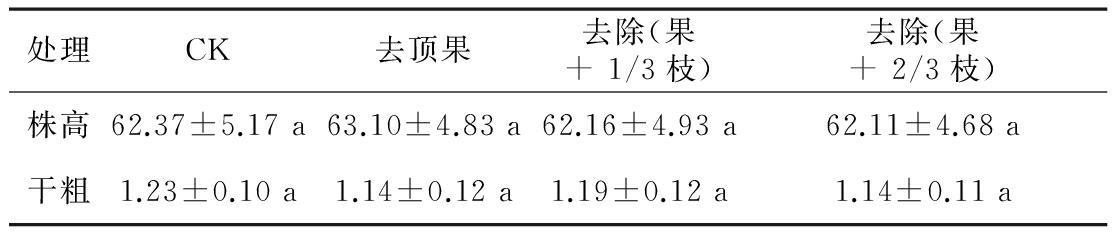
1.2.1 Experimental treatments In May 2015, 360 plants with basically consistent growth vigor were selected as test material and divided into 4 groups, with 90 plants in each group. As shown in Table 1, the statistical results of the 4 groups of oilseed peonies showed consistent growth conditions such as plant height and trunk thickness. Four different degrees of pruning treatment were applied to the fruiting branches: (1) removing the terminal fruit; (2) removing the terminal fruit + the upper 1/3 of shoots and leaves of the fruiting branch; (3) removing the terminal fruit + the upper 2/3 of shoots and leaves of the fruiting branch; (4) fruiting branches with no pruning treatment (i.e., the deferred-release treatment) as the control.
Table 1 Growth basis of the tested oilseed peony population cm
Data are mean ± standard error; the same lowercase letter after the data indicates no significant difference (P>0.05)
1.2.2 Investigation methods In January 2016, the plant height, trunk thickness, trunk height, number of leaf buds and number of flower buds of plants in each treatment were investigated. In May 2016, the crown width (east-west width × north-south width), terminal shoot length and thickness of the plants were investigated. In early August 2016, when the peony fruits matured, indicators such as the number of follicles per treated branch, number of pods/number of follicles, and seed yield/number of follicles were investigated.
2 Results and Analysis
2.1 Effects of different summer pruning treatments on the vegetative growth of young Fengdan trees
From the results (see Table 2), it can be seen that after removing the terminal fruit, the plant height, trunk thickness and trunk height in the 2nd year showed no significant difference from the control, indicating that removing fruits cannot promote the vegetative growth of the tree. However, as the amount of removed branches increased, the plant height, trunk thickness and trunk height decreased accordingly.
Table 2 Effect of summer pruning on the growth of Fengdan plants in the current year cm
Data are mean ± standard error; different lowercase letters after the data indicate a significant difference (P<0.05)
After removing the terminal fruit, the length and thickness of the terminal shoots and the crown width sprouted in the 2nd year showed no significant difference compared with the control, while removing a large amount of branches significantly reduced the terminal shoot length, thickness and crown width (see Table 3).
Table 3 Effect of summer pruning on the new shoot growth of Fengdan in the following year cm
Data are mean ± standard error; different lowercase letters after the data indicate a significant difference (P<0.05)
2.2 Effects of different summer pruning degrees on the reproductive growth of Fengdan
Removing the terminal fruit had little effect on the total number of buds on the current-year branches and the composition of leaf and flower buds, while removing more than 1/3 of the terminal branches significantly reduced the number of flower buds (see Table 4). This may be because after removing branches, the amount of leaves decreases, and the corresponding photosynthetic assimilates decrease, which is not conducive to flower bud differentiation of the branches.
Table 4 Effect of summer pruning on flower bud differentiation of Fengdan
Data are mean ± standard error; different lowercase letters after the data indicate a significant difference (P<0.05)
From Table 5, it can be seen that after removing the terminal fruit, the fruit yield of the plants in the 2nd year decreased slightly compared with the control, but did not reach a significant difference. However, when more than 1/3 of the branches were further removed, the single fruit yield decreased by 38.89% compared with the control, and the yield per plant (number of follicles × single fruit weight) decreased by more than 40%. This indicates that the branch removal treatment not only reduces the number of flower buds differentiated on the branches in the current year, but also reduces the quality of flower bud differentiation in the current year, affecting the fruit yield in the following year.
Table 5 Effect of summer pruning on fruiting and yield of Fengdan
Data are mean ± standard error; different lowercase letters after the data indicate a significant difference (P<0.05)
3 Summary and Discussion
3.1 Effect of fruit growth on the growth of young Fengdan trees
Fruit growth competes nutritionally with shoot and leaf vegetative growth [4-5]. For the vast majority of fruit trees, reducing the nutritional consumption of current-year fruit growth by removing fruits will promote flower bud differentiation of current-year branches and increase fruit yield in the following year. In order to promote long-term high and stable yields of fruit trees, the amount of fruiting is generally reduced during the young tree stage, controlling yield, promoting current-year shoot growth and nutrient accumulation, in order to obtain long-term benefits.
The results of this experiment show that after removing the terminal fruit of young oilseed peonies, the number of flower buds on the tree in the current year did not increase, and the plant height, trunk thickness and new shoot length in the 2nd year did not increase, while the fruit yield indicators even decreased slightly [Jishan Huayao].
This result is not consistent with the research results of most woody crops. This may be because peony is a small shrub, the annual growth of shoots is not large, and the presence of the terminal fruit increases the synthesis and supply of growth hormones such as auxin and gibberellin, promoting the growth of shoots below the fruit and nutrient accumulation.
3.2 Effect of summer pruning on the growth and fruiting of young Fengdan
Research by Liu Jixiang et al. [4] showed that various summer pruning methods can inhibit the growth of new shoots of pear trees to varying degrees and increase their flowering rate; research by Huang Zhiqiong et al. [5] showed that carrying out different degrees of summer pruning on densely shaded Dongkui bayberry affected the number of shoots in the inner canopy, the fruit set in the inner canopy, the yield per plant and fruit quality, among which the yield per plant was highest and fruit quality better when the pruning amount was controlled at about 20% of the whole tree's branch and trunk amount.
The author's experiment with 4 pruning degrees on Fengdan showed that as the pruning degree increased, the number of flower buds on the tree in the current year decreased sequentially, the vegetative growth of the tree in the following year was correspondingly inhibited, and the yield decreased accordingly. This indicates that the pruning response of young Fengdan differs from that of other woody plants, and it is not feasible to promote current-year flower bud differentiation and increase seed yield in the following year by controlling the current-year shoot growth of peony.
Therefore, the shaping and pruning of Fengdan cannot be carried out according to the pruning methods for fruit trees. The branches of young Fengdan are suitable for the deferred-release treatment of allowing them to grow naturally, which not only saves labor costs but also increases the early yield of peony.