Recommended bonsai for the home: highly ornamental, and they also purify the air and benefit your health
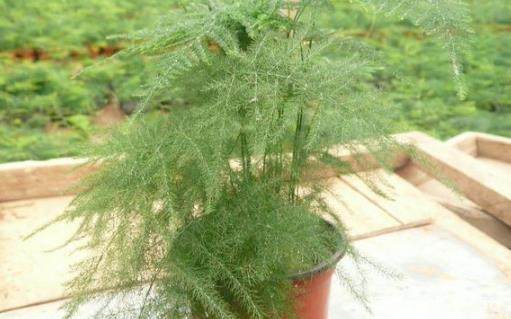
Asparagus fern (Asparagus setaceus) is a highly ornamental plant. It prefers a warm, humid, semi-shaded and well-ventilated environment, is not tolerant of severe cold in winter or of drought, and cannot be overwatered or its roots will rot; in summer it must be kept out of direct sunlight. It is best grown in a loose, fertile, well-drained sandy loam rich in humus. It can be placed in the living room or study; while purifying the air, it also adds a literary and scholarly atmosphere. Its roots are used in medicine and can treat acute bronchitis, with the function of moistening the lungs and relieving cough.
Podocarpus bonsai, also known as small-leaf podocarpus, and also called sparrow-tongue podocarpus, sparrow-tongue pine, or short-leaf podocarpus, is shrub-like, with short, densely growing leaves mostly borne at the tips of the small branches and with white powder on the underside. It is shrub-like or small-tree-like, with short, densely growing leaves, graceful foliage, an ancient yet vigorous look, and a striking posture. In the growing season it sprouts new shoots, and its tender green new leaves are interspersed among the dense green foliage. It is quite beautiful and is a top-grade material for making bonsai, especially the first choice for making miniature bonsai. Short-leaf podocarpus, also known as small podocarpus or podocarpus, is often shrub-like.
Pothos: belongs to the genus Epipremnum in the family Araceae, a large evergreen vine that grows in tropical regions and often climbs over rocks and tree trunks in rainforests; it twines strongly, has well-developed aerial roots, and can be grown hydroponically. On mature branches the petioles are thick and strong, 30-40 cm long, slightly enlarged at the base, with the upper joint 2.5-3 cm long and slightly thickened, with a broad groove on the upper side, and long leaf sheaths; the leaf blade is thinly leathery, emerald green, usually (especially on the leaf surface) with many irregular pure yellow patches, entire, unequal-sided, ovate or ovate-oblong, with a short pointed tip and a deeply heart-shaped base, slightly thick, with both sides slightly raised. It is generally used in new homes to purify the air.
Wanniansong, a traditional Chinese medicine name. It is the whole plant of Phlegmariurus pulcherrimus (Wall. ex Hook.et Grev.) L.Love et D.Love, a plant of the genus Phlegmariurus in the family Huperziaceae. The plant Phlegmariurus pulcherrimus is distributed in western Yunnan and southern Tibet in China, and also in India, Nepal, Sikkim and Bhutan. It has the effects of activating collaterals and dispelling blood stasis, and of promoting eruption and removing toxins. It mainly treats traumatic injuries, unnamed swellings and sores, and incomplete eruption of measles.