Key cultivation techniques for new raspberry varieties in Fuxin City
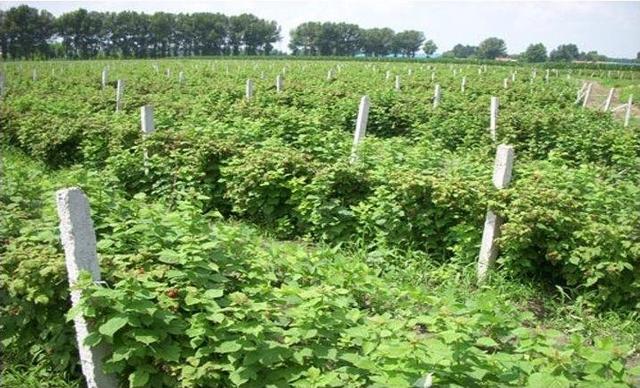
Key cultivation techniques for new raspberry varieties in Fuxin City
1 Variety selection
Currently, the main raspberry varieties cultivated in Fuxin City include Fertod, Virami, Meeker, and others. To promote variety renewal, three superior new raspberry varieties, Qiuping, Qiufu, and Jinqiu, were introduced in early 2016.
3 superior new raspberry varieties.
2 Orchard site selection and soil treatment
A raspberry orchard should be established on a site with convenient transportation, relatively high terrain, good soil permeability, fertile soil, organic matter content of no less than 2%, and access to irrigation. When establishing an orchard on flat land, choose a section with good drainage. If establishing an orchard on mountain land, a slope of 5° to 8° is suitable, and a windward-facing slope with a soil depth of no less than 40 cm should be selected [Jishan Huayao].
In view of the relatively barren sandy soil characteristics of Fuxin City, raspberry orchards with the necessary conditions can improve the soil before planting. In the autumn of the year before planting, before the soil freezes, evenly apply decomposed farmyard manure and garden soil throughout the raspberry orchard. Apply 3,000 to 6,000 kg of decomposed farmyard manure per 667 sq m, then deeply plow the soil. Before the soil freezes, water thoroughly with winter sealing water. After spring begins the following year, prepare the land and plant the raspberries [Jishan Huayao].
3 Setting up shelterbelts
Because Fuxin City has strong spring wind and sand, especially during the raspberry flowering and pollination period, excessive wind has a certain impact on pollination and fertilization. Therefore, raspberry orchards with the necessary conditions are advised to set up shelterbelts. The establishment of shelterbelts is generally based on the size of the raspberry orchard. The main belt should be perpendicular to the main wind direction, with 4 to 6 rows of tall trees planted, and two or three rows of small shrubs can be planted on the inner side.
4 Planting period
Raspberries can be planted in spring, summer, and autumn, but considering the climatic conditions of Fuxin City, spring planting is generally recommended, preferably from mid-April to early May.
5 Seedling selection
In production, it is recommended to use virus-free tissue-cultured seedlings, which are uniform, vigorous in growth, highly resistant, and have a relatively high survival rate after planting. Second, root sucker seedlings with good height, thickness, root development, and relatively uniform growth can be selected. Generally, root sucker seedlings should be selected with a height above 30 cm, more than 5 lateral roots, and a length of no less than 15 cm.
6 Planting pattern and method
Use wide-ridge double-row planting, with a plant and row spacing of 0.5 m x 3.0 m, maintaining more than 440 plants per 667 sq m; for single-row planting, a plant and row spacing of 0.5 m x 2.0 m is suitable, with 667 plants planted per 667 sq m. Raspberry cultivation can use the single-plant method or the strip method. For Fuxin City, the single-plant method is recommended. In the single-plant method, plant two or three seedlings per planting hole, and leave about 15 canes per plant cluster.
After planting, water thoroughly immediately. After the water has completely infiltrated, seal the hole promptly. Two to four days after planting, water thoroughly again. When the soil is slightly dry, promptly carry out deep soil loosening.
7 Soil, fertilizer, and water management
Before establishing the orchard, apply farmyard manure in combination with deep plowing for cold protection to improve the soil and increase soil organic matter content. As the plants gradually grow, intercropping crops in the raspberry orchard is not suitable. Soil loosening and weeding must be carried out promptly. In the early growth stage, loosen the soil four or five times to a depth of about 10 cm, and promptly remove weeds and unnecessary root suckers that appear at any time. Raspberry is a relatively high-yielding and stable-yielding fruit tree variety, so nutrient consumption is relatively large. Under normal circumstances, fertilizer should be applied 4 times during a growing season. The 1st time is in early April before bud break, with nitrogen fertilizer as the main fertilizer; the 2nd time is during the vigorous new shoot growth period, still with nitrogen fertilizer as the main fertilizer; the 3rd time is before flowering, with phosphorus and potassium fertilizer as the main fertilizer; the 4th time is in combination with overwintering cold protection, applying decomposed farmyard manure. Each fertilization must be combined with irrigation.
The development of raspberry production in Fuxin City must have irrigation conditions. The bud break period, flowering period, fruit enlargement period, and winter sealing water for cold protection are the 4 irrigation periods for raspberries. In addition, if conditions permit, irrigate once after removing the soil for cold protection. The rest should be flexibly controlled according to natural precipitation and soil moisture conditions.
8 Training and pruning
Training includes tying canes. Raspberry canes are soft, and especially after bearing fruit, they are prone to bending and drooping, soiling the berries and causing rot, which affects yield and fruit quality. Raspberry canes should be tied promptly. The principle is to ensure that drooping canes do not shade each other, that ventilation and light penetration conditions are good, and that field management and fruit picking are convenient. Summer-fruiting raspberries are pruned 4 times during the growing season, while autumn-fruiting raspberries are pruned 2 times. The 1st time is in late April after the soil is removed, removing diseased and dead canes, cutting healthy canes to about 150 cm and tying them to the trellis; the 2nd time is in late May to early June, when summer-fruiting types have fruiting canes below 30 cm from the ground removed to ensure ventilation and light penetration; the 3rd time is from late July to early August, when all 2nd-year fruiting canes are removed; the 4th time is in mid-to-late October, pruning before cold protection, cutting off the dried top portion and leaving about 180 cm.
9 Pest and disease control
The main pests and diseases of raspberries in Fuxin City include gray mold, stem rot, gray leaf spot, crown gall, and scarab beetles. In terms of control, adhere to the guiding ideology of "prevention first, control as supplementary; biological control as the main approach, chemical control as supplementary." Promptly prune diseased canes, leaves, and fruits, promptly clean the orchard, increase the application of organic fertilizer, prune rationally, scientifically thin flowers and fruits, maintain a reasonable load, and strengthen tree vigor; use physical methods such as insect traps, colored sticky boards, and sugar-vinegar solution to trap and kill pests such as scarab beetles and leaf rollers.