Key cultivation techniques for Sanhong honey pomelo in Danzhou City
Cultivation techniques for Sanhong honey pomelo in Danzhou City
Sanhong honey pomelo (Min Ren Guo 2013004) is a new variety that arose from a second bud mutation after Guanxi honey pomelo mutated into red-fleshed honey pomelo, and belongs to the Guanxi honey pomelo series. As a variety formed through two bud mutations, Sanhong honey pomelo has better quality, with juicy, tender, refreshingly sweet and palatable flesh; its lycopene and beta-carotene contents are higher than those of red-fleshed honey pomelo, giving it high nutritional value and better health benefits, as well as strong market competitiveness and development prospects [1-2].
1 Introduction performance
1.1 Growth characteristics. Young Sanhong honey pomelo trees are relatively upright with vigorous growth; mature trees are semi-spreading with a semi-round-headed canopy, and the leaves are large, dark green and smooth. The Danzhou Forestry Science Institute introduced and planted them in September 2014; a survey in August 2017 found that three-year-old trees reached 245-255 cm in height, with a canopy spread of 265-285 cm and a trunk circumference of 27-30 cm.
1.2 Flowering and fruiting habits. For Sanhong honey pomelo planted in the Danzhou area, flower clusters begin to emerge in early February, flower buds begin to show white in mid-February, full bloom occurs in early March, flowering ends in late March, and the final flowers appear in early April. The fruit expansion period is from April to August, and the fruit reaches maturity in mid-to-late August.
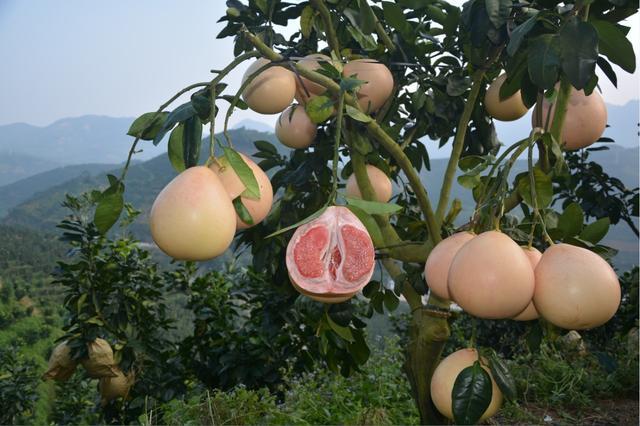
1.3 Fruit quality traits. Sanhong honey pomelo fruits are large and obovate, with a fruit shape index of 0.93 and a single fruit weight of 1,430-1,810 g. The flesh is purplish red and the spongy layer is light purplish red; the fruit turns red through specially made bagging, and at maturity the outer rind is light purplish red. The fruit is juicy, tender and melting, with a sweet-and-sour, palatable flavor.
2 Overview of the planting trial site
The trial site is at Dacipo, Team 3 of the Mupai Tropical Crop Farm in Danzhou City, with geographical coordinates of 19°54' N and 109°66' E. It is located on gentle sloping land with a slope of 5°-8° and an altitude of 162 m. It has a tropical monsoon climate with distinct dry and wet seasons; May to October is the wet season, and November to April of the following year is the dry season. The effective accumulated temperature of ≥10 °C is 8,500-9,200 °C, the annual sunshine duration is 2,100 h, and the average annual rainfall is 1,807.7 mm.
3 Cultivation techniques
3.1 Introduction and cultivation of nursery stockIn June 2014, the Danzhou Forestry Science Institute introduced two-year-old grafted seedlings from Fuqing, Fujian, and repotted and cultivated them in the institute's safeguarded nursery, strengthening water and fertilizer management and pest and disease control. After nearly 3 months of cultivation in the nursery greenhouse, the seedlings' growth recovered. After hardening, vigorous seedlings with a ground diameter of 1.5-2.0 cm and a height of 70-90 cm were selected for field planting.
3.2 Orchard site selectionFor a newly built pomelo orchard, plots with convenient transportation and good natural conditions should be selected, usually gentle sloping land with deep, fertile soil and convenient drainage and irrigation. Red soil or sandy loam with an organic matter content above 1.5% and a soil pH of 5.5-6.5 is preferable.
3.3 Planting densityPlanting density depends on the terrain. On hillside land, the spacing between plants and rows is 3.5 m × 4 m, with 47 plants per 667 sq m; on flat land, the spacing between plants and rows is 4 m × 4 m, with 42 plants per 667 sq m.
3.4 Basic orchard establishmentCut down mountain weeds and pile them for later use; land preparation methods include full reclamation, strip reclamation and hole reclamation; mark horizontal planting lines according to the row spacing for pomelo planting; the planting holes are 80 cm × 80 cm × 80 cm; dig pits and backfill them, keeping topsoil and subsoil separately on each side when digging.
3.5 Field plantingThe planting time was September 20, 2014, with an area of 0.66 hm2, 42 plants per 667 sq m, and a total of 420 plants. When planting, dig a small hole in the center of the earth mound and place the seedling into the hole; the seedlings used this time were bagged seedlings. The bags should be removed from bag-grown seedlings, but they should be handled gently to prevent the root soil ball from loosening.
3.6 Soil and fertilizer managementFor fertilizing young trees, fertilization can begin once the fruit seedlings survive 1 month after planting. For fertilization in the first year, the principle of balancing fertilizer and water and applying thin fertilizer frequently should be followed. Decomposed manure water or biogas slurry diluted with 3 times water can be used for drenching; or 0.3% urea or compound fertilizer can be used for drenching, 5 kg per plant; or 100-150 g of urea or compound fertilizer can be broadcast after rain; as the young trees grow, gradually increase the concentration and amount of fertilizer [Jishan Huayao].
3.7 TrainingAfter the seedlings are planted, cut and head them 30-40 cm above the graft union (40-50 cm above the ground). After new shoots emerge, select and retain three or four new shoots that are strong, evenly distributed around, and spaced from one another as main branches, and remove the rest. When the tip of each main branch continues to extend to about 40 cm, promptly pinch and top it. On each main branch, select and retain two or three appropriately positioned strong branches as secondary main branches.
3.8 Rational pruningFor pruning, thinning is adopted: "prune the upper, not the lower; prune the outer, not the inner; prune the straight, not the slanted." Pruning time: young pomelo trees are generally pruned 2 times, namely summer pruning and winter pruning; fruiting pomelo trees are generally pruned 3 times, namely spring pruning, summer pruning and winter pruning. Spring pruning is in February-March, summer pruning is in May-July, and winter pruning is in late October to early December.
3.9 Sod culture and mulching cultivationAfter planting at this trial site, beneficial natural weeds were allowed to cover the orchard, and harmful weeds were removed manually along with loosening the soil. When the weeds grew to about 40 cm, machine mowing was used. Each year, weeds were machine-cut or removed four or five times along with shallow loosening and soil improvement and fertilization, and returned to the orchard to fertilize the soil; after 3 consecutive years, the orchard's water and fertilizer retention and organic matter content all improved to some extent. Persisting over the long term can enrich and fertilize the orchard and effectively reduce pesticide and chemical fertilizer pollution in the orchard, safeguarding orchard ecological safety.
3.10 Pest and disease controlThe main diseases include canker, anthracnose and scab; the main insect pests include leafminer, aphids, scale insects and swallowtail butterfly larvae. After carrying out agricultural measures such as scientific fertilization and rational drainage and irrigation, in chemical control, emphasis should be placed on integrated pest and disease control, and alternating rotation and mixed use of pesticides for simultaneous control of pests and diseases are advocated, so as to slow the development of pesticide resistance, effectively control pest and disease damage, and achieve twice the result with half the effort.