How to manage greenhouse grapes during the dormant period? Key technical points explained in detail
Greenhouse grape dormant period management techniques
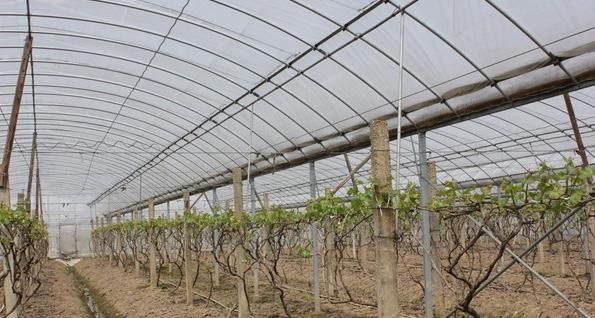
In the eastern coastal area of Laoting County, Hebei Province, solar greenhouses are concentrated in contiguous stretches, and a distinctive industrial zone with Victoria as the main greenhouse grape cultivar has begun to take shape, and the protected grape industry is still further expanding. However, in actual production operations, some farmers, in order for their grapes to reach the market as early as possible, abruptly lift the covers, raise the temperature, and force buds before the grape plants have satisfied their own chilling requirement and passed through the natural dormant period, resulting in delayed sprouting, uneven flowering, or abnormal growth and development of the grapes, thereby reducing the commercial quality of the grapes and causing man-made economic losses.
1 Cultivar introduction
At present, the grape cultivars used in production in Laoting County include Victoria, Auguste, Wuhe Zaohong, Zana, and Black Balado, among others. Among them, the yellow-green grape cultivar Victoria is predominant, and its cultivar characteristics are superior to those of other cultivars, such as tolerance to weak light, adaptation to high-temperature and high-humidity environments, and commercial quality featuring large clusters, elongated oval berries, firm and crisp flesh, sweet and palatable taste, medium-thick skin, resistance to berry shatter, and tolerance to storage and transport, and it has gained recognition in markets in various places.
2 Preparatory work before grape dormancy
2.1 Fertilization Fertilization is carried out from mid-September to early October, mainly with fully decomposed farmyard manure, supplemented by commercial organic fertilizer. Trench application and broadcast application on the pond surface are combined and applied alternately. When applying base fertilizer in trenches, open trenches 90 to 120 cm from the plant root crown, with a depth of 40 to 50 cm and a trench width of 30 cm, and the application rate is 3,000 to 5,000 kg/667 sq m of farmyard manure and 150 to 250 kg/667 sq m of commercial organic fertilizer. At the same time, the principle is not to damage the roots extensively.
2.2 Pruning In mid-to-late October, when green intact leaves still remain at the tips of the grape canes in the greenhouse, spray a mixed solution of 150 times urea and 200 times ethephon to promote early senescence and abscission of the leaves, so that the leaf nutrients fully flow back into the shoots, and prune only after the leaves fall, thereby achieving the purpose of forcing dormancy.
2.2.1 Newly planted young trees In production, most farmers, in order to increase early economic income, adopt a mixed cultivation model of small trellis dragon-trunk training and single-arm hedge training. As the main canes of the small trellis grapes fill the trellis surface, the grape seedlings under hedge training are gradually removed completely. The main pruning technical points are: for the current year's growing main cane, the cut diameter should be 1.0 cm or more, and the retained length after cutting should be 1.0 to 1.2 m; for mature new shoots with a cut diameter of 0.8 cm or more, retain about 1.0 m and cut back; for those whose cut diameter does not reach 0.8 cm, the retained length after cutting should be appropriately shortened. For excessively weak and thin new shoots, retain two or three nodes above ground and cut back severely. The pruning of each grape cultivar should determine the retained length according to its specific conditions such as growth vigor and branching ability, and cannot be mechanically copied. The extension head of the main cane under small trellis dragon-trunk training should not be retained too long after cutting, so as to avoid causing "blind eyes" and making the main cane develop a "whip-pole"-like bare zone.
2.2.2 Full-bearing-period mature trees Small trellis dragon-trunk training is mainly used, and the pruning of fruiting mother branches combines medium and short cane pruning, selecting and retaining as much as possible new shoots close to the main cane for cut-back, so that the fruiting position does not move outward. Remove excessively weak branches and excessively dense branches, and for branch groups whose fruiting position has already moved outward, retract them to near the main cane.
2.3 Irrigation On both sides of the plant trunk, form ridges 30 cm high and make beds about 2.0 m wide, and irrigate once with a large amount of water as the freeze-up water to improve soil moisture, which helps reduce overwintering freeze damage to the root system.
2.4 Clearing the orchard Remove weeds in the greenhouse as well as fallen branches and leaves after pruning, sweep them clean, and burn them in a centralized manner or bury them deeply, so as to eliminate overwintering pathogenic bacteria and insect eggs, etc. And immediately spray the whole greenhouse with pesticide to control grape powdery mildew, downy mildew, etc.
3 Management during the grape dormant period and techniques for ending dormancy early
The grape dormant period begins after leaf fall and ends at budding the following year. The chilling requirement of Victoria grapes is to spend 1,000 to 1,200 h in an environment with a temperature below 7 °C, that is, under low-temperature conditions below 7 °C, natural dormancy can be completed after 40 to 50 days and nights, and dormancy ends in mid-December. Management during the dormant period is mainly based on temperature regulation in the greenhouse. If too high, the purpose of dormancy cannot be achieved; if too low, it easily causes freeze damage to the plants.
3.1 Manual forced dormancy stage From late October to mid-November, when the daytime temperature is 10 to 15 °C and the nighttime temperature is below 7 °C, plastic drip-free film can be promptly used to cover the shed, and straw mats or thermal insulation quilts should be covered. Accumulate nighttime cold to extend the low-temperature time and force entry into the dormant state. The specific operation method is to cover the greenhouse with straw mats or thermal insulation quilts during the day and close the ventilation openings, so as to achieve the purpose of shading and cooling; at night, roll up the straw mats or thermal insulation quilts and open the ventilation openings to lower the greenhouse temperature, so that the day-night temperature in the greenhouse is
below 7 °C. This process lasts 10 to 15 d.
3.2 Natural dormancy stage From mid-November to mid-December, when the outside temperature is below 7 °C and the conditions for natural dormancy of grapes are reached, there is no need to repeatedly uncover and cover, and straw mats or thermal insulation quilts can be covered all day. This process lasts 30 to 35 d.
3.3 Techniques for breaking grape dormancy To ensure uniform grape sprouting and flowering and fruiting, and to make up for insufficient chilling requirement, the following 2 fruit tree dormancy-breaking agents are mainly used in actual production.
3.3.1 Calcium cyanamide dormancy-breaking agent About 20 d before temperature rise, use the dormancy-breaking agent calcium cyanamide (CaCN2) in a 5-times aqueous solution for bud smearing treatment. When using, add 2.5 kg of warm water to each 500 g of calcium cyanamide in a plastic basin, mix and stir for 2 h, then take the upper clarified liquid and apply it with a brush to the winter buds of the fruiting mother branches. To prevent excessive vegetative growth, do not smear the tips of extension branches at all levels or the top one or two buds of the fruiting mother branches. In addition, calcium cyanamide is toxic, so attention should be paid to safety during application and labor protection should be done well [Jishan Huayao].
3.3.2 Cyanamide dormancy-breaking agent About 7 d before temperature rise, use the new fruit tree dormancy-breaking agent cyanamide (CN2H2) in a 20 to 25-times aqueous solution, either directly spray or dip a brush in the liquid and smear it. When directly spraying, do not repeat the spray, and no branch on each tree may be missed; it is sufficient to spray it, and it is better to apply lightly rather than heavily; for smearing, it is best to moisten the bud eyes thoroughly. Keep the top one or two bud eyes of each branch untreated. After spraying, put down the straw mats in the afternoon of the same day after the liquid dries. For young trees planted in the current year, the concentration used needs to be reduced to prevent bud burn. After bud smearing, the main cane must be laid flat on the ground to break apical dominance and make the plant sprout more evenly and uniformly.
As a new fruit tree dormancy-breaking agent, cyanamide aqueous solution has the characteristics of being convenient to prepare, ready to mix and spray, and saving labor and time, and has the advantages of effectively improving the uniformity of grape sprouting, promoting the number of sprouts, and advancing sprouting. In addition, cyanamide aqueous solution has irritating effects on the eyes and skin, and labor protection should be strengthened during application.