Detailed Explanation of Key Techniques for Summer Cutting Propagation of Photinia × fraseri
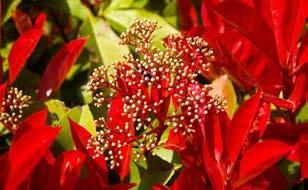
Summer Cutting Propagation Techniques for Photinia × fraseri
Photinia × fraseri is widely distributed in China, mainly concentrated in East China, Central South and Southwest regions. With the vigorous development of urban landscaping, it has been introduced and cultivated in Hunan, Hubei, Yunnan, Anhui, Shandong, Hebei and other places. The main propagation method for Photinia × fraseri is cutting, with summer cutting having the highest survival rate.
Cutting Time
In the middle and lower reaches of the Yangtze River, the cutting time for Photinia × fraseri is generally early March for spring cutting, early June for summer cutting and early September for autumn cutting. Summer cutting has the highest survival rate, but when cutting in summer, drainage, moisture retention and pest and disease control must be handled well [Jishan Huayao].
Cutting of Spike Branches
Semi-lignified young branches of the current year should be selected as cuttings. This is because the cells of semi-lignified young branches divide vigorously and root relatively easily. The length of the cuttings should be cut to 6-10 cm; too short will affect bud sprouting. The upper and lower cuts should be smooth. Generally, 1-2 healthy leaves are kept on the cutting, and 1/2-1/3 of the leaves should be removed to reduce water loss from the branches. After cutting the cuttings, attention should be paid to moisture retention, and they should be cut and inserted as quickly as possible. Generally, branches are cut in the evening and inserted the next morning.
Rooting Agent Treatment
After the branches are trimmed and organized into cuttings, every 100 are tied into a bundle, and the lower 1-2 cm is neatly arranged and soaked in rooting agent. The soaking time should not be too long, generally around 4 hours. The rooting agent is for one-time use; mix more only after it is used up.
Seedbed Preparation
The nursery site should choose sandy loam soil with good drainage, a low groundwater table, fertility and quick drying after rain, and it must also have sufficient water sources. In the winter of the previous year, deep plowing of more than 30 cm should be carried out. Before cutting, 15 kg of ferrous sulfate should be spread per 667 sq m to prevent damping-off disease. The seedbed should be about 1 m wide and 20 m long. The middle of the seedbed should be slightly higher than both sides to prevent water accumulation. The soil particles on the bed surface should be fine and crumbly. The drainage ditches between seedbeds must ensure smooth drainage, and the drainage ditches around the field must be dug deep.
Cutting Method
Before cutting, use a spray pot to fully moisten the bed surface so that the cuttings can be inserted smoothly into the soil. Control the density so that the front, back, left and right leaves do not overlap, generally about 1,000 plants per sq m. After one bed is finished, water immediately until thoroughly soaked, and promptly spray 800-fold carbendazim solution. Use bamboo strips to arch over and insert on both sides of the seedbed at intervals of 1-1.5 m, cover with plastic film, and compact and seal with soil to maintain humidity.
Later Management
It should be noted that after cutting, the wounds generally heal in about 15-20 days and callus tissue forms. During summer cutting, the temperature will continue to rise, so the temperature inside the shed should be observed at all times. When the temperature exceeds 38°C, it will cause seedling scorching and death, so water should be sprayed on the film to cool it down. Generally, new roots and new leaves will grow in about one month. At this time, ventilation and hardening of the seedlings can be carried out gradually. At first, the film at both ends of the seedbed can be opened every other day for one day. After one week, both ends can be opened and left unclosed. If ventilation is not timely and the bed surface is too humid, black roots and root rot will occur. After ventilating at both ends for one week, half of the film on one side can be opened, and after another week, the film can be removed completely.