Personal experience with Phalaenopsis potting media and repotting, worth learning for beginners
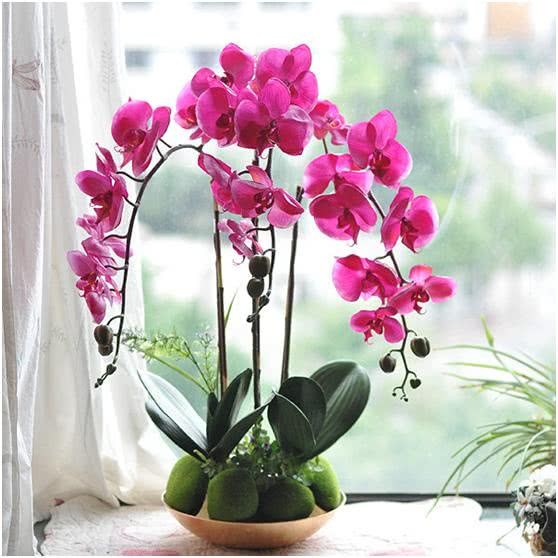
Based on my personal growing experience, and after reading quite a few tips from expert growers, I'll just jot down some thoughts for fellow flower enthusiasts for reference.
I feel that sphagnum moss, as an already widely used potting medium, is indeed the best medium for ordinary home-grown Phalaenopsis; it roots quickly and keeps the leaves firm, so it is best not to switch it easily.
For those who like hard potting media such as bark, charcoal, clay pebbles, orchid stone and so on, mixing a small amount appropriately into the sphagnum moss when repotting enhances its air permeability, and in practice the results are also fairly good.
If conditions allow the use of a natural mounting board for cultivation, the results are even better, but this is generally not easy to achieve in home growing.
However, using hard potting media alone is not very ideal, including offbeat methods like semi-hydroponics. In practice, when all-hard potting media is used, most plants grow slowly, with small leaves that droop easily. Even if the Phalaenopsis can adapt and grow and may even bloom later, the strength of its roots and leaves, the quantity and quality of the flowers, and the flowering period differ greatly from those of plants cultivated in sphagnum moss.
Now let's talk about repotting. After obtaining a Phalaenopsis, if its root system is relatively well developed and healthy, it is best not to change the potting medium. If you don't like the outer nursery pot (that is, the transparent soft plastic pot), you can remove it and place the plant in a slightly larger, more attractive pot, filling the surrounding gaps simply with something like foam plastic, as long as it is fixed in place and doesn't fall over. The plant is completely unaffected and continues to grow normally, and it will easily produce flower spikes in the future.
If the root condition is poor or the potting medium must be changed, it is still recommended to mainly use sphagnum moss. No matter what potting medium you switch to, there will be considerable damage to the roots, and the plant will become weaker, so after repotting, by no means water it thoroughly with any kind of settling-in water; watering will certainly cause root rot. From then on, just mist the whole plant frequently, and you must wait until new roots and new leaves begin to grow before watering normally. If sphagnum moss is used, growth generally recovers faster, whereas switching to pure hard potting media may cause problems: the lower leaves quickly become soft and droop, healthy roots begin to shrivel, the plant takes a very long time to adapt, and new shoots are delayed.
In addition, some sources say that the technique of growing Phalaenopsis in all-bark media is already very mature abroad. Through experimentation, it is prone to failure when cultivated at home; all-bark media very easily breaks out in mold, the temperature and ventilation requirements are too high, and it is best to start cultivating from seedlings, so only orchid nurseries or professionals have the conditions to do it.
The above is just a bit of my personal experience with potting media and repotting. To grow Phalaenopsis well, water and fertilizer management is even more important, and we will continue to discuss this in the future.