How to prepare soilless cultivation nutrient solution? A complete analysis of the technical key points
Techniques for preparing soilless cultivation nutrient solution
The first step in soilless cultivation is correctly preparing the nutrient solution, which is a key technical step in soilless cultivation. If the preparation
method is incorrect, some nutrient elements will become ineffective due to precipitation, or affect plant absorption, and may even cause plant death.
I. Principles for preparing nutrient solution
The general principle for preparing nutrient solution is to ensure that no precipitation of poorly soluble compounds occurs either after preparation or when the nutrient solution is used. Every nutrient solution formula carries the potential to produce precipitation of poorly soluble substances, which is inseparable from the composition of the nutrient solution. Whether precipitation occurs in the nutrient solution mainly depends on concentration. Almost any chemically balanced formula will produce precipitation at high concentration. For example, Ca2+ and SO42- interact to produce CaSO4 precipitate; Ca2+ and phosphate radicals (PO43- or HPO42-) produce Ca3(PO4)2 or CaHPO4 precipitate; Fe3+ and PO43- produce FePO4 precipitate, and Ca2+, Mg2+ and OH- produce Ca(OH)2 and Mg(OH)2 precipitates. In practice, using the solubility product rule for poorly soluble substances as a guide, the following two methods can avoid precipitation in the nutrient solution: first, separately prepare salt compounds that readily produce precipitation, store them in separate tanks, and dilute and mix them before use; second, add acid to the nutrient solution to lower the pH value, then add alkali to adjust it before use.
II. Preparatory work before preparing nutrient solution
1. Correctly select and adjust the nutrient solution formula according to plant species, growth stage, local water quality, climatic conditions, fertilizer purity, cultivation method and cost. This is because differences in water quality and fertilizer purity among different regions directly affect the composition of the nutrient solution; different crop varieties and growth stages require different proportions of nutrient elements, especially the proportions of the three elements N, P and K; the cultivation method, especially substrate cultivation, can change the composition of the nutrient solution through the adsorption of the substrate and its own nutrient content. The use of different nutrient solution formulas also involves cultivation cost issues. Therefore, before preparation, the selected nutrient solution formula must be correctly and flexibly adjusted, and only after it has been proven truly feasible should it be applied on a large scale.
2. Choose suitable fertilizers (inorganic salts) When choosing fertilizers, consider both the concentration and proportion of usable nutrient elements in the fertilizer, and also pay attention to selecting fertilizers with high solubility, high purity, few impurities and low price.
3. Read relevant materials Before preparing the nutrient solution, first carefully read the instructions or packaging descriptions of the relevant fertilizers or chemicals, and pay attention to the molecular formula of the salts, the crystal water they contain, purity, etc.
4. Choose a water source and carry out water quality testing as a reference for preparing the nutrient solution.
5. Prepare liquid storage tanks and other necessary items Nutrient solution is generally prepared as a mother solution concentrated 100-1000 times for later use. Each formula requires 2-3 mother solution tanks. The volume of the mother solution tanks is preferably 25 or 50 L, and dark, opaque ones are best.
III. Methods for preparing nutrient solution
There are two preparation methods for nutrient solution: concentrated solution (also called mother solution) and working solution (also called cultivation solution). In production, concentrated stock solution is generally diluted into working solution, which is convenient for preparation. If the amount of nutrient solution used is small, the working solution can also be prepared directly.
(1) Preparation of concentrated solution
The preparation procedure for concentrated solution is: calculation - weighing - dissolution - subpackaging - storage.
1. Calculation Calculate the amount of each compound in the formula according to the volume and concentration multiple of the concentrated solution to be prepared. Note the following points when calculating:
(1) Fertilizers for soilless cultivation are mostly industrial products and agricultural products, often containing hygroscopic water and other impurities, with relatively low purity, so the amount used should be corrected according to actual purity.
(2) In hard water areas, the Ca2+ and Mg2+ contained in the water should be deducted. For example, if Ca2+ and Mg2+ in the formula are provided by Ca(NO3)2·4H2O and MgSO4·7H2O respectively, the actual amounts of Ca(NO3)2·4H2O and MgSO4·7H2O used are the formula amounts minus the amounts of Ca2+ and Mg2+ contained in the water. However, after deducting Ca2+, the amount of nitrogen in Ca(NO3)2·4H2O decreases. This reduced portion of nitrogen can be supplemented with nitric acid (HNO3). The added nitric acid not only supplements the nitrogen source but can also neutralize the alkalinity of hard water. If adding nitric acid still cannot lower the pH value of the water to the ideal level, the amount of phosphate can be appropriately reduced, and phosphoric acid can be used to neutralize the alkalinity of the hard water. If the nutrient solution is too acidic, the amount of potassium nitrate can be increased to supplement nitrate nitrogen, and the amount of potassium sulfate correspondingly reduced. After deducting the amount of magnesium in the nutrients, the actual amount of MgSO4·7H2O used decreases, and the amount of sulfate radical (SO42-) used is correspondingly reduced. However, because hard water itself contains a large amount of sulfate radical, it generally does not need additional supplementation. If necessary, a small amount of sulfuric acid (H2SO4) [Jishan Huayao] can be added for supplementation. In hard water areas, the amount of calcium nitrate used is small, and the insufficient parts of phosphorus and nitrogen are supplied by nitric acid and phosphoric acid.
2. Weighing Weigh each fertilizer separately, place it in a clean container or plastic film bag, or spread it flat on a plastic film on the ground to avoid loss. When weighing various salt fertilizers, pay attention to being steady, accurate and quick, and weighing should be accurate to within plus or minus 0.1.
3. Fertilizer dissolution Arrange the weighed fertilizers neatly, and after a final check confirms they are correct, dissolve them separately, or mix and dissolve compounds that do not produce precipitation with each other. Note that dissolution must be thorough, stirring while adding until the salts are completely dissolved.
4. Subpackaging Prepare the concentrated solution separately into three concentrated solutions, A, B and C, and store them in three liquid storage tanks respectively. Tank A: centered on calcium salts, all compounds that do not produce precipitation with calcium salts can be dissolved together; Tank B: centered on phosphates, all compounds that do not produce precipitation with phosphates can be dissolved together; Tank C: prepare the chelated iron solution in advance, then dissolve the other compounds weighed for solution C separately in small plastic containers, then slowly pour them into the chelated iron solution respectively, stirring while adding. Concentrated solutions A, B and C should all be made up with clean water to the required preparation volume according to the concentration multiple, and stirred evenly. The concentration multiple of the concentrated solution should be determined according to the amounts specified in the nutrient solution formula and the solubility of each salt, so as not to exceed saturation and precipitate out. It is best for the concentration multiple to be a whole number for ease of operation. Generally, it is 100-200 times higher than the balanced nutrient solution that plants can directly absorb, and the trace element concentrated solution can be concentrated to 1000 times.
5. Storage When the concentrated solution is stored for a long time, it should be acidified to prevent precipitation. Generally, HNO3 can be used to acidify it to pH 3-4, and it should be stored in plastic containers in a cool, dark place.
(2) Preparation of working solution
1. Dilution of concentrated solution The steps for diluting the concentrated solution are:
Step one, calculate the amount of each concentrated solution that needs to be measured out, and adjust the pH value of the water according to the formula requirements;
Step two, inject water amounting to 50-70% of the volume of the nutrient solution to be prepared into the liquid storage tank or other container holding the cultivation solution;
Step three, measure mother solution A and pour it in, start the water pump for circulation for 30 min or stir to make it diffuse evenly;
Step four, measure mother solution B and slowly inject it at the clean water inlet of the liquid storage tank, allowing the water source to dilute mother solution B and carry it into the liquid storage tank to participate in flow diffusion. The amount of water added in this process should reach 80% of the total liquid volume;
Step five, measure mother solution C and let it be carried into the liquid storage tank with the water to participate in flow diffusion. After adding enough water, circulate for 30 min or stir evenly;
Step six, use a pH meter and a conductivity meter to test the pH value and EC value of the nutrient solution respectively. If the measurement results do not conform to the formula and crop requirements, adjust them promptly. The pH value can be adjusted with dilute acid solutions such as sulfuric acid or nitric acid, or dilute alkali solutions such as potassium hydroxide or sodium hydroxide. After adjustment is completed, let the nutrient solution stand for a while before use, then circulate it on the planting bed for about 5-10 min, and test the pH value once more until it matches the requirement;
Step seven, keep a detailed record of the nutrient solution preparation for future inspection.
2. Direct preparation
Step one, calculate the amount of each fertilizer required according to the formula and the volume of nutrient solution to be prepared, and adjust the pH value of the water;
Step two, prepare mother solution C;
Step three, inject water amounting to 50-70% of the volume into the liquid storage tank or other holding container;
Step four, weigh the various compounds equivalent to mother solution A, dissolve them in a container, pour them into the liquid storage tank, and start the water pump for circulation for 30 min;
Step five, weigh the various compounds equivalent to mother solution B, dissolve them in a container, dilute them with a large amount of clean water, and let the water source dilute mother solution B and carry it into the liquid storage tank, then start the water pump for circulation for 30 min. The water added in this process should reach 80% of the total liquid volume;
Step six, measure mother solution C, dilute it, slowly pour it at the water inlet of the liquid storage tank, and start the water pump for circulation until the nutrient solution is uniform;
Step seven and step eight are the same as in the concentrated solution dilution method.
In countries such as the Netherlands and Japan, when large-scale soilless cultivation production is carried out in modern greenhouses, two mother solution tanks, A and B, are generally used. Tank A mainly contains calcium nitrate, potassium nitrate, ammonium nitrate and chelated iron, while Tank B mainly contains potassium sulfate, potassium nitrate, monopotassium phosphate, magnesium sulfate, manganese sulfate, copper sulfate, zinc sulfate, borax and sodium molybdate, usually prepared as a 100-fold mother solution. In order to prevent precipitation in the mother solution tanks, an acid tank is sometimes also provided to adjust the acidity of the mother solution. The entire system is controlled and regulated by computer, and dilution and mixing form the working solution.
During the process of making the working solution, prevent the formation of a large amount of precipitation due to local over-concentration caused by adding the mother solution too quickly. If these precipitates still cannot be dissolved after starting the water pump for circulation for a relatively long time, the nutrient solution should be prepared again.
IV. Operating procedures for preparing nutrient solution
In order to ensure that no mistakes occur during the preparation of the nutrient solution, a strict set of operating procedures needs to be established. The content should include:
1. Carefully read the instructions for fertilizers or chemicals, pay attention to indicators such as molecular formula, content and purity, check whether the raw materials match their names, prepare containers for holding the stock solution, and attach labels of different colors.
2. The calculation process and final results of the raw materials must be checked three times by three staff members to ensure accuracy without error.
3. After each raw material is weighed separately, place them together in the specified positions at the preparation site, and only start preparation after a final check confirms nothing is missing. Never rush to operate when the materials and preparation tools are not all present.
4. When adding water to dissolve raw materials, some reagents dissolve too slowly and can be heated; some reagents such as ammonium nitrate must not be struck or scooped with iron tools, and can only be handled with wooden, bamboo or plastic tools.
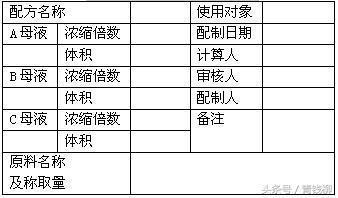
5. Establish strict record files for future inspection. The record forms are shown in Table 2-8 and Table 2-9.
Table 2-8 Concentrated solution preparation record book
Table 2-9 Working solution preparation record book