How do you arrange a succulent dish garden? Master these 4 layouts and you also need to know these things
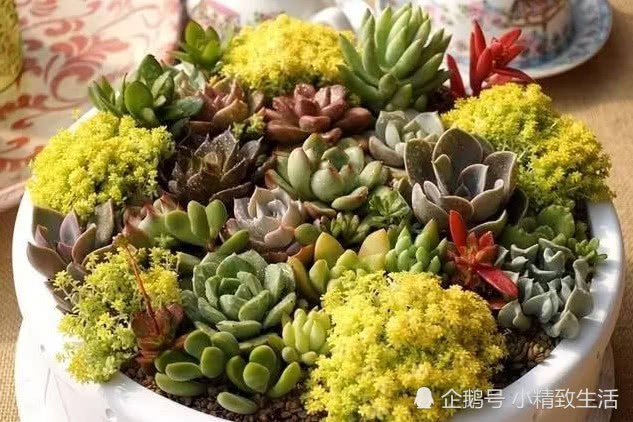
I believe many friends fell in love with succulents only after seeing a beautiful succulent dish garden. A well-matched succulent dish garden is colorful and gorgeous, looking just like plate after plate of delicious food. A succulent dish garden is also called a succulent group planter; simply put, it can be understood as a big mixed pot, that is, planting many succulents together in the same flower pot. In fact, among everyday meals, Xiao Jingzhi Life happens to be fond of the deliciousness of a big mixed pot, and well-matched succulents are likewise something Xiao Jingzhi Life loves. The earliest succulent dish gardens may have come about because there were not enough flower pots and the succulents were simply planted together haphazardly, just to save pots (Xiao Jingzhi Life's assumption, haha), but after putting them together, people discovered that the dish garden was actually so beautiful, and from then on fell in love with succulent dish gardens.
So, do these succulent dish gardens, each of which seems like it could never be repeated, have any rules when it comes to matching? And what matters need attention in the care of a succulent dish garden? Next, Xiao Jingzhi Life will study together with everyone.
1. Pots and soil mix
In growing succulents, veteran flower lovers are unconventional in choosing pots, and in succulent dish gardens this unconventionality is displayed even more fully: anything from iron woks to water buckets can be put to use. From this it seems the material of the pot chosen for a dish garden can vary endlessly, but personally I think you need to choose a container with a bit of depth, and drainage must be good. This can make the succulents even plumper and more beautiful.
As for the soil mix, I still use the original general formula: the simplified version of 5 peat soil + 5 coarse sand, and the upgraded version of 3 peat soil + 1 sawdust + 1 coal cinder + 5 coarse sand. It is best to mix a small amount of insecticide and fungicide into the potting soil; there is no need to say much about the effects of insecticide and fungicide, as prevention is always better than treatment.
2. Selection of succulents
The selection of plants is very important, including the shape and size of the plants, the color matching of the plants, and more importantly, the growth habits should be similar so that the dish garden can continue to be cared for over the long term.
First, let's talk about color: white varieties commonly used in succulent dish gardens include Echeveria 'Lola', Echeveria 'Lilacina', Echeveria runyonii and so on; blue varieties include Sedum 'Little Beauty', Echeveria peacockii and so on; red varieties include Echeveria 'Red Gem', Echeveria 'Toluca', Graptopetalum paraguayense and so on; yellow ones include Sedum lineare, Sedum adolphi and so on; there are also pink-series Graptosedum 'Francesco Baldi' and Graptopetalum mendozae; black Echeveria 'Black Prince'; purple Echeveria 'Perle von Nurnberg' and so on.
Next, let's talk about appearance: in general, succulents such as Sedum 'Angel's Tears', Graptopetalum paraguayense, and Graptoveria 'Titubans' are planted around the outer edge of the dish garden. These succulents grow relatively quickly, easily climb upward and easily form old stems, and can create a large-area trailing-over-the-pot effect; while succulents with a more regular shape such as Echeveria 'Black Prince', Echeveria 'Chihuahua', and Echeveria pulidonis should be kept as much as possible in the central area of the dish garden, and finally succulents with fine, broken leaves such as Sedum lineare and Sedum 'Little Beauty' are used as pot-covering plants to fill the remaining space in the potting soil.
Then let's talk about habits: according to their growth habits, succulents can generally be divided into "winter-type", "summer-type", and "spring-autumn type". In addition, some succulents like shade and some like sun, some like water and some do not like water; only by putting succulents with similar habits together can they be cared for better.
3. Dish garden methods
A succulent dish garden is the same as ordinary potting: it also needs to go through the process of root trimming - root washing - root drying - potting - establishing in the pot. The difference is that the succulents in a dish garden need to be laid out. Here are several layout methods:
1. Straight-line type: The straight-line layout can be called an all-purpose layout. Arrange the main flowers in a straight line, and just add accent flowers of different colors.
2. Straight line + spiral or arc type: Adding a spiral or arc arrangement to a straight-line arrangement will create an overall full and pleasingly staggered feeling. For lotus-shaped ones, note that only by placing the large heads in the middle and the small heads around the edges can the focal point be highlighted. This arrangement is suitable for larger dish gardens.
3. Clustering type: Plant the same succulents closely together, and the groups should also be close to each other, creating a neat and cute feeling of cluster after cluster. It is suitable for smaller dish gardens.
4. Zigzag and diagonal-line type: Suitable for long strip-shaped dish gardens. Arrange the main flowers in a diagonal or zigzag line, and add accent flowers in the gaps.
The above are only the more convenient and commonly used placement layouts; in actual planting, they can be infinitely varied according to the plant species and the shape of the flower pot.
5. Later care
It is worth noting that a succulent dish garden is not like an inanimate object that stays fixed once arranged and will not move. It is alive, and its appearance is different at different stages. Only with careful care can the dish garden become more and more beautiful.
1. If there is Sedum japonicum 'Tokyo Sun' in the dish garden, give it a little more water when watering.
2. Ventilation and light must be sufficient, and water control as well; a dish garden cannot lack any of the care that ordinary succulents should have.
3. When encountering individual succulents that are leggy, just behead them directly.
4. Do not be afraid that the succulents are too dense; as long as the environment is well ventilated, it is fine even if they are a bit dense.
The above was compiled and published by Xiao Jingzhi Life, and I hope it is helpful to everyone.