Why is pure granular soil not recommended for succulent growing
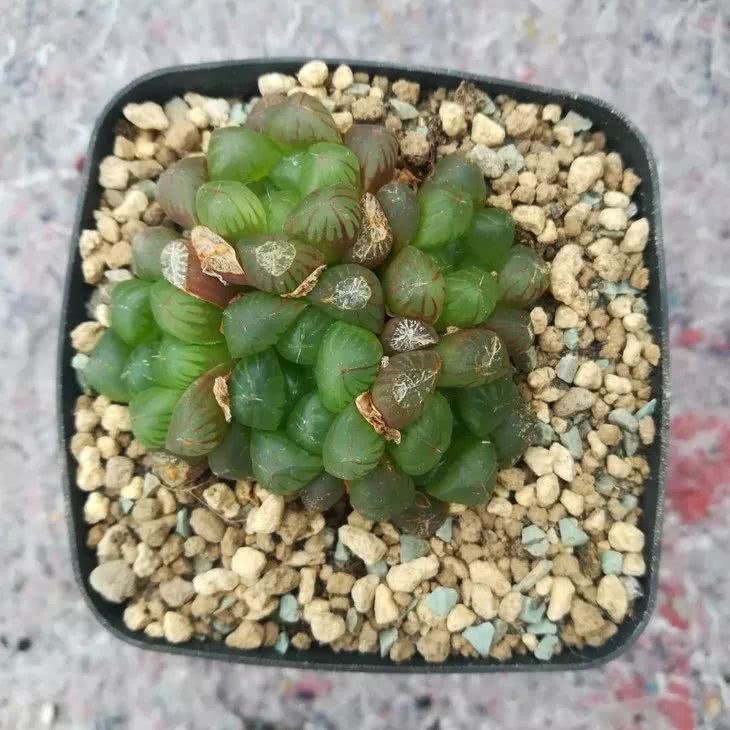
We all know that granular soil has good aeration, good drainage and good wetting ability, making it a very suitable soil mix for succulents.
It seems that adding the word "pure" in front of granular soil, turning it into pure granular soil, makes the whole term sound even more positive, doesn't it? This is why many growers are fascinated by pure granular soil and use large amounts of it to grow succulents.
However, the results of growing succulents in pure granular soil are often less than satisfactory. Judging from the problems reported by a large number of growers, using pure granular soil to grow succulents often triggers the following 3 problems:
1. The succulents take a long time to establish;
2. Few fine feeder roots, and both water absorption capacity and speed are on the weak side;
3. Roots struggle to grow, and some roots even become deformed;
Before we discuss the above three problems in detail, we must first accurately define what pure granular soil is.
The "pure granular" mentioned here refers to the situation where all the growing medium in the soil consists of hard granular materials. Which materials count as hard granular materials? They are those "little stones" that have no elasticity at all when squeezed and will not crush even when squeezed hard. For example, maifan stone, sand, volcanic rock, green zeolite, pumice, perlite... and also various artificial or semi-artificial fired products, such as expanded clay pellets, coal cinders and various artificial growing mediums, all fall into the category of hard granules.
Materials such as akadama, kanuma and xian soil are essentially soil, but they form into granules under natural conditions, so they do not count as purely hard granules. Fired and hardened akadama also has decent hardness, but after long use it will still break down into powder, so it can also be left out of the hard granular category for now.
The biggest crime of pure granular soil is that it is beautiful. We are willing to grow succulents precisely because we pursue beautiful things. Beautiful pure granular soil looks just like gemstones, with vivid colors, and using it also gives a kind of elegant experience of never getting your fingers dirty, which feels simply wonderful.
However, beauty is not the standard by which plant roots evaluate soil. From the plant's perspective, pure granular soil has the following 3 very serious problems.
1. The succulents take a long time to establish;
Growers who use pure granular soil are often inwardly seeking to control water and control shape, and the surface layer of pure granular soil dries out too quickly. During the establishment period, succulents with shallower roots often struggle to establish because the surface soil does not hold enough moisture.
When new roots of succulents have just emerged, they are basically near the soil surface, but the surface layer of pure granular soil is almost always dry, so the new roots cannot get moisture and nourishment and easily wither. This leads to the problem that newly planted succulents do not establish for a very long time.
Even if it is not pure granular soil, succulents with shallower roots need to be watered several times during the establishment period, let alone pure granular soil, which dries out even faster, right?
2. Few fine feeder roots, and both water absorption capacity and speed are on the weak side;
Root water absorption depends on the surface area where the roots contact the soil. In order to absorb water quickly, the roots will grow many fine feeder roots; the more fine feeder roots there are, the larger the contact area with the soil. When water needs to be absorbed, the succulent's root water absorption capacity can then burst forth.
When succulent leaves become soft from lack of water, if you water them, the succulents with more developed roots will restore leaf firmness faster.
But pure granular soil has a problem: there are actually many gaps inside pure granular soil, and the larger the granule size, the larger these gaps are. This means that a large number of the succulent's roots are actually not in contact with the soil granules.
To give a vivid example, for the succulent's roots, pure granular soil is like a big pile of large stones. The succulent's roots are merely pressed down by these large stones. There are not many places where they truly contact these large stones.
Even if the succulent grows many developed roots in pure granular soil, the total area actually in contact with the soil is not large. This causes the speed at which leaf firmness recovers after watering to be greatly reduced.
3. Roots struggle to grow, and some roots even become deformed
We will use stones as a metaphor again. A flowerpot filled with pure granular soil is actually filled with stones. When roots grow, they must weave through the gaps between the stones. Because the stones are very hard, roots pinched by the stones are subjected to relatively high soil pressure, while roots passing through the gaps are almost free of soil pressure.
In this way, the succulent's roots will show abnormal bending, uneven thickness and even deformation.
I took a few photos, which should help everyone understand the condition of plant roots in the soil.
The soil used for the Haworthia cooperi above is mainly akadama, kanuma and green zeolite, so it does not really count as pure granular soil. But in the photos you can see that the originally square black plastic pot has been severely deformed by being pushed outward. This shows that during root growth, the roots were subjected to a great squeezing force.
If the flowerpot cannot deform, and the soil granules have no elasticity at all, then you can imagine that the succulent's roots would be unable to get enough room to grow.
In the photo above, the soil used to plant this Haworthia is relatively hard, which caused the Haworthia's roots to drill back and forth through the gaps between the granules, bending abnormally and resulting in very deformed growth.
Whereas the Haworthia roots grown in soft soil produced well-proportioned, beautiful taproots.
Although the fleshy roots of Haworthia succulents are a special case, they can quite directly reflect, from one angle, the importance of soil having a certain degree of elasticity. Crassulaceae plants do not need to be grown in purely soft soil, but when faced with hard pure granules, they will still encounter the same problems that the Haworthia above faced.
Finally, let's talk about how to rescue pure granular soil. It is very simple: add elastic materials such as peat, coconut coir, vermiculite and smoked charcoal to the pure granules, and this can effectively improve the soil's properties, making the soil retain water better and letting the roots grow more healthily.
When adding, you can stir while adding. At any time, grab a handful of the evenly mixed soil and squeeze it; if you feel the soil already has a slight elasticity when squeezed, then it is about right.
I suggest that everyone, when mixing soil, should grab a handful with your hand and squeeze it to feel the soil's elasticity. If the soil's elasticity is too great, it means there is probably too much peat and similar material, which will slow down the soil's recovery of aeration after watering and make aeration worse. If the soil lacks elasticity and feels like grabbing little stones, then such soil will show problems similar to those of pure granular soil.
That is the content shared today. I hope it can help everyone better mix soil for their succulents.