Hardwood cutting propagation and cultivation method for rhododendrons
How are rhododendrons propagated and cultivated by hardwood cuttings?
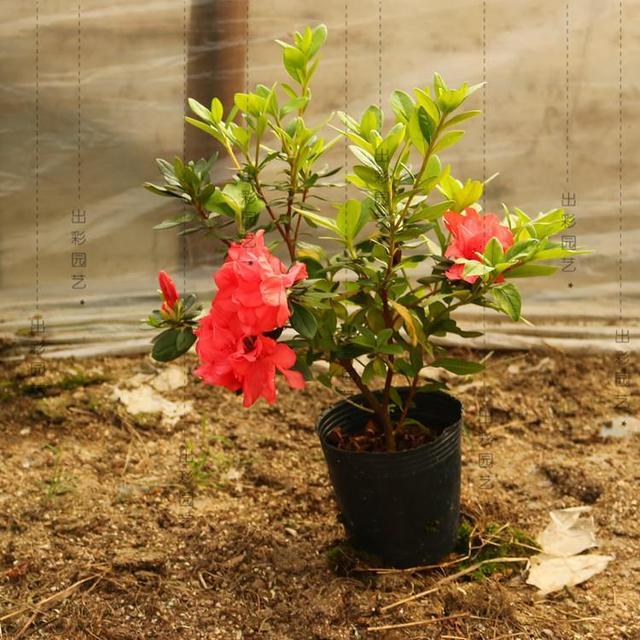
Rhododendron generally refers to plants of the genus Rhododendron in the family Ericaceae. It is one of the world's three major alpine flowers and one of China's traditional top ten famous flowers. China is the origin and geographic distribution center of rhododendrons worldwide, with 571 native species. Its plant form is graceful, its flowers are abundant and brightly colored, and its ornamental value is high, giving it broad market application prospects, so it is widely used in landscape engineering.
Cutting is the main propagation method for deciduous, semi-evergreen and evergreen rhododendrons, and it is widely used. However, rhododendrons are difficult to root from cuttings, and after transplanting they grow slowly. Therefore, in response to problems such as the large demand for rhododendron seedlings, the difficulty of rooting cuttings, and slow growth, in recent years scholars at home and abroad have carried out cutting propagation experiments on some species and found that: rooting of cuttings is affected by endogenous factors such as endogenous hormones in the cuttings, rooting cofactors, nutrient levels and antioxidant enzyme activity, while exogenous auxin can regulate the physiological activities of cuttings, induce changes in enzyme activity and cofactors, and thereby promote cell elongation, division, root primordium differentiation and adventitious root formation; the cutting time is closely related to the degree of lignification and physiological characteristics of the cuttings, and is another key factor affecting the rooting of plant cuttings.
1. Seedbed preparation:The seedbed is set up inside a glass greenhouse or plastic shed, with red bricks or cement bricks used for the bed edge. A drainage hole is reserved at the bottom of the seedbed every 100cm, and then the following are added in order from bottom to top:stones, pebbles, coarse sand, to increase the drainage and aeration of the seedbed; a 10-15cm thick cultivation substrate is laid on top of the coarse sand, raked level and lightly pressed to make the seedbed flat, then watered thoroughly; to control the temperature, humidity and light of the seedbed environment, an arched plastic tunnel is built on the seedbed, automatic misting facilities are installed inside the tunnel, and a shade net is set up 30cm above the plastic tunnel; after the seedbed is completed, the substrate and surrounding environment are disinfected with a 500-fold carbendazim aqueous solution.
2. Collection and preparation of cuttings:Select vigorous adult East Asian azalea (Rhododendron) plants about 5-25 years old as mother plants for cutting collection. In June, collect robust lignified branches (also called hardwood) from the previous year in the plant canopy, spray with water to retain moisture, and transport them back indoors promptly; select thick, upright, pest- and disease-free small branches without flower buds (with leaf buds), cut them into 10-25cm long cuttings; the hardwood length is 8-10cm, retain 2-5 branches at the branching point, and remove the tender buds at the tips of 2-3cm branches; remove the leaves at the base of the cutting, retain 3-4 leaves at the upper part, then cut off 1/2-2/3 according to leaf size to reduce water evaporation; on one side of the base of the cutting, use a grafting knife to peel away a 1.0-1.2cm long strip of cortex and cambium, with the cut surface forming an angle of more than 45° with the branch, to facilitate absorption of rooting agent and the formation of a large area of callus tissue.
3. Callus treatment:Treat the cuttings with 1000mg/L IBA aqueous solution for 1min, then soak the base of the cuttings in 500mg/L NAA aqueous solution for 1min, and air-dry naturally for 12 hours; place the cuttings in an environment at 23-26°C and 60-70% relative humidity for 6 hours; then place the cuttings in an environment at 10-15°C and 40-60% relative humidity for 2 hours; finally soak the base of the cuttings in ABT rooting agent solution (ABT rooting agent: water = 1 gram: 2kg) for 3-5 seconds, and place them in an environment at 23-26°C and 50-60% relative humidity for 24 hours.
4. Cutting and management:The cuttings are inserted immediately after treatment. When inserting, first use a small bamboo stick to make a small hole to reduce mechanical damage to the cutting tissue from the substrate; the plant and row spacing between cuttings is 15×15cm, and the insertion depth is 1/3-1/2 of the cutting length; after insertion, spray thoroughly with water. During the experiment, an automatic intermittent misting system is used to replenish water and increase humidity: 5min/4h during the day and 2min/4h at night, and after 40 days the misting frequency is gradually reduced; the temperature and light intensity inside the tunnel are adjusted according to weather conditions through ventilation on both sides of the plastic tunnel and the shade net respectively (the air temperature inside the tunnel is controlled at 20.0-30.0°C and the relative humidity at 80.0-95.0%); when the temperature is higher than 30.0°C, open the plastic shed for ventilation to lower the temperature; to reduce contamination, promptly remove fallen leaves and rotting cuttings from the seedbed, and every 7-10d spray once alternately with 500-fold carbendazim or 1000-fold thiophanate-methyl aqueous solution.
After 50 days, observe the rooting of the rhododendrons, checking once every 10 days. When more than 3 roots have formed at the base and the root length is more than 2cm, transplanting can begin. The planting substrate for transplanting is peat soil: yellow soil: perlite: vermiculite at 4:1:1:1. When transplanting, water thoroughly to settle the roots, set up a shade net 50cm above the ground, with a shading rate of 50%; from 9 a.m. to 5 p.m., cover with the shade net, and remove the shade net at other times; 2 months after transplanting and planting, remove the shade net.
Using this propagation and cultivation method for cutting propagation of East Asian azalea, the callus formation rate is as high as 95%, the rooting rate reaches 90%, each plant forms more than 3 roots, and the root length is more than 2cm. In the second year the plant grows to a height of 30-50cm, with strong branches, and can leave the nursery. The technique lies in selecting previous-yearlignified branchesas cuttings, whose front end bears the current-year semi-lignified to lignified transitional branch; the cutting is more than 2 times the length of a traditional cutting, and after rooting it becomes a plant with multiple branches. It roots and is transplanted in the same year, and in the second year it can leave the nursery as a strong seedling, solving the previous situation in which cuttings only branched in the second year after surviving and could only leave the nursery as strong seedlings after the 3rd year; moreover, the seedlings from this technique have strong branches and the whole plant grows quickly. [Jishan Huayao] 2. This technique breaks the traditional concept regarding cutting time, carrying out cuttings in June-July, which facilitates rapid rooting and the rapid development of the seedlings after rooting. 3. This technique solves the difficulties of rhododendrons being difficult to root from cuttings, low propagation rate and slow production, and effectively improves the rooting rate and rooting quality. 4. This technique requires no special treatment, is simple and easy to carry out, and is an effective method for the large-scale rapid propagation of rhododendrons, especially suitable for the industrial seedling raising of evergreen rhododendrons.