How do you propagate and transplant Sempervivum tectorum by division?
How do you propagate and transplant Sempervivum tectorum by division?
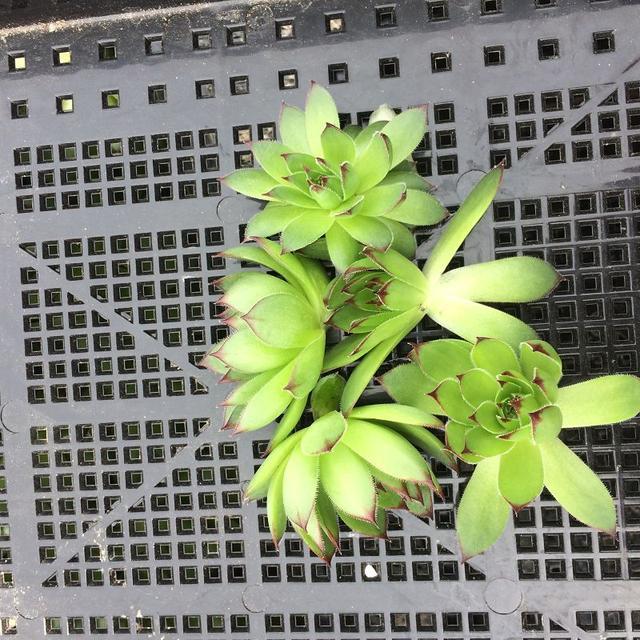
Sempervivum tectorum is a succulent in the Crassulaceae family, Sempervivum genus, also called houseleek, Guanyin zuolian, or Fozuo lian. It originated in the mountainous areas of Spain, France, Italy and other European countries, and is an alpine succulent. It is now widespread everywhere and is one of the most common succulent varieties, worthy of being called the king of ordinary plants. The flesh of Sempervivum tectorum is just like its name: the leaves grow in a rosette-like ring, with a shape like a lotus seat, the leaves flat and slender, the tips sharply pointed, and the leaf margins bearing tiny fuzz. Under full light, the leaf tips and margins form a very beautiful coffee-colored or purplish-red color.
The leaf color of Sempervivum tectorum is rich in variation, and the purplish-red leaf tips are extremely distinctive. It is suitable for small and medium potted plants or combination potted plants. Planted in flower pots of different shapes, its ornamental effect also differs greatly. Planted in a cartoon-style flower pot, it is lively and cute, and very popular with children; planted in a purple clay pot or a blue-and-white porcelain pot, it is dignified and elegant, and quite favored by middle-aged and elderly people; while planted in a small wooden flower pot, it is stylish and natural, and very popular with young people.
General cultivation techniques for Sempervivum tectorum. Soil: the potting soil should be loose and fertile, with good drainage and air permeability. You can add one third humus soil to the potting soil, plus another one third river sand or coal cinder, and mix in a little bone powder. Because the soil is moist, newly planted specimens do not need too much water; keep them in a semi-dry state to help the root system recover. Ordinary soil can be used for the potting soil; a better option is garden soil plus one third humus soil, plus another one third river sand or coal cinder, and mix in a little bone powder. Do not water too much: in spring and autumn about once every 15 days, in summer once every four or five days, avoiding the hottest period at noon. Try not to let water droplets touch the leaves. Provide plenty of light, and every three or four days turn the pot to a different direction so that all sides of the rosette can receive light; this will make it grow flat and even, with an enticing emerald green leaf color. But do not expose it to scorching sun.
1. Mother plant cultivation: topdress and cultivate the obtained Sempervivum tectorum plants, applying a mixed fertilizer of 20% potassium chloride, 30% urea, and 40% phosphate fertilizer, dissolved in water every day and poured at the roots, maintaining a moisture content of 25%-30%, and spraying gibberellic acid on the leaf surface once every three days at a concentration of 5g-6g /L.
2. When the mother plant grows to a height of 15cm-20 cm and the sword leaves are thick and fleshy, leaf cutting propagation can be carried out. Use a blade to cut the lower leaves off from the roots, let the sword leaves dry at the cut, then soak them in a 0.2% indolebutyric acid solution for 18 hours-20 hours, and take them out ready for planting [Jishan Huayao].
3. Bud plant cultivation: prepare fine dryland soil, open furrows 6 cm-7 cm deep, place in the sword leaves, gently press so that the leaf base makes full contact with the soil, no need to cover with soil, spray with water mist, and keep the soil at a moisture content of 25%-30% and a temperature of 25°C-35°C.
4. Cultivating the number of divisions: after 8 days-10 days, roots grow from the base of the leaves, and new small buds and leaves grow on the leaf surface. After 13 days the number of small buds and leaves is basically determined, and division can then be carried out.
5. Division and transplanting: carefully lift the sword leaves in the furrow soil away from the soil, use a blade to cut them apart according to the number of small buds and leaves, dividing the mother sword leaf equally among the bud leaves, then plant the small buds and leaves together with the sword leaf body as one plant separately into holes in the soil furrow, with a plant spacing of 15 cm-20 cm. When covering with soil, only bury and press the mother sword leaf. After division is complete, spray with water, keep the soil at a moisture content of 25%-30%, and after 4 days-5 days the small plants will have fully taken root and grow vigorously.