Key Technical Points and Cultivation Management Methods for Soilless Strawberry Cultivation
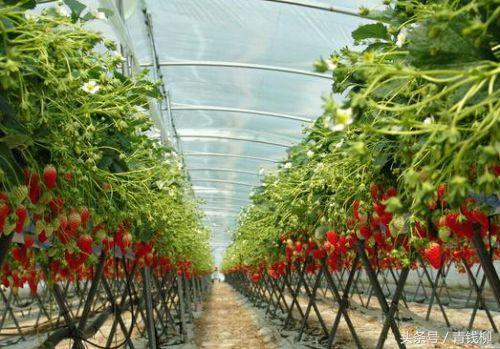
Strawberry Soilless Cultivation Techniques
The strawberry fruit is sweet and tart, juicy, and highly nutritious, rich in vitamins and minerals, for example, every 100g of fresh strawberry fruit contains 50-100mg of vitamin C. Strawberries can be eaten fresh and can also be processed into foods such as strawberry juice, strawberry jam, and strawberry wine; market demand is very high, and they are deeply loved by consumers. Besides being eaten fresh as a fruit, the strawberry is also a potted flower with considerable ornamental value; its flowering and fruiting periods are very long, and it is easy to cultivate, so it is gradually gaining attention in the market. [Jishan Huayao]
In recent years, soilless strawberry cultivation has developed relatively quickly. At present, strawberries are cultivated in countries around the world, and the main methods are the elevated NFT hydroponic method and rockwool culture.
(1) Biological Characteristics
Strawberry (Fragaria ananassa Duch.) is a perennial herbaceous plant of the Rosaceae family, with a plant height of about 30cm, fibrous roots, and a shallow distribution. The strawberry has three types of stems, namely the new stem, the rhizome, and the stolon. The new stem is the stem of the current year, and the rhizome is a perennial stem; the new stem of the previous year becomes the rhizome of this year, and the stolon is the reproductive organ of the strawberry. The leaves of the strawberry are pinnately compound leaves, alternate. The flowers are white, self-pollinating, and usually about 20 flowers grow on one inflorescence, opening in succession. The fruit is formed by the enlargement of the receptacle, soft and juicy, with a red fruit surface; the flesh may be white, red, or pink, with a pith in the center. Fruits set from early-opening flowers are larger, and fruits set from later-opening flowers are smaller.
(2) Cultivation Season and Variety Selection
In October, virus-free plantlets are planted in a seedbed, covered with a small shed, and overwintered under a cover of white non-woven fabric or cheesecloth; in March, the plantlets are planted into a propagation nursery so that a large number of stolons are produced to form young plantlets. In July, young plantlets are collected for soilless seedling raising, and then undergo artificial low-temperature and short-day treatment to induce flower bud differentiation; in September they can be planted in the greenhouse, and in December of that year they begin to bear fruit, which can be supplied continuously until April to May of the following year. This is the entire process of forcing cultivation of strawberries.
In addition to requiring early maturity, high yield, and good quality, strawberry varieties for soilless cultivation should also have the characteristics of strong fertilizer tolerance and a short dormancy period, so that the growth vigor of strawberries in winter is not easily weakened. At present, the most commonly used varieties are Nyoho and Toyonoka, etc.
(3) Induction of Flower Bud Differentiation
For strawberries cultivated in the open field, after planting in late autumn, the seedlings overwinter in dormancy, flower buds differentiate the following year, and harvest is in May. For soilless strawberry cultivation, forcing cultivation in large sheds or greenhouses is mostly practiced, and strawberries can be harvested as early as November to December, continuing until May of the following year. For this purpose, varieties with shallow dormancy or almost no dormancy must be selected, and artificial flower bud induction treatment must be carried out. Traditional methods include moving young plantlets to high-altitude mountains during the high-temperature season in August for seedling raising, to promote flower bud formation. Under soilless seedling-raising conditions, interrupted N supply treatment and low night temperature treatment are mostly used to induce flower bud formation.
(4) Cultivation Management
1. Cultivation Methods and Planting Strawberries can be grown in various soilless cultivation forms, such as NFT hydroponics, DFT hydroponics, trough substrate culture or bag substrate culture, as well as vertical cultivation and aeroponics, etc.
When planting strawberry seedlings in DFT hydroponics, first place small gravel, accounting for about 1/4 of the height of the planting cup, at the bottom of the planting cup, then place the strawberry seedling in, and fix it with a small amount of gravel. Do not place the root system directly at the bottom of the planting cup, to prevent the nutrient solution from soaking the seedling roots for too long and causing root rot. Place the planting cups with the transplanted seedlings in the growing trough, and a plant and row spacing of about 20cm x 20cm is suitable.
When planting strawberries in NFT hydroponics, it is best to plant the strawberry seedlings in 8cm x 8cm x 5cm rockwool seedling blocks, and then place them in the growing trough to grow.
When cultivating strawberries in trough substrate culture, strawberry seedlings can be planted directly into the substrate at a plant and row spacing of 20cm x 20cm. The nutrient solution should be added in the form of drip irrigation, and the nutrient solution or water must not be supplied in the form of sprinkler irrigation, because sprinkler irrigation of the nutrient solution will cause the strawberry fruit to be too humid and rot, and it is also not conducive to keeping the strawberry fruit clean.
2. Nutrient Solution Management
(1) Selection of Nutrient Solution Formulas Various forms of soilless strawberry cultivation can all use the South China Agricultural University fruit and vegetable formula, the Japanese Garden Test formula, and the Yamazaki formula, etc. Among these three nutrient solution formulas, except that the pH value of the Japanese Garden Test formula will rise somewhat during strawberry cultivation (generally not exceeding pH 8.0), the pH of the other 2 formulas is relatively stable.
(2) Control of Nutrient Solution Concentration Generally speaking, the fertilizer tolerance of strawberries is relatively weak. Too high a nutrient solution concentration will cause root aging to accelerate and lifespan to shorten, thereby affecting nutrient absorption, aboveground growth, and yield improvement. However, there are certain differences in fertilizer tolerance among different varieties. In the process of strawberry cultivation, the method generally used to control nutrient solution concentration is to control a relatively low concentration before flowering, which can control the occurrence of deformed fruits later; after flowering, because flowering and fruiting consume more nutrients, the nutrient solution concentration should be increased to prevent weak plant growth vigor and premature senescence. Based on experiments and production experience, the nutrient solution management concentrations for several strawberry varieties are listed in Table 10-1 for reference.
Table 10-1 Nutrient solution management concentrations for different variety groups of strawberries
(Based on 1 dose of the Yamazaki strawberry formula as the standard, 1985)
Because the growth period of strawberries is as long as 8 months (from October of the current year to May of the following year), within the first 2-3 months after planting, an EC meter can be used to measure the concentration to determine whether nutrients need to be supplemented. After this period, however, relying on an EC meter to measure the concentration may not truly reflect the amount of nutrients contained in the nutrient solution. This is because after a long growth period, some roots die and rot, and root exudates accumulate in the nutrient solution, and substances with low or no plant demand that are brought in when nutrients are added also accumulate. Therefore, the content of major elements such as N, P, and K in the nutrient solution can be determined by chemical analysis to supplement nutrients, and if necessary, the original nutrient solution can be replaced.
(3) Control of Nutrient Solution pH The optimum pH value for strawberries is 5.5-6.5, but they can grow normally within the range of pH 5.0-7.5. If the pH does not deviate excessively from the optimum range, there is no need to adjust it.
(4) Solution Supply Method If deep flow technique is used for cultivation, a timer can be used to control the intermittent supply time of the nutrient solution. Before flowering, turn on the water pump to circulate for 10min every hour, and after flowering, the pump circulation solution supply time should be increased to 15-20min/h.
If nutrient film technique is used to grow strawberries, before planting until the root mat is formed, a continuous solution supply of 0.2-0.5L/min per growing trough can be used. After the root mat is formed, use a flow rate of 1-1.5L/min for continuous solution supply in an intermittent mode of 15-20min/h.
If rockwool or other substrates are used for cultivation, the relative water content in the substrate should be controlled at about 70-80% according to the weather and plant growth vigor; the solution supply amount can also be determined based on the maximum daily water consumption of a single strawberry plant of 0.3-0.8L, and a timer can be used to control the water pump for timed solution supply.
(5) Solution Temperature Management Strawberries have strong adaptability to temperature, are tolerant of low temperatures, and are not tolerant of high temperatures. The optimum growth temperature is 20-26°C, and the optimum temperature for rhizosphere growth is 8-21°C. The root system will suffer freezing damage at -8°C, and the terminal bud at -15°C; high temperatures above 30°C will cause strawberry growth to stagnate and will also cause the leaf edges to become scorched and withered.
3. Plant Adjustment
(1) Vine Training and Renewal After the plants bear fruit, new plants formed from stolons need to be replanted; they have strong vitality and high yield. Alternatively, after harvest is finished, all the stolons growing from the plants on the cultivation bed can be removed in several batches, and the original fruiting plants will still maintain relatively high vitality and production capacity.
(2) Removing Old Leaves and Thinning Flowers After strawberry planting, when there are 5-6 leaves, dead leaves and old leaves should be removed in a timely manner. It is best to complete the removal of dead leaves and old leaves before flowering, to facilitate subsequent growth. After the plants show buds, keep 2-3 flower branches per plant, and keep 3-5 fruits per flower branch. Keep 8-15 fruits per plant. Remove the rest to ensure large and uniform fruits and prevent the occurrence of small fruits and deformed fruits.
(3) Artificial Pollination When soilless strawberry cultivation is carried out in protected facilities, because there are mostly no insects active during the flowering period, pollination and fruit development are affected. Therefore, according to specific circumstances, either raise bees during the flowering period, or manually shake the flower branches, etc., to improve pollination and fruit set rate and reduce the occurrence of ineffective flowers and deformed fruits.