The zebra plant gets its name because its leaves resemble zebra stripes.
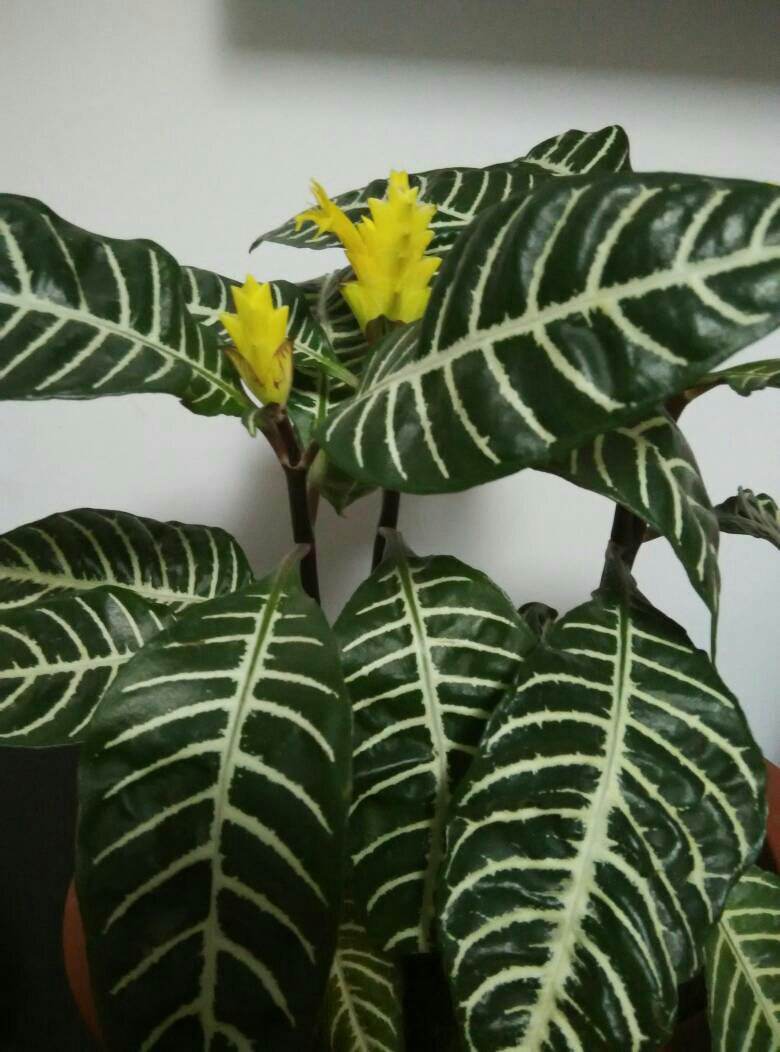
The zebra plant, also known as silver-veined aphelandra or Daniel's aphelandra, gets its name because the markings on its leaves closely resemble the stripes on a zebra. It is native to the tropical and subtropical regions of South America. It is a perennial evergreen herbaceous plant. The flower clusters are pyramid-shaped, with yellow bracts, sometimes edged in red, alternately wrapping around the flower stalk. The zebra plant has charmingly mottled leaf colors, peculiar flower shapes, and bright, brilliant colors. It is an excellent indoor potted flowering plant that offers both attractive foliage and beautiful flowers, and is suitable as a medium or small potted plant.
Zebra plant
Morphological characteristics:
The zebra plant gets its name because the markings on its leaves closely resemble the stripes on a zebra. Also known as silver-veined aphelandra, it is an evergreen shrub or perennial herbaceous plant in the Acanthaceae family, genus Aphelandra. The stems are upright, square, and the plant is stout and somewhat fleshy. The leaves are opposite, ovate or elliptic-ovate, with pointed tips and short petioles; the leaves are 15 cm to 30 cm long and about 10 cm wide. The leaf tips are pointed, and the leaves are dark green and glossy, with obvious white striped veins on the surface; both the veins and leaf margins are undulate. The spike inflorescences are terminal or axillary, and the flower clusters are pyramid-shaped; the bracts are yellow, sometimes edged in red, alternately wrapping around the flower stalk, somewhat like roof tiles overlapping layer upon layer; the flowers are bilabiate, with five sepals, pale yellow, and can bloom year-round under suitable conditions.
Zebra plant
Variety introduction:
The zebra plant is further divided into the golden-veined aphelandra and the tiger-striped aphelandra. Among them, the more common one is the golden-veined aphelandra. The golden-veined aphelandra, also known as golden-veined zebra plant or golden-veined Daniel's aphelandra, is a perennial evergreen herbaceous foliage plant in the Acanthaceae family, genus Aphelandra.
The golden-veined aphelandra grows 25-30 cm tall. The leaves are opposite, long elliptic, 10-12 cm long and 5-8 cm wide; the margins are entire and slightly rolled inward, the tips are acuminate, and the bases are cuneate; they are dark green with pale yellow or yellow veins. The flowers are terminal spike inflorescences that open gradually from bottom to top, yellow, with a flowering period in summer and autumn that can last several weeks. The golden-veined aphelandra is mainly produced in the vast tropical American region from Mexico to Brazil. It prefers warm, humid environments and likes light, but avoids direct sunlight and is sensitive to cold. The optimum growing temperature is 20-28°C, and the overwintering temperature is 10°C.
Zebra plant
Growing environment:
It prefers a warm, humid, semi-shaded environment, is not cold-tolerant, and fears drought. Although it likes ample sunlight, it also fears strong direct sunlight, so it can be grown in a spot with bright light but no direct sunlight. The optimum growing temperature is 18°C to 25°C. Because its leaves are large, water evaporation is also high, so during the growing season, in addition to watering heavily, it is also necessary to frequently spray the leaves to raise air humidity and prevent the leaf margins from drying and scorching. It requires loose, fertile soil. It fears direct light, dislikes heat, and is sensitive to severe cold; temperatures above 35°C or below 6°C will cause leaf damage. It likes fertile, loose soil and fears waterlogging.
Landscape application:
The zebra plant has charmingly mottled leaf colors, deep green and glossy, with pale yellow veins and neat leaves whose markings resemble the stripes on a zebra. Its flower shapes are peculiar and its flower spikes golden yellow, with bright, brilliant colors. Together they create a display where foliage and flowers compete in beauty and can be enjoyed at the same time. It is an excellent indoor potted flowering plant that offers both attractive foliage and beautiful flowers, with high ornamental value. It is suitable as a medium or small potted plant, and is mostly grown in pots in halls, reception rooms, exhibition halls, and similar places; in the south, it is planted in flower borders, flower beds, and similar sites together with red-flowered plants, enhancing the ability of gardens and other outdoor displays.