Bleeding heart vine has a stunning appearance and is a highly attractive ornamental flower.
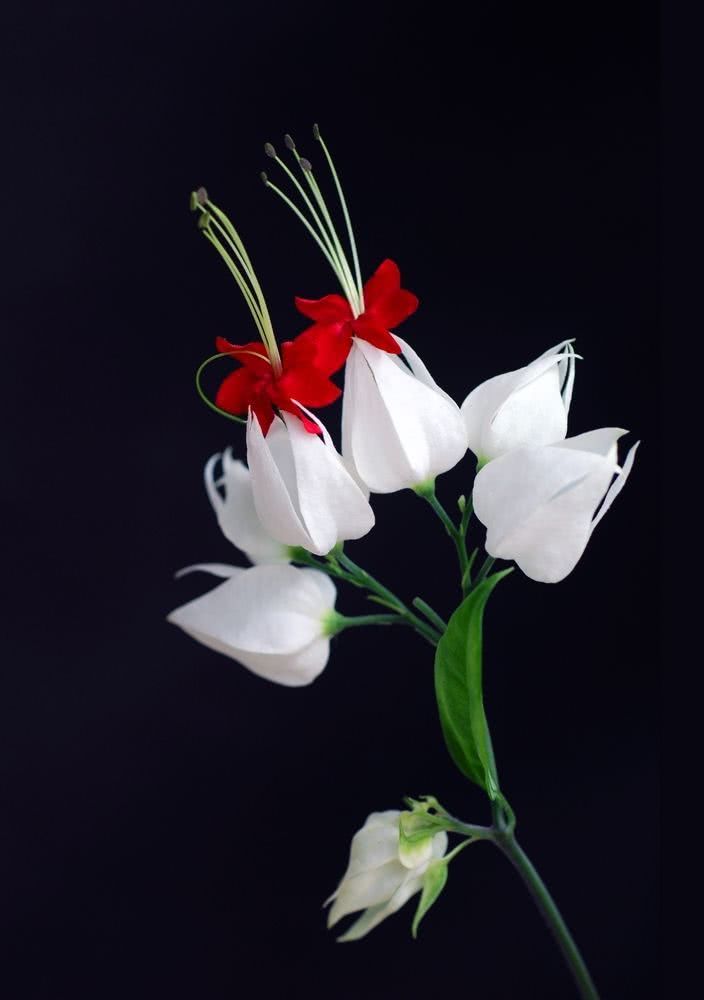
Bleeding heart vine: a shrub in the Verbenaceae family, young branches four-angled, covered with yellowish-brown short tomentum, hairless when old. Leaves papery, narrowly ovate or ovate-oblong, apex acuminate, base nearly rounded, margin entire; cymes axillary or pseudoterminal, dichotomously branched; bracts narrowly lanceolate; calyx white, connate at the base, swollen at the middle, lobes triangular-ovate, apex acuminate; corolla deep red, externally covered with fine glandular hairs, lobes elliptical; stamens 4, exserted from the corolla together with the style; stigma 2-cleft. Drupe nearly spherical, exocarp glossy, brownish-black; persistent calyx not enlarged, red-purple. Flowering period March-May. Bleeding heart vine prefers a warm, humid, semi-shaded environment with plenty of sunlight, and is not cold-tolerant. It is distributed in tropical West Africa and Mexico, and is cultivated in China.
Bleeding heart vine
Plant history:
In the mid-eighteenth century, the English traveler Cos Thomson went on a journey through Africa, where he happened to see many dark-skinned girls wearing necklaces strung from bleeding heart vine flowers, adorning their chests, one black and one white, a sharp contrast that aroused great interest, so he collected seedlings and brought them back for trial cultivation. At the time, botanists considered him the first discoverer, so they named it after him. By the late nineteenth century, Mali began to cultivate this plant and renamed it "Pearl Pagoda", which was indeed one step better than using a person's name. By the early twentieth century, bleeding heart vine entered the international flower market in the Netherlands, and at first sales were very low. An overseas Chinese worker, Fang Fulin, responding to flower customers' fondness for auspiciousness, suggested changing the flower's name to "Dragon Spitting Pearls" to attract customers, and the boss immediately adopted it. As a result, business flourished, with sales reaching almost all over the world. Since then, the name "Dragon Spitting Pearls" has become popular worldwide.
Bleeding heart vine
Propagation methods:
Cuttings
Cuttings are generally taken from May to June each year. You can choose the tender top shoots of robust, disease-free branches, or cut the lower old branches into 8-10 cm stem segments as cuttings. Bud grafting takes lateral buds from branches with a portion of xylem as cuttings. Root cuttings involve cutting root-like stolons into 8-10 cm lengths as cuttings. The cutting bed can use substrates such as peat, perlite, leaf mold, river sand and vermiculite. Spring and autumn are the best times for cuttings. The suitable temperature for cuttings is 21°C, and a cutting bed temperature of 26°C is very favorable for rooting. Roots can form 3 weeks after cutting. If the base of the cuttings is treated with a 0.5%-0.8% indolebutyric acid solution for 1-2 seconds, rooting will be faster and more abundant.
Sowing
Seeds have a short lifespan and should be sown immediately after collection. Sowing can be done from March to April each year in a shallow pot, keeping the temperature at 24°C; seedlings emerge in 10 days. When the seedlings are 10 cm tall, repot and transplant them, and they can bloom the following year. Sowing does not easily succeed, so cutting propagation is recommended.
Bleeding heart vine
Ornamental value:
This species is a beautiful ornamental plant. When it blooms, the deep red corolla extends from the white calyx, shaped like spitting pearls. The flower shape is unusual and the blooming is abundant. Its flowers all have prismatic calyces composed of bracts, like little milk-white "carambola fruits", and from the gaps at their tips emerge five crimson flowers, evenly distributed over the leaves, like red pearls containing the fire of life, spat out one after another. Generally, potted plants remain quite short due to pruning restrictions. It is mainly used for ornamental cultivation in greenhouses, can be used for flower stands, and can also be potted to decorate windowsills and small summer courtyards. It can also be used in parks or tourist sites to build flower baskets, arches, pavilions and various patterned shapes, adding elegance and enjoyment for visitors.