Variety Introduction to the Blue Apple Succulent
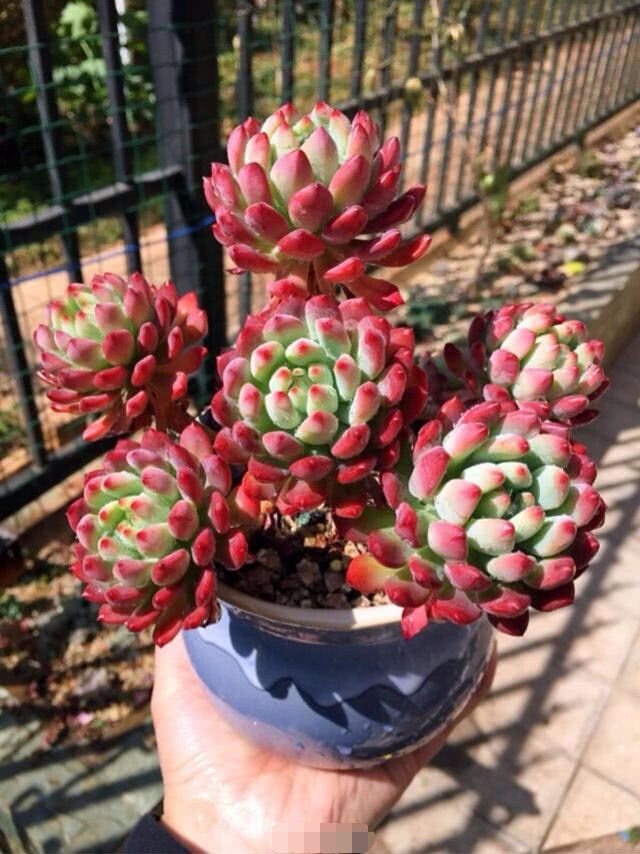
Blue Apple is a succulent in the Crassulaceae family, a cross-genus hybrid between Sedum and Echeveria.
Blue Apple
Morphological characteristics:
Blue Apple succulents often grow in a rosette form, readily producing new shoots from the lower part of the stem to form clumping growth and gradually becoming old stock. The leaves are spoon-shaped, whorled, and arranged in a rosette, plump and fleshy, slightly flattened, with the underside of the leaf somewhat raised and bearing a keel line, while the upper surface is flat or slightly concave; the leaf tip tapers and narrows slightly, and the leaf color is fairly rich, changing with the seasons and temperature differences, including blue-green, purple, and a beautiful jelly color, with the leaf tip bearing a peach-red, pink, or rose-red blush, while the upper and lower surfaces of old leaves show large areas of red blush, becoming even more intense and intoxicating in color when in prime condition, and the leaf surface is covered with a white powder.
In summer, the red color at the leaf tips of Blue Apple succulents easily fades, sometimes disappearing completely, leaving a basically blue-green state. The flowering period is in spring, with cymes, and the flowers open with 5 petals in a five-pointed star shape and are lemon yellow.
Blue Apple
Cultivation techniques:
Blue Apple is relatively vigorous by nature and comparatively easy to cultivate. It is a summer-growing type, with an optimum growth temperature of 15-25°C. Like most plants of the same genus, it likes a warm, dry environment with plenty of light, is drought-tolerant, not cold-tolerant, and slightly tolerant of partial shade.
Blue Apple succulents can be cared for outdoors during the growing season, and in winter can be moved indoors to a sunny spot for care. Blue Apple still grows in summer, so watering cannot be completely stopped when overwintering through summer; water can be poured along the edge of the pot, just enough to moisten, avoiding excessive dampness. In midsummer, avoid harsh sun and heavy rain, and pay attention to shading and ventilation. When winter temperatures fall below 5°C, watering should be controlled. Propagation is mainly by cuttings.
Blue Apple