Several flowers with long blooming periods - once they bloom, they last for over half a year
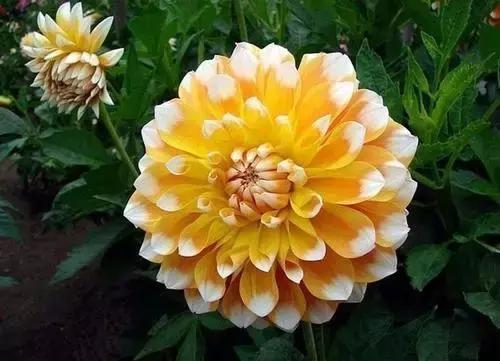
If you have a few pots of flowers at home that bloom all year round, it is truly a very proud and happy thing.
Next, let us take a look at these flowers with long enough blooming periods.
See if there are any you like?
--- Dahlia ---
Dahlia, also called East Asian chrysanthemum or sweet potato flower, is a perennial herbaceous plant and a tropical flower native to Mexico. It is now cultivated in many countries, with over 30,000 varieties. It is a world-famous flower and also the national flower of Mexico.
The dahlia has upright stems with branches, and large tuberous roots that store nutrients. The flower colors are numerous, bright and gorgeous, grand and enchanting.
Just hearing the variety names of dahlias, you can tell the character and temperament of this flower: Liren, Shouguang, Zhaoying, Huazi, Fushou, Ruibao, Hongfei...
Dahlias can be propagated by sowing, division, or cuttings. They like moisture but dislike waterlogging. The soil needs to be fertile and loose. They like sunlight; shading tends to make them weaken.
Temperature control is very important: no higher than 25°C, no lower than 10°C. Too cold or too hot will affect them. Around 20°C is the most suitable temperature; if maintained, the flowers will surely bloom beautifully.
Wintering temperature is also very important. After the leaves fall and wither, they should be promptly moved indoors for protection.
Dahlias like fertilizer. Before blooming, apply a light fertilizer every 7 to 10 days.
--- Four-Season Primrose ---
Four-season primrose, also called crane lotus, originates from Yunnan, Guizhou, Sichuan, and Hubei. The four-season primrose has at least 6 colors. From March to June, if the dormant period after flowering is managed properly, it can bloom again in autumn.
The flower language of the four-season primrose is: the joy and sorrow of youth.
One wonders if it is inspired by its beautiful flower language - each color expresses its own spring sentiment. Petals are either single or double; happy people see it as lively and gorgeous, sad people see it as sentimental and melancholic.
The four-season primrose is mostly propagated by sowing. Some varieties have scarce seeds, so cuttings or division are also used.
It is suitable to grow in fertile, loose humus soil. It likes a bright, moist, cool, and ventilated environment. The suitable growth temperature is between 10°C and 25°C.
The care environment is best with sun and shade. In summer, keep the temperature below 25°C; in winter, 7 to 10°C is suitable.
After the spring blooming period, promptly prune the flower stems and strengthen water and fertilizer management, and it can bloom again.
--- Shrimp Plant ---
Shrimp plant, also called fox tail wood or qilin spitting pearls, is an evergreen shrub native to Mexico and now cultivated in many countries. It is named for its resemblance to a lobster.
The shrimp plant blooms all year round and fruits all year round.
Its flower language is: the distress of love, drinking alone under the moon.
The shrimp plant can reach up to 2 m tall, and the whole plant is covered with hairs. The stems are slender and weak, and the leaves are elliptical.
Another name for the shrimp plant, "qilin spitting pearls," fits very well, because the white flowers inside are wrapped by the outer "gradient-colored" spike inflorescence and persistent bracts. Viewed from a distance, it truly lives up to its name.
The shrimp plant can be propagated by sowing, cuttings, or layering.
Except during the high-temperature period of midsummer, cuttings can be taken in all other seasons.
For layering, take thick and strong branches and layer them with thin bark.
The shrimp plant likes warmth and moisture and is also fairly drought-tolerant. Fertile, loose, neutral to slightly acidic soil is best.
The suitable temperature range is a minimum of 5°C and a maximum of 28°C. Above about 18°C, it can grow and bloom.
The shrimp plant likes light and tolerates shade but cannot be exposed to harsh sun. If there is insufficient sunlight, it blooms less and the flower color is not beautiful. So attention must be paid to providing enough light.
In summer, pay attention to shading and maintain ventilation.
The minimum winter temperature is 5°C.
During the growing period, prune and pinch back at any time to promote a sturdy and beautiful plant.
--- Nasturtium ---
Nasturtium, also called big red sparrow, is native to South America and is now cultivated in all provinces north and south of China.
Under good environmental conditions, it can bloom all year round.
The flower language of nasturtium is: love is everywhere, it is just that your heart is absent.
It can be brewed as tea, has a fragrance, and clears the liver and brightens the eyes. There is also a legend that Empress Dowager Xiao in ancient times used nasturtium for beauty and skincare.
Nasturtium has varieties in many colors. The stems are trailing, gorgeous and fragrant. The flower and leaf shapes resemble bowl lotus. When blooming, flowers and leaves complement each other, graceful and charming, very beautiful.
Two propagation methods: sowing and cuttings. It likes warmth and moisture, is suitable for sandy soil rich in organic matter, grows at 18 to 24°C, and the overwintering temperature needs to be above 10°C.
Nasturtium generally blooms in summer, but sustained high temperatures will inhibit it.
One flower can last nearly 10 days, and one plant can bloom dozens of flowers at a time.
During the growing period, water frequently while also paying attention to drainage. After blooming, reduce watering to prevent leggy branches.
Flowers with long blooming periods mostly need to be fertilized. Nasturtium needs it once every three to four weeks.
This flower is strongly phototropic, so be sure to remember to change its position and direction to keep its growth balanced.
In addition, because the stems are trailing, support is needed to make the flower shape more beautiful.
--- Star Flower ---
Star flower, also called umbrella flower or five-star flower. It is named for its five-pointed star-shaped petals.
It is a perennial herbaceous flowering plant of the perennial-root type, native to tropical Africa. It is now mostly grown in pots in southern China.
Generally, it can bloom from March to October.
There are many varieties of star flower, including the New Look series, Madame Butterfly series, Kaleidoscope series, Mural series, Northern Lights series, and so on.
The flower colors range from white to peach red, and they are single-colored flowers. Dozens of small star-shaped flowers gather into a cluster, like intricate flower balls and also like dense stars, very pleasing to the eye.
Star flower seeds are very small, so propagation requires plug tray sowing or strip sowing in a seedling tray.
The star flower comes from the tropics, likes high temperatures (it stops blooming below 10°C) and strong light, and fears waterlogging.
It is drought-tolerant and sun-tolerant, but not water-tolerant, so it is better to keep it dry than waterlogged.
After blooming in autumn and winter, there will be a dormant period of about one month, during which water must be controlled.
Star flower leaves are very sensitive to cold water, so it is best to use warm water when watering.
During the growing period, pay attention to pruning to control plant shape.
--- Lantern Flower ---
Lantern flower, also called fuchsia or hanging bell begonia, is named for its shape resembling a hanging small bell. It is a perennial herbaceous plant.
As long as it is cared for well, it blooms in all four seasons.
Flower language: believe in love, an ardent heart.
The lantern flower's blooms droop, with sepals above and petals below. The sepals are the same color as the stamens, contrasting with the petal color. Three to five blooms together are interesting and cute.
It is very suitable for placing in the living room or as a small plant on a desk.
The lantern flower can be propagated in three ways: cuttings, layering, and repotting transplants.
It likes cool and moist conditions, and fears high temperatures and direct summer sun. Fertile, loose, slightly acidic soil is suitable.
Shade in summer, face the sun in winter.
To make it bloom more, be sure to pay attention to air humidity and spray or sprinkle water in a timely manner.
In summer, it begins dormancy at 30°C, and at 35°C it will die.
The minimum winter temperature is suitably 5°C.
The lantern flower grows quickly and blooms many times, so it needs fertilizing about once every 10 days, with light fertilizer applied frequently.
--- Chinese Ixora ---
Chinese ixora, also called maizimu or hundred-day red, comes from southern China and Malaysia. It is a common potted woody flowering plant and also the national flower of Myanmar.
The blooming period of Chinese ixora is from March to December.
Chinese ixora comes in red, orange, yellow, and white colors. Dozens of flowers form a cluster, and clusters lean against one another, lush and gorgeous, each cluster lofty and striking. Pruning can shape it into patterns, and planted in rows it can make a flower hedge.
Chinese ixora is propagated by cuttings, sowing, and layering.
Chinese ixora likes a humid and hot climate and is not drought-tolerant.
After the temperature falls below 20°C, it blooms less.
It likes acidic humus soil rich in organic matter.
Whether potted or planted in the ground, Chinese ixora needs a sunny environment. When grown indoors, the temperature needs to be above 15°C, otherwise it will cause leaf drop and weakening.
Chinese ixora likes moisture and fears dryness, but long-term waterlogging can also easily rot the root system.
Except in winter, attention must be paid to water and fertilizer management during the growing and blooming periods, suitably once a month.
--- Musella Lasiocarpa ---
Musella lasiocarpa, also called golden lotus or Kunming banana, is a flower variety unique to China, originating from Yunnan and Sichuan.
It is a perennial herbaceous clumping plant with a blooming period of half a year, from spring to autumn. When conditions are warm and suitable, it can bloom in all four seasons of the year.
It is one of the "five trees and six flowers" of Buddhism. In Dai traditional culture, it is a symbol of goodness and punishing evil.
Musella lasiocarpa has a rhizome, a pseudostem of 15-60 cm, and elliptical long leaves that can reach up to half a meter.
The inflorescence grows upright on the pseudostem and is yellow.
Before blooming, the bud is fresh green. After blooming, the golden petals are layered and the color is bright and solemn, much like a golden lotus, bright and spectacular, joyful and peaceful to look at.
Musella lasiocarpa blooms first and then leafs. New stems grow from the leaf axils and bloom again. During the blooming season, it is astonishing.
Musella lasiocarpa is mostly propagated by division in early autumn, and can also be propagated by sowing.
It likes fertile, loose soil and a sunny, warm, and humid environment. It is not cold-tolerant and fears waterlogging.
Outdoor plants need timely drainage in summer. In winter, wrap the plant with straw to prevent frost damage.
For household potted plants, note: in spring and autumn, appropriately use organic fertilizer; in summer high temperatures, avoid direct sunlight; you can water more but also pay attention to drainage.
Dead leaves should be removed early. In winter, provide more light, and move indoors for warmth when the room temperature is below 10°C.
These flowers, as long as they are cared for properly, can bloom for at least more than half a year.
To persist in doing everything meticulously is truly not easy.
If you are also captivated by them like I am, then let's work hard together with the editor!