Study bonsai creates a miniature forest and spring by the desk, revealing natural elegance and refined charm within a square inch
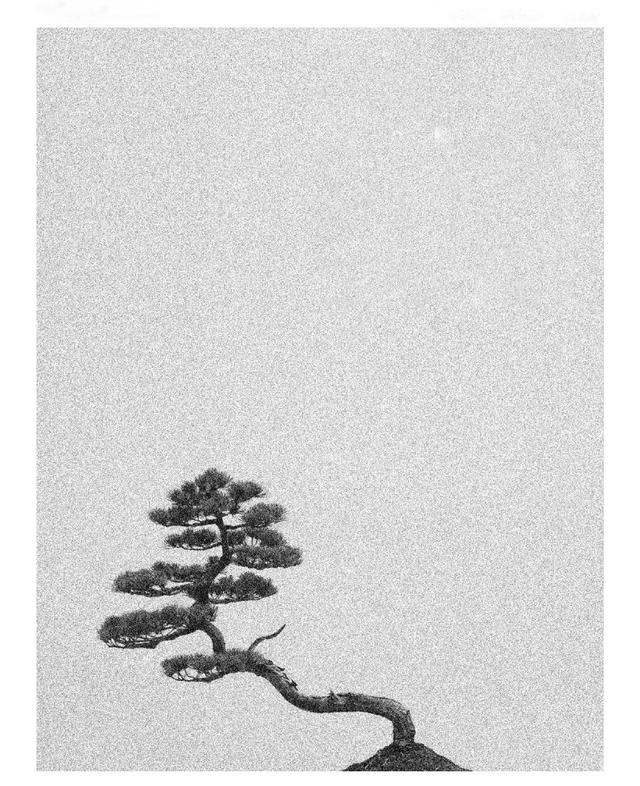
Losing oneself in the mountains and wilds, strolling through sparse woods, accompanied by a lone tree, quietly listening to the sighing of pines - such was the leisure of the ancients, which people today may find hard to seek. If this scene were moved to the study for quiet appreciation, then even a knee-sized space would generate a feeling of clear expansiveness - what a joy. "Literati tree" bonsai perfectly suits this charm! Within a foot of space, it contains the momentum of reaching the clouds, swaying with grace, its noble character striking - truly a miniature forest and spring upon the desk.
"Literati tree" is an established term in the bonsai world, called "bunjin-ki" in Japan, and is a type of bonsai that expresses literati taste. Its distinctive lines, tall and slender solitary trunk, and simple sparse branches and foliage give it a beauty of understated elegance without ostentation.
Elegance
Lines are the sinews and bones of traditional Chinese art, possessing independent aesthetic value. "Literati tree" bonsai deeply embodies the beauty of lines, offering great distinction compared to other tree-form bonsai. These lines are not merely elements for shaping form, but rather the concentration of the creator's spiritual sensibilities. Whether upright and vigorous, or winding and subtle, they possess a posture of clear elegance without any arrogant bearing.
Solitary nobility
Solitary nobility is a prominent feature of "literati tree" bonsai. Generally, the trunk is slender, rising tall, with branches concentrated at the top of the trunk. Although the trunk is slender, it is slender yet ancient, slender yet vigorous, revealing spirit within its slenderness! What is expressed is precisely the solitary noble character of the literati.
Simplicity
"At this moment, silence speaks louder than sound." A seemingly "incomplete" form is often spiritually complete and full of qi and resonance. In the "Ma's one corner" and "Xia's half side" styles of painting, the untouched areas all leave lingering resonance. "Literati tree" bonsai is likewise. Regardless of tree form, branches and foliage are always extremely few, using less to achieve more, reaching the realm of "seeing spirit in a single branch and a single leaf."
Methods of shaping literati trees
The methods of shaping must follow the spirit of painting:
Gnarled and winding, coiling and turning, glancing and posing with grace, high and low corresponding, sparse and dense with order.
Only thus does one achieve organic interest and lively spirit resonance.
Single trunk
A pine is like an upright and honorable person,
Though it has a hidden winding posture to charm the secluded valley,
It possesses a towering air, stern and inviolable.
Two trunks
There are two methods for painting two trunks:
One large plus one small - this is "carrying the old"; one small plus one large - this is "leading the young."
The old tree must be graceful and full of feeling; the young tree must be delicate and charming.
Like people standing together, gazing at one another.
Three trunks
Methods for painting three trunks:
Most taboo is roots and tops all being uniform, shaped like a tied bundle of firewood.
There must be mutual yielding left and right, with natural interweaving.
Ten years to grow a tree
An elegant room need not be large; within a foot of space, spirit is fully revealed.
Life's twists and turns are all contained within this scene!