Potted orchid care requires skill, and only then will the blooms be beautiful
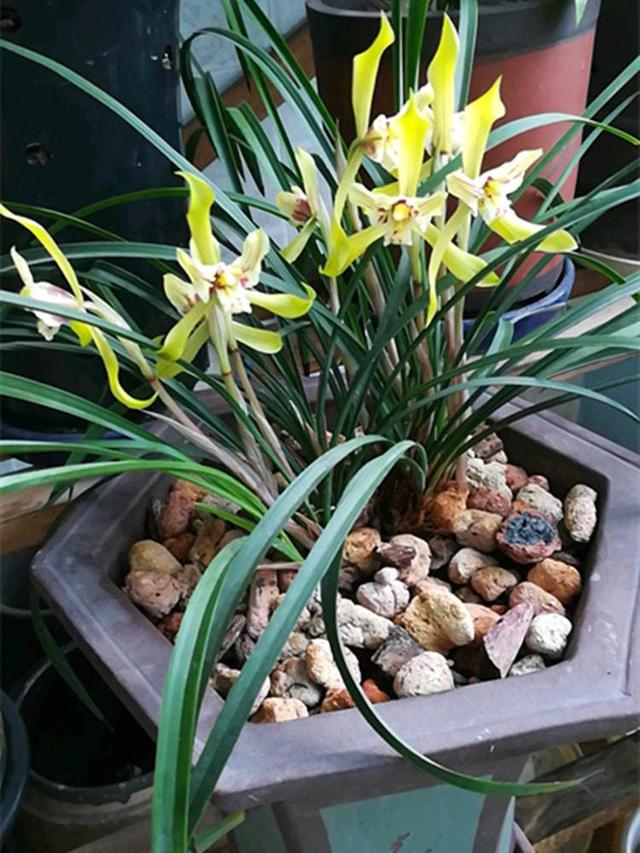
Orchids mostly grow in clusters and receive short sunlight hours. If you want to grow potted orchids well, with beautiful and lovely blooms, you need to learn to "be clever." So-called "being clever" means learning to use techniques according to how the orchids are growing, to promote orchid growth and abundant flowering.
1. Watering should "be clever"
As the saying goes, a thousand orchids and wet chrysanthemums, which shows that orchids need far less water than chrysanthemums. Orchid leaves are small and the roots are fleshy, so although they do not need too much water, they like humid air. In early spring each year, orchid new shoots begin to grow. During summer drought, watering can be slightly increased and the humidity of the leaves and air raised, but water must not accumulate in the pot.
The "clever" way to water: in summer, it should be done in the early morning and at dusk, along the edge of the pot. After autumn, on clear nights the dew is heavier, the soil in the pot should be on the drier side, with more sun and less watering. At this time the degree of shading should be reduced and the shading time shortened. After mid-October, all shading material should be removed and full light given.
If autumn has long clear spells without rain and the pot is very dry, more watering is fine. After orchids drop their flowers, or when growth is nearly stopped, water less. After being brought indoors in winter, just keep the potting soil at a certain humidity.
2. Fertilizing should "be clever"
Generally speaking, orchids should not be given much fertilizer. If the leaves are yellow and thin, it indicates a lack of fertilizer; if the leaf color is dark green, it indicates too much fertilizer. During the peak growth period of orchids, from June to July, when leaf buds are 1 cm long, a diluted fertilizer specially for orchids can be applied several times as a top dressing. In the hot summer season, fertilizer is usually not applied. In September, when autumn turns cool, it can be applied 1 to 2 times, in the evening, followed by watering once with clear water the next morning. Cymbidium goeringii and Cymbidium ensifolium can be top-dressed 4 to 5 times a year, once each in June to September.
Besides using organic nutrient solutions specially made for orchids, flower lovers can also use the following 2 kinds of fertilizer:
(1) Crush soybean cake or rapeseed cake, add soil, mix at a ratio of 1:2, and use after air-drying for 2 to 3 months.
(2) Sun-dry chicken manure, ferment it for 3 months, then mix it with twice its amount of fine soil.
(3) Soak 2 parts soybean cake in 3 parts clear water for 1 year, then use the clarified liquid and dilute it (5%). In addition, mixing some bird droppings with a suitable amount of chemical fertilizer, soaking it until fully fermented, and then diluting it for use is also a good fertilizer for orchids.
3. Pruning should "be clever"
When orchid flower buds appear, bud thinning can be carried out, removing the thin and small ones and leaving 3 to 4 robust ones. After flowering, appropriate flower thinning can also be done, removing the poorly growing orchids. For those growing better, leave 1 to 2 flower buds, or let them bloom for 3 to 5 days before removing them. One pot of orchids can keep 1 to 2 flower stems. When the topmost flower has been open for 1 week, part of the flower stem can be cut off, cutting 3 cm from the pot. After the flower stem has completely withered, cut off all the remaining stems.
4. Entering winter should "be clever"
Before Frost's Descent, when the temperature begins to drop, autumn orchids must be brought indoors; winter orchids are brought indoors earlier than autumn orchids because their place of origin is in the south. Spring orchids and summer orchids are more cold-tolerant than winter orchids and autumn orchids. During overwintering, as long as the temperature is not below 0°C, they do not need to be brought indoors, but if there is freezing, appropriate cold protection is also needed. Indoors, autumn orchids should be placed in a south-facing sunny spot.