Growing roses for half a year, they've covered half the trellis; in the second half of the year, the dream will come true
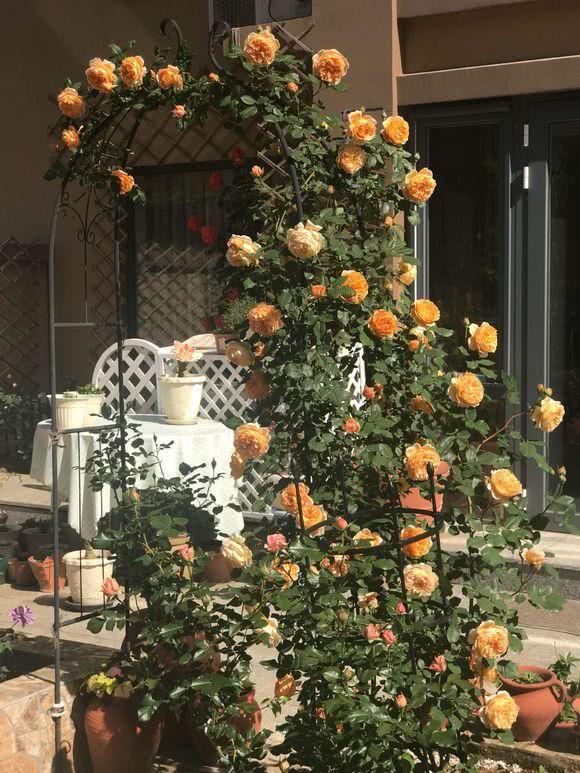
It must be said that growing roses is truly a very rewarding thing. After just half a year of growing, the roses have already climbed halfway up the trellis. I plan to have them cover the entire trellis in the second half of the year, and it's quite possible, because what I bought were mature large seedlings, which makes things much faster.
First, let's talk about soil mixing for roses
The media commonly used for mixing rose soil fall roughly into two categories: one type retains water and nutrients; the other type is loose and breathable.
1. Water- and nutrient-retaining media commonly include peat soil, grass peat, fine coconut coir, garden soil, Northeast China black soil, mountain soil, pond mud, and so on.
2. Loose and breathable media commonly include perlite, coarse coconut husk, pine bark, coarse sand, coal cinders, wood shavings, rice husk charcoal, peanut shells, and so on.
3. There is also a category of media that both retains water and nutrients and drains and aerates, such as: leaf mold (humus soil), sandy loam, and vermiculite. Leaf mold itself is rich in organic matter, humic acid, and small amounts of vitamins, auxins, trace elements, etc.; it should also be noted that sandy loam is not sandy soil (sandy soil), nor is it soil with sand added to it.
Next, let's talk about fertilizing roses
After the seedling stage, the root system of climbing roses is already stable and begins to grow rapidly. To prepare for blooming, frequent fertilizing is needed during this period to ensure the roses have sufficient nutrients.
During this period, frequent fertilizing is needed, about once every 7-10 days.
For fertilizer, ready-made commercial compound fertilizer is sufficient. When choosing fertilizer, pay attention to the nitrogen, phosphorus, and potassium content. Because climbing roses need large amounts of phosphorus and potassium to bloom, it is best to choose a fertilizer with balanced content of all three elements: nitrogen, phosphorus, and potassium.
Then there's watering
When watering potted roses, if you give too little when they need more, or too much when they need less, it will affect normal growth, make it hard for them to produce good flowers, and may even cause death. Practice has proven that whether watering potted or ground-planted roses, you must water timely and in appropriate amounts according to the characteristics of their physiological water needs, so as to promote continuous root development and the opening of good flowers while maintaining vigorous growth.
Taking the region south of the Yangtze River as an example, the physiological water needs of roses throughout the entire growing period from early to mid-March to the end of November are as follows: the water requirement from each budding to flowering gradually increases with the increasing intensity of physiological activity at different stages, such as new shoot growth, flower bud development, and blooming. When the terminal bud or axillary bud begins to sprout, the water requirement is not high; keeping the potting soil moist is enough, and after each watering, water again only when the surface soil turns white. This can promote root development and lay the foundation for thick new shoots and good flowers.
Especially in spring when the first batch of axillary buds sprouts, and in autumn for plants with few leaves remaining on the branches after pruning, even more attention should be paid to controlling watering. Otherwise, it easily causes root rot and decline in growth. When new shoots enter the growth stage and flower buds appear, the water requirement increases, and the potting soil should basically remain moist; after each watering, a moderate supplement should be given when the surface soil dries.
The most important point: light
Roses are a very sun-loving plant. If there is insufficient light, it is very difficult to achieve monthly blooming. In general, as long as you grasp the following key points, you can keep roses blooming every month.