A Detailed Guide to Hydroponic Growing and Care of Cyclamen
How to grow and care for cyclamen hydroponically?
Cyclamen, also known as rabbit ear flower, rabbit flower, yipinguan, and radish begonia. It belongs to the genus Cyclamen in the family Primulaceae. Cyclamen plants grow 15-40cm tall and have flattened, round fleshy tubers. Leaves grow in clusters at the top of the tuber, with long petioles, nearly heart-shaped, green with silvery-white markings, and margins bearing blunt teeth of varying sizes. Flowers emerge from the leaf axils, mostly large, with fleshy long pedicels (15-25cm); the calyx has 5 lobes, and there are 5 petals joined at the base into a short tube, with the upper parts recurved and twisted, like rabbit ears, hence the name "rabbit ear flower." The plant's form resembles an immortal treading on clouds, extraordinarily graceful, hence it is also called "cyclamen" (xiankelai, meaning "immortal guest arriving"). Flower colors are rich, including white, red (bright red, purplish red, orange-red, pink), purple, and mixed colors, and some are fragrant. The flowering period lasts up to 5 months. It is a precious potted flower for winter and spring.
1. Hydroponic Method
(1) In late August, after cyclamen has gone dormant and before it resumes growth, select plants with tubers over 3cm, more than 10 leaves, free of pests and diseases, and growing healthily, dig them out, wash the roots, and use them for hydroponic growing.
(2) Generally, for tubers over 3cm, choose a container with a diameter of over 15cm. Anchor the tuber to be transplanted in the planting cup with foam plastic, expanded clay pebbles, sphagnum moss, or vermiculite, leaving 1/3 of the tuber exposed; do not bury the growing point. The roots that grow through should be immersed in the nutrient solution. When transitioning from soil culture or substrate culture to hydroponics, it is advisable to let the plant acclimatize for 1 week. After 1 week, provide light in the morning and evening; after 1 month, provide full-day light. The nutrient solution level should preferably submerge 1/2 of the root system.
(3) Use Garden Test nutrient solution at about 1/2 of the standard concentration, pH 6-7, and replace it every 25-30 days.
2. Care Guide
(1) Temperature and Light The suitable temperature for cyclamen growth is 10-20°C. When the temperature is above 30°C, the plant enters a dormant state; if it exceeds 35°C and ventilation is poor, root rot may occur. The safe overwintering temperature in winter is 10°C; if it is below 10°C, the flowers will suffer cold damage. Cyclamen prefers ample diffused light and avoids direct sunlight.
(2) Watering When the indoor air is too dry, cyclamen flower buds are prone to drying out and turning black, and the leaves will also gradually turn yellow, significantly shortening the flowering period. Therefore, water should often be sprayed on the leaf surfaces to increase air humidity.
(3) Fertilizing When changing the water for hydroponic cyclamen, add nutrient solution; after the flowering period, simply maintain it with clean water.
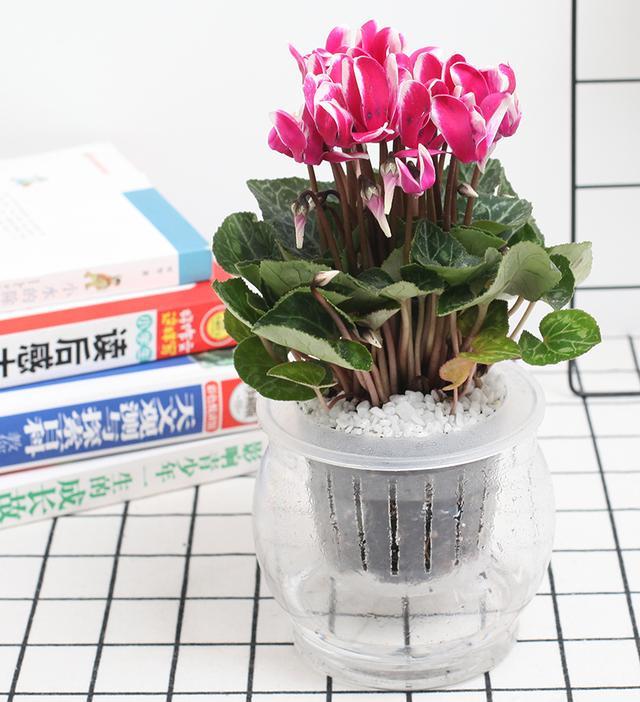
(4) Changing Water At the beginning of hydroponic growing of cyclamen, place the plant in a dark place and change the clean water once every 5 days. After 1 week, new roots can grow at the bottom of the tuber, and at this point it can be moved to a place with sufficient light for care. When the water roots reach more than 5cm, switch to hydroponic nutrient solution for care. The figure shows hydroponic cyclamen.
(5) Pest and Disease Control Hydroponic cyclamen is prone to soft rot and aphid infestation. During the high-temperature season from July to August, if ventilation is poor, soft rot is likely to occur and needs timely prevention. Dense old leaves and dead leaves can be pruned; if aphids are found, kill them promptly and observe at any time for recurrence. [Jishan Huayao]