How can Chinese fir (Cunninghamia lanceolata) plantations be managed to improve wood properties?
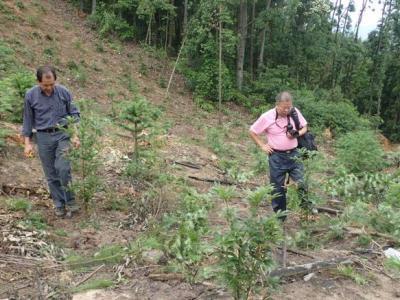
What silvicultural techniques improve the wood properties of Chinese fir?
Chinese fir and Masson pine are coniferous tree species with high-quality, fast-growing timber that are unique to southern China. For a long time, large areas of Chinese fir plantations have been established in the Chinese fir producing regions of the south. Because Chinese fir grows fast, has a short rotation period and consumes many nutrients, its litterfall is sparse and slow to decompose, the litter has low nutrient content, and the woodland has poor self-fertilizing capacity, resulting in soil erosion. Consequently, continuous cropping of Chinese fir leads to soil fertility decline, serious habitat deterioration, a severe drop in stand stability, and a decline in stand productivity with each successive generation. China began to pay attention to the decline in soil fertility of plantations in the 1960s, and Chinese fir plantations were especially prominent in this regard. As people's understanding of forest resources and the ecological environment has deepened, forests are recognized as having the dual role of providing numerous renewable resources and delivering public-benefit functions. The previous practice of establishing plantations dominated by pure coniferous stands has shifted toward establishing mixed coniferous-broadleaf plantations. The construction of mixed coniferous-broadleaf plantation bases was a key forestry project launched in the early 1980s. Through more than 30 years of cultivation and research, mixed coniferous-broadleaf forests have clearly demonstrated their functions and characteristics. According to research both in China and abroad, compared with establishing pure stands, establishing mixed coniferous-broadleaf forests offers advantages such as improving the soil, conserving water, improving wood quality, achieving higher comprehensive woodland productivity, and withstanding disasters better. It also optimizes the structure of forest resources, promotes the diversification of plantation tree species, simulates natural conditions, develops ecological forestry, follows a path of efficient and coordinated sustainable forestry development, and achieves the overall optimal benefits of forestry. Establishing mixed coniferous-broadleaf forests to improve the soil fertility of coniferous woodland and raise woodland productivity and stand stability has become a consensus among forestry workers.
The mechanical properties of wood directly determine its subsequent processing utilization rate. Therefore, raising the level of mechanical processing of wood is crucial for improving the quality of wood products, broadening their application fields, and achieving high value-added utilization. Mixed coniferous-broadleaf forests are to a certain extent beneficial for wood control, and studies have shown that the wood density, shrinkage properties and mechanical strength of tree species in mixed forests are all greater than those in pure forests, and the anatomical characteristics of the wood are good. However, at present, no silvicultural method for improving the wood properties of Chinese fir and similar species has been reported.
(1) Cultivation of superior seedlings: select nearby superior provenances and cultivate high-quality Chinese fir seedlings;
(2) Site preparation and fertilization: select broad plots for site preparation and afforestation. For flat plots with a slope of 15 degrees or less, carry out full site preparation; for sloping plots with a slope greater than 15 degrees, carry out partial site preparation. When carrying out partial site preparation on sloping plots, build contour terraces with a terrace surface width of 2.0-3.0 m, and leave room for machinery to turn around. The length x width x depth specifications for digging planting holes should preferably be 50 x 40 x 40 cm, with a spacing between plants of 2.0-3.5 m. Apply 0.25-0.75 kg of compound fertilizer as base fertilizer per hole according to the soil fertility status of the afforestation site or stand, and backfill with topsoil after fertilization;
(3) Tree species arrangement: in the afforestation site obtained after step (2), plant the high-quality Chinese fir seedlings obtained after step (1) in mixed planting, matching species to site. The mixing method is inter-plant mixing or inter-row mixing of Chinese fir with one or more of Masson pine, Phoebe bournei, red beech (Zelkova serrata), Chinese tulip tree (Liriodendron chinense) and Chinese schima (Schima superba);
Afforestation sites with an elevation below 500 m are hilly land, and the mixing method for hilly land is "3 Chinese fir + 2 Masson pine + 3 Phoebe bournei + 2 red beech" or "7 Chinese fir + 2 red beech + 1 Phoebe bournei", where the numbers represent the proportion of each tree species, totaling 10 parts, that is: mixed planting of 3 plants/row of Chinese fir, 2 plants/row of Masson pine, 3 plants/row of Phoebe bournei and 2 plants/row of red beech, or mixed planting of 7 plants/row of Chinese fir, 2 plants/row of red beech and 1 plant/row of Phoebe bournei;
Afforestation sites with an elevation of 500-800 m are mountainous land, and the mixing method for mountainous land is "8 Chinese fir + 2 Chinese tulip tree" or "6.5 Chinese fir + 2.5 Phoebe bournei + 1 Chinese schima", where the numbers represent the proportion of each tree species, totaling 10 parts, that is: mixed planting of 8 plants/row of Chinese fir and 2 plants/row of Chinese tulip tree, or mixed planting of 6.5 plants/row of Chinese fir, 2.5 plants/row of Phoebe bournei and 1 plant/row of Chinese schima;
(4) Planting: choose to plant on cloudy days or drizzly days during the period from Yushui (Rain Water) to Jingzhe (Awakening of Insects) (Qingming), select 1-year-old seedlings with a seedling height of more than 50 cm, and use the method of one plant per hole for field planting. Carry out pest and disease quarantine before moving the seedlings. When planting, hold the seedling with one hand, place the seedling into the soil hole, cover with half of the soil, then gently lift the small sapling upward so that the root system spreads out, then tread the soil firmly, cover with soil again, and tamp the root area with a hoe so that a small mound 3-5 cm high forms at the base of the seedling. Check the survival of the seedlings 30-40 days after field planting, and replant dead seedlings in time;
(5) Tending management:
① Brush cutting and weeding: in May and September each year, remove weeds that affect tree growth, cut down brush and non-target tree species, and ensure a reasonable supply of light, water, nutrients, air and heat for the trees;
② Tending thinning: tend continuously for ten years. In the first three years, carry out 2-3 times per year of blade tending or hole-shaped hoe tending; after three years, carry out 1-2 times per year of blade tending. When hoe tending, dig out all thatch rhizomes, cut down all brush and vines, remove sprouts, earth up the base, and straighten the trees. Carry out thinning according to the principle of "thinning the small and keeping the large, thinning the inferior and keeping the superior, thinning the dense and keeping the sparse, and keeping uniform distribution". Ensure that design comes first, then marking, then thinning, and put an end to mistaken or omitted thinning, so as to ensure a reasonable nutrient space for the trees. At around 6-8 years, evenly transplant 30-50 living trees with a diameter at breast height of 4-5 cm, and finally retain 50-55 trees per mu for targeted cultivation;
③ Pruning and shaping: in combination with brush cutting and weeding or tending thinning, carry out pruning and shaping during the dormant period of the trees, pruning dead and diseased branches below the crown. The pruning height should not exceed 1/3 of the total tree height, and the pruning cut should be smooth without damaging the bark. For red beech, implement staking to straighten the trunk and pruning [Jishan Huayao] during the first five years;
④ Topdressing: open a half-moon-shaped trench on the upper bank above the tree, evenly scatter compound fertilizer and cover with soil. Apply fertilizer once in the spring of that year, and thereafter apply fertilizer once each spring every 3-5 years, mainly compound fertilizer, and clear weeds before each fertilization;
(6) Archive and information management: establish a professional archive management system, and create dedicated files for all technical, management and financial materials related to project planning and design, implementation plans and operation designs, quality tracking, inspection and acceptance, use of funds, and effectiveness monitoring, and gradually improve project archive management.
, by inter-plant mixing or inter-row mixing of Chinese fir with one or
several of Masson pine, Phoebe bournei, red beech, Chinese tulip tree and Chinese schima, the competition between Chinese fir and other tree species is intensified, and broadleaf species such as Phoebe bournei, red beech, Chinese schima and Chinese tulip tree decay more easily than Chinese fir needles to form humus, which is rich in various mineral nutrients. After these mineral nutrients are absorbed by Chinese fir and accumulated in the wood of the trunk, the wood properties of Chinese fir are improved. Compared with traditional pure Chinese fir woodland, the basic density of the Chinese fir trunk increased by 8.16%-9.27%, the fiber length increased by 1.32%-2.54%, the fiber width increased by 1.83%-2.61%, the bending strength increased by 36.91%-79.39%, the modulus of elasticity in bending increased by 63.87%-90.7%, and the compressive strength parallel to grain increased by 14.44%-27.48%.