Detailed Explanation of the Classification Methods for Ornamental Peony Cultivars
What are the classifications of ornamental peony cultivars?
Peony flowers are brilliantly colored and magnificent, and have long enjoyed the reputation of "king of flowers." At the same time, because peony flowers are large and fragrant, they are also known as "national beauty and heavenly fragrance." China currently has thousands of peony cultivars. These cultivated cultivars can be classified according to plant type, flower color, petal shape, leaf shape, root type, and so on, with classification by plant type, flower color, and petal shape being the most common. There are many peony cultivars and also many colors. Yellow, green, flesh red, deep red, and silver red are considered superior, with yellow and green especially prized. Among them, Yao Huang, Wei Zi, Dou Lu, and Zhao Fen are called the four famous cultivars. Below, peony cultivars are classified respectively by plant type, petal shape, and flower color.
I. Classification by Plant Type
(1) Upright type
The branches are upright, straight, and relatively tall, compactly distributed, with a small spreading angle; the angle between the branches and the vertical line is mostly within 30 degrees. The internodes are relatively long, and the annual growth of new branches is 10-15 cm. Generally, a five-year-old plant is 40-50 cm tall, and taller ones reach more than 1 m. Examples include 'Shou An Hong', 'Zi Er Qiao', 'Yao Huang', and others.
Yao Huang
(2) Spreading type
The branches are mostly spreading, curved, and extend in all directions, with the plant width greater than the plant height, forming a low, spreading plant shape. When the branches spread, the angle with the vertical line is mostly more than 45 degrees, and the new branches are long and relatively soft. Examples include 'Zhao Fen', 'Shou Zhong Hong', 'Shan Hua Lan Man', 'Qing Long Wo Mo Chi', and others.
Zhao Fen
(3) Single-trunk type
Mostly artificially cultivated artistic forms, with an obvious trunk. The trunk height varies, generally 20-80 cm. The upper part of the trunk produces several branches, forming a crown (some have no crown). The form is antique and elegant, much like a bonsai, and growth is relatively slow. Generally, the shaping period requires more than 8 years. Examples include 'Shi Ba Hao' and others.
Shi Ba Hao
(4) Open type
The branches grow robustly and upright, extending diagonally in all directions, with an angle between the above two types. The plant shape is full and upright, with moderate height. The annual growth of new branches is 6-8 cm. Generally, a five-year-old plant is 30-40 cm tall. Examples include 'Zhuang Yuan Hong', 'Yin Hong Qiao Dui', 'Jin Yu Jiao Zhang', and others.
(5) Dwarf type
The branches grow slowly, with short internodes and dense leaves. The branches are compact, short, and small. The annual growth of new branches is 2-4 cm. Generally, a five-year-old plant is about 15 cm tall. Representative examples include 'Mei Ren Hong', 'Luo Han Hong', 'Hai Yun Zi', and others.
II. Classification by Flower Type
According to flower type, peonies can be divided into 10 categories: single-petal type, lotus type, chrysanthemum type, rose type, osmanthus type, golden-ring type, crown type, hydrangea type, thousand-layer terrace type, and tower terrace type.
(1) Lotus type
Petals in 4-5 whorls, 20-25 pieces. The petals are broad and large, similar in shape and size, clearly arranged, with normally developed pistils and strong seed-setting ability, but individual cultivars occasionally show petalization of stamens or pistil stigmas. Representative cultivars of this flower type include 'Si He Lian', 'Jin Yun Hong', 'Yu Ban Bai', and others.
Si He Lian
(2) Single-petal type
Petals in 2-3 whorls, 10-15 pieces, broad, large, and flat. There are 200-300 stamens and 4-6 pistils. The stamens and pistils develop normally, and seed-setting ability is strong. Representative cultivars of this flower type include 'Ya Pian Zi', 'Shi Liu Hong', 'Feng Dan Bai', and others.
(3) Crown type
Outer petals in 2-5 whorls, broad, large, and flat. Most or all stamens are petalized into finely fragmented, curved, and wrinkled petals. The petal mass is dense and towering, shaped like a crown. Inner petals are irregularly arranged, often mixed among the petals with normal stamens or degenerating stamens, and anthers often remain among the petals. Pistils degenerate or become petalized, occasionally setting seed. Representative cultivars of this flower type include 'Lan Tian Yu', 'Hu Hong', 'Yao Huang', 'Shou An Hong', and others.
Hu Hong
(4) Chrysanthemum type
Petals in more than 6 whorls. The petal shape is similar, neatly arranged, with distinct layers, gradually becoming smaller from outside to inside, and occasionally petalized. There are 5-11 pistils, growing normally or degenerating and becoming smaller. In some cultivars the stigmas show petalization, and seed-setting ability is relatively poor. Representative cultivars of this flower type include 'Mei Gui Hong', 'Cong Zhong Xiao', 'Yin Hong Qiao Dui', 'Jin Pao Hong', and others.
Cong Zhong Xiao
(5) Hydrangea type
The stamens are fully petalized, and the inner and outer petals are similar in shape and size, crowded and raised, forming a spherical shape. The pistils are basically or entirely degenerated or petalized, with no seed-setting ability. Representative cultivars of this flower type include 'Dou Lu', 'Lu Xiang Qiu', 'Xue Ying Zhao Xia', and others.
(6) Rose type
Petals in many whorls, gradually becoming smaller from outside to inside. Some stamens are petalized into normal petals, and the pistils degenerate and become smaller or become petalized, with poor seed-setting ability. Representative cultivars of this flower type include 'Zi Er Qiao', 'Wu Jin Yao Hui', 'Hong Xia Zheng Hui', and others.
(7) Golden-ring type
Outer petals in 2-3 whorls, broad, large, and flat. In the center of the flower, some stamens are petalized into narrow, long, upright large petals. Between the central petals and the outer whorl petals there is a ring of normal stamens forming a golden ring shape. The pistils are normal or slightly petalized, and seed-setting ability is poor. This flower type is very rare. Representative cultivars include 'Bai Tian E', 'Jun Yan Hong', 'Fen Mian Tao Hua', 'Yu Mei Ren', and others.
(8) Tuo Gui type
Outer petals in 2-5 whorls, broad, large, and neat. Some stamens are petalized into slender petals, and anthers or anther traces often remain at the petal tips. Normal stamens are mixed among the petals, irregularly and sparsely arranged. The pistils are normal or slightly petalized, with seed-setting ability. Representative cultivars of this flower type include 'Shu Nü Zhuang', 'Jiao Hong', 'Xian E', 'San Bian Sai Yu', and others.
(9) Tower terrace type
The stamens of the lower flower are relatively fully petalized and similar in shape to normal petals, and the pistils are petalized into normal petals or colored petals. The petals of the upper flower are slightly larger and fewer in number, and the stamens are basically all petalized or degenerated. The pistils are petalized into normal petals or colored petals, and in some cultivars they degenerate and disappear. Representative cultivars of this flower type include 'Chi Long Huan Cai', 'Sheng Dan Lu', 'Yu Lou Dian Cui', 'Zi Chong Lou', and others.
(10) Thousand-layer terrace type
The lower petals are in more than 4 whorls, neatly arranged and similar in shape, with no stamens or degenerated stamens mixed among the petals. The stamens are normal and few in number, or occasionally petalized, and the pistils degenerate and become smaller or become petalized. The upper petals are few in number, flat or upright, the stamens are few and become smaller, and the pistils degenerate and become smaller or become petalized. Representative cultivars of this flower type include 'Ling Hua Zhan Lu', 'Zhi Hong', 'Shou Xing Hong', and others.
III. Classification by Color
The flower colors of peonies are extremely rich, including red, orange, yellow, green, cyan, blue, purple, as well as purplish red, pink, white, black, and bicolor, and so on. They are usually divided into the following nine major categories:
(1) Bicolor category
Representative cultivars include 'Er Qiao', 'Shi Yang Jin', 'Jiao Rong San Bian', 'Dou Yan', 'San Bian Sai Yu', 'Ma Nao He Hua', 'Cai Die', 'Hua Hu Die', and others.
Er Qiao
1. Er Qiao, also known as Luoyang Jin, is a traditional treasure of Luoyang peonies and ranks first among the bicolor series. Deciduous shrub. The plant can reach 2 m tall, upright. The branches are relatively thin and hard, with relatively long internodes. Medium-sized round leaves, usually bipinnately trifoliolate compound leaves, green on the surface, hairless, light green on the back, sometimes with white powder. Flowers are solitary at the branch tips; bracts 5, oblong, unequal in size; sepals 5, green, broadly ovate, unequal in size. The flower is rose type, the bud is oblate, and the flower is bicolor. The same plant and the same branch can bear both purplish red and pink flowers; the same flower can also bear intermingled purple and pink colors, brilliantly colored.
(2) Green category
Representative cultivars include 'Dou Lu', 'Lu Xiang Qiu', 'Chun Shui Lu Bo', 'Lu Yu', and others.
1. 'Dou Lu' is one of the four famous peony cultivars, with medium growth vigor, a high flowering rate, and many adventitious shoots. Deciduous shrub. The stem reaches 2 m tall; the branches are short and thick. The leaves are usually bipinnately trifoliolate compound leaves, and the terminal leaflets are broadly ovate, green on the surface, hairless, light green on the back, sometimes with white powder, sparsely short-pubescent or nearly hairless along the veins. Flowers are solitary at the branch tips; bracts 5, oblong, unequal in size; sepals 5, green, broadly ovate, unequal in size; the flower is double, crown type or hydrangea type. The bud is round, and the tip often splits open; the flower is yellow-green, with an irregularly wavy tip; the upper part of the filaments is white, the anthers are oblong, and the disc is leathery, cup-shaped, and purplish red; flowering period is May; fruiting period is June.
Dou Lu
(3) Yellow category
Representative cultivars include 'Yao Huang', 'Jin Gui Piao Xiang', 'Yu Xi Ying Yue', 'Huang Hua Kui', 'Jin Yu Jiao Zhang', 'Yu Yi Huang', and others.
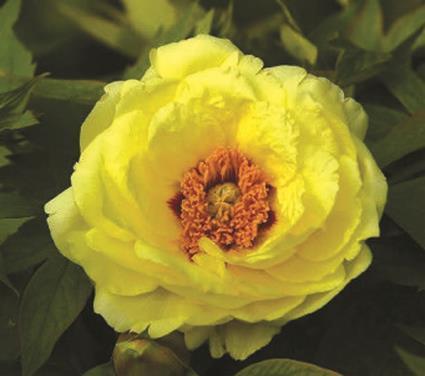
1. 'Yao Huang' (see the lead image) is one of the four famous peony cultivars and originated in the home of Tang Dynasty chancellor Yao Chong. It is a mid-season cultivar with relatively strong growth, a high flowering rate, neat flowering, and full flower form. The ancients praised it as the "king of flowers." It is a deciduous shrub with an upright plant shape, thin and hard branches, and short and thick branchlets. The leaves are usually bipinnately trifoliolate compound leaves, and the terminal leaflets are broadly ovate, green on the surface, hairless, light green on the back, sometimes with white powder. Flowers are solitary at the branch tips; bracts 5, oblong, unequal in size; sepals 5, green, broadly ovate, unequal in size; the flower is crown type, sometimes golden-ring type. The bud is round and pointed, and the tip often splits open; the flower is pale yellow; the upper part of the filaments is white, the anthers are oblong, and the disc is leathery, cup-shaped, and purplish red; flowering period is May; fruiting period is June.
(4) Ink-purple category
Representative cultivars include 'Qing Long Wo Mo Chi', 'Guan Shi Mo Yu', 'Yan Rong Zi', 'Mo Lou Zheng Hui', 'Wu Jin Yao Hui', 'Hei Hua Kui', and others.
1. 'Qing Long Wo Mo Chi' is a famous peony cultivar. Deciduous shrub with a spreading plant clump and luxuriant branches and leaves. The leaves are thick and round, thick in texture, and the leaflets are ovate with few and blunt notches. The leaf surface is green with a purple tinge. The flower is light ink-purple, Tuo Gui type, sometimes crown type. The clearly darkened, broad, and rounded two whorls of outer petals at the base surround the finely fragmented and curled inner petals. The pistil in the very center is petalized into blue-green, narrow, long, curled colored petals, surrounded by multiple layers of ink-purple petals, resembling a blue dragon lying in the center of an ink pool, hence the name Qing Long Wo Mo Chi. It has high ornamental value, vigorous growth, and many flowers.
Qing Long Wo Mo Chi
2. 'Guan Shi Mo Yu' has the laudatory title of "leader of black flowers." Mid-season cultivar. The plant shape is medium-tall and compact, with few branches, upright, and also few adventitious shoots. The branches are relatively sturdy, and the one-year-old branches are relatively short, light purple, with short internodes. The scaly buds are large, round and pointed. Medium-sized round leaves, thick but soft in texture, relatively dense; the total petiole is about 11 cm long, relatively thick and soft; the leaflets are ovate, with many notches, short-pointed tips, drooping, rough leaf surface, dark green. Medium growth vigor, high flowering rate, crown type, sometimes Tuo Gui type. The bud is round and pointed; the flower is ink-purple and glossy; flower diameter 17 cm x 8 cm. Outer petals in 3-4 whorls, hard in texture, with ink-colored spots at the base; inner petals folded and overlapping, tight, with a small amount of stamens mixed among the petals; pistils degenerate and become smaller or become petalized.
Guan Shi Mo Yu
(5) Pink category
Representative cultivars include Zhao Fen, Lu Fen, Fen Zhong Guan, Tao Hua Fei Xue, Gui Fei Cha Cui, Xue Ying Tao Hua, Ruan Yu Wen Xiang, Shu Nü Zhuang, Fen He Piao Jiang, Yin Lin Bi Zhu, Sheng Dan Lu, Qing Long Wo Fen Chi, and others.
1. Zhao Fen is one of the four famous peony cultivars. Deciduous shrub. The plant shape is medium-tall and spreading. The branches are short and thick, relatively soft and curved, and the one-year-old branches are long and light green. The leaves are usually bipinnately trifoliolate compound leaves, and the terminal leaflets are broadly ovate, green on the surface, hairless, light green on the back, sometimes with white powder, sparsely short-pubescent or nearly hairless along the veins. Flowers are solitary at the branch tips; bracts 5, oblong, unequal in size; sepals 5, green, broadly ovate, unequal in size; the petals are double, and the flower is crown type, sometimes lotus type, golden-ring type, or Tuo Gui type. The bud is large, round and pointed; the flower is pink. The upper part of the filaments is white, the anthers are oblong, and the disc is leathery, cup-shaped, and purplish red; flowering period is May; fruiting period is June.
(6) White category
Representative cultivars include Li Hua Xue, Ye Guang Bai, Jing Yu, Xiang Yu, Jin Xing Xue Lang, Liu Li Guan Zhu, Xue Ta, Bai Yu, Xue Gui, Kun Shan Ye Guang, Yu Lou Dian Cui, Yu Ban Bai, Xue Lian, Shui Jing Bai, Bai He Yu, Feng Dan Bai, Shui Jing Qiu, Feng Dan Bai, Yu Ban Bai, Qing Xiang Bai, and others.
1. Li Hua Xue is a deciduous shrub with a dwarf and spreading plant shape. The branches are slender and weak. The leaves are usually bipinnately trifoliolate compound leaves, and the terminal leaflets are broadly ovate, green on the surface, hairless, light green on the back, sometimes with white powder, sparsely short-pubescent or nearly hairless along the veins. Flowers are solitary at the branch tips; bracts 5, oblong, unequal in size; sepals 5, green, broadly ovate, unequal in size; the flower is crown type. The bud is round and pointed; the flower is white; the anthers are oblong, the disc is leathery, cup-shaped, and purplish red; carpels 5, densely pubescent. Flowering period is May; fruiting period is June.
Li Hua Xue
(7) Pink-blue (purple) category
Representative cultivars include Jiu Zui Yang Fei, Lan Tian Yu, Zi Lan Kui, Lan Bao Shi, Ling Hua Zhan Lu, Chui Tou Lan, Zhu Sha Lei, Xiu Tao Hua, Yu Hou Feng Guang, Cai Hui, Da Duo Lan, Si He Lian, Lan Fu Rong, Lu He Hong, and others.
1. Jiu Zui Yang Fei is a precious peony cultivar. Deciduous shrub, with new branches green with a purple tinge, and branches short and thick. The buds are round and pointed. The leaves are usually bipinnately trifoliolate compound leaves, and the terminal leaflets are broadly ovate, green on the surface, hairless, light green on the back, sometimes with white powder, sparsely short-pubescent or nearly hairless along the veins. Flowers are solitary at the branch tips. Because the plant's branches are soft and the flower heads droop, with a delicate drunken posture, it is named "Jiu Zui Yang Fei." Bracts 5, oblong, unequal in size; sepals 5, green, broadly ovate, unequal in size; the flower is lotus type or Tuo Gui type, occasionally crown type. The flower is pink-purple. The upper part of the filaments is white, the anthers are oblong, and the disc is leathery, cup-shaped, and purplish red; flowering period is May; fruiting period is June.
Jiu Zui Yang Fei
2. Lan Fu Rong is a mid-season cultivar, deciduous shrub. The stem is tall and the branches are short. The leaves are usually bipinnately trifoliolate compound leaves, and the terminal leaflets are broadly ovate, green on the surface, hairless, light green on the back, sometimes with white powder, sparsely short-pubescent or nearly hairless along the veins. Flowers are solitary at the branch tips; bracts 5, oblong, unequal in size; sepals 5, green, broadly ovate, unequal in size; the flower is thousand-layer terrace type. The bud is oblate. The flower is pink-purple, with an irregularly wavy tip; the upper part of the filaments is white, the anthers are oblong, and the disc is leathery, cup-shaped, and purplish red; carpels 5, densely pubescent. Flowering period is May; fruiting period is June.
Lan Fu Rong
(8) Purple category
Representative cultivars include Sheng Ge Jin, Wei Zi, Zhao Zi, Ge Jin Zi, Xiao Wei Zi, Zi Kui, Shen Hei Zi, and others.
1. Ge Jin Zi is one of the traditional precious peony cultivars. Deciduous shrub. The stem is tall and the branches are short. The leaves are usually bipinnately trifoliolate compound leaves, and the terminal leaflets are broadly ovate, green on the surface, hairless, light green on the back, sometimes with white powder, sparsely short-pubescent or nearly hairless along the veins. Flowers are solitary at the branch tips; bracts 5, oblong, unequal in size; sepals 5, green, broadly ovate, unequal in size; the petals are double, purple in color, hydrangea type, with an irregularly wavy tip; the upper part of the filaments is white, the anthers are oblong, and the disc is leathery, cup-shaped, and purplish red. Flowering period is May; fruiting period is June.
Ge Jin Zi
2. Mo Kui has a medium-tall, spreading plant shape. The branches are sturdy and curved, the one-year-old branches are relatively short, and the internodes are short; the scaly buds are fat and large. Round and pointed. Large round leaves, fat and large, thick in texture; the total petiole is about 14 cm long, sturdy, and horizontally extended; the leaflets are broadly ovate, with shallow notches, blunt tips, rough leaf surface, dark green, with a deep purple tinge. Strong growth vigor, high flowering rate, and large, full flowers. The flower is purple; flower diameter 17 cm x 9 cm. The outer petals are in 2 whorls, large in shape and relatively hard in texture, with ink-purple spots at the base; the inner petals are wrinkled, often with residual anthers at the tips, tight, raised, and the whole flower resembles a hydrangea; the pistils degenerate or become petalized. The pedicel is relatively soft, and the flower opens to the side. Mid-season cultivar. Few branches, and very few adventitious shoots.
3. Wei Zi is one of the four famous peony cultivars and originated in the home of Wei Renbo, a chancellor of Luoyang during the Five Dynasties period. Mid-season cultivar. Richly fragrant, and known as the "queen of flowers." The plant shape is medium-tall, semi-spreading, beautiful and elegant. The branches are relatively sturdy, the one-year-old branches are relatively short, and the internodes are relatively short. Medium-sized round; the leaflets are ovate, with many notches, blunt tips, with a light purplish red tinge along the edges, sunken veins, rough leaf surface, dark green. Strong growth vigor, high flowering rate, many branches, and many adventitious shoots. The flowers of this cultivar are huge, layered and towering, shaped like a crown, crown type. The bud is oblate; the flower is gorgeous, purple, with pinkish white petal tips, slightly glossy; flower diameter 18 cm x 12 cm. There are many petals, with 3 whorls of outer petals, large in shape and hard in texture; the inner petals are finely fragmented, upright and folded, thick and relatively hard in texture, densely curled and wrinkled. The pedicel is thick and hard, and the flower is upright.
Wei Zi
(9) Purplish red category
Representative cultivars include Zhu Sha Hong, Hong Xia Zheng Hui, Hong Xia Ying Ri, Jin Pao Hong, Wu Long Peng Sheng, Cang Zhi Hong, Bai Yuan Hong Xia, Ying Jin Hong, Da Zong Zi, Shou An Hong, Zhuang Yuan Hong, Pan Zhong Qu Guo, Jin Xiu Qiu, Luoyang Hong, and others.
1. Zhu Sha Hong opens a brilliant purplish red, glossy, and near fading becomes purplish red, rose type, with sparse petals and normal stamens remaining among the petals. The outer petals are large, and the inner petals are slender and twisted. Near the pistils in the flower center there are fringed petals. Between the inner and outer petals there is a ring of normal stamens. There are 5-7 pistils, normal or petalized, with purplish red stigmas and a purplish red ovary covering. The flower is relatively large, with a flower diameter of 18 cm, and the flower is level with or slightly lower than the leaf surface. Mid-season cultivar. Large long leaves, thick and fleshy, dark green with a purple tinge, slightly rolled upward and concave. New branches are light red. The plant is semi-spreading type, with vigorous growth and strong branching ability [Jishan Hua Yao].
2. Luoyang Hong originated in the Tang Dynasty and is the only peony cultivar named after Luoyang. Deciduous shrub. The plant shape is tall and upright. The branches are relatively thin and hard. The leaves are broadly ovate, green on the surface, hairless, light green on the back, sometimes with white powder, sparsely short-pubescent or nearly hairless along the veins. Flowers are solitary at the branch tips; bracts 5, oblong, unequal in size; sepals 5, green, broadly ovate, unequal in size; the flower is rose type. The bud is round and pointed. The flower is purplish red and glossy. The upper part of the filaments is white, the anthers are oblong, and the disc is leathery, cup-shaped, and purplish red; flowering period is May; fruiting period is June.
Zhu Sha Hong
Luoyang Hong
(10) Red category
Representative cultivars include Huo Lian Jin Dan, Shan Hu Tai, Cong Zhong Xiao, Chen Hong, Jiao Hong, Ping Shi Yan, Jin Zhang Fu Rong, Ying Ri Hong, Shi Ba Hao, Ni Hong Huan Cai, Hong Bao Shi, Hong Tu, Shan Hua Lan Man, Zhi Hong, Ming Xing, Chun Hong Jiao Yan, Rou Fu Rong, Yu Ji Yan Zhuang, Fei Yan Hong Zhuang, Yin Hong Qiao Dui, Hu Hong, Hong Zhu Nü, Ying Luo Bao Zhu, and others.
1. Huo Lian Jin Dan, also called "Zhong Sheng Hong," has a flower type belonging to the tower terrace type. It has relatively few flowers and is not easy to propagate. After opening, the flower is hidden beneath the leaves. The flower color is delicate and lustrous, almost the same as the red on the national flag, so it is also called "national flag red." The branches are relatively sturdy, the one-year-old branches are short, and the internodes are also short. Medium-sized round leaves, thick in texture, dense. The total petiole is about 9 cm long, thick and hard, horizontally extended; the leaflets are ovate, with few notches, short-pointed tips, upward-rolled edges, and yellow-green leaf surface. Medium growth vigor, a relatively low flowering rate, and bright flower color. However, the flower shape is irregular, with few adventitious shoots and a compact plant shape.
Huo Lian Jin Dan
2. Ni Hong Huan Cai is a deciduous shrub. The plant shape is tall and semi-spreading. The branches are sturdy. The leaves are usually bipinnately trifoliolate compound leaves, and the terminal leaflets are broadly ovate, green on the surface, hairless, light green on the back, sometimes with white powder, sparsely short-pubescent or nearly hairless along the veins. Flowers are solitary at the branch tips; bracts 5, oblong, unequal in size; sepals 5, green, broadly ovate, unequal in size; the flower belongs to the thousand-layer terrace type. The bud is round, and the tip often splits open; the flower is carmine; the upper part of the filaments is white, the anthers are oblong, and the disc is leathery, cup-shaped, and purplish red; flowering period is May; fruiting period is June.
Ni Hong Huan Cai