The Pinellia cordata grows where water drips
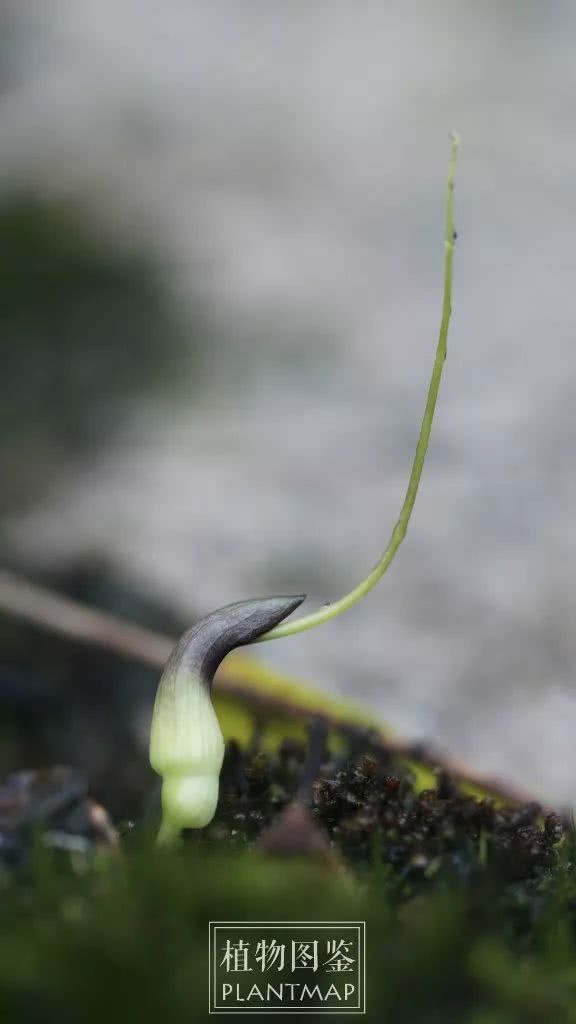
The Pinellia cordata is a very cool plant, it is a snake monster sticking out its tongue on a moist rock wall.
[Pinellia cordata] Araceae >> Pinellia
The Pinellia cordata is an Araceae plant, its flower is very Araceae, and it is very similar to the "boss" of the same genus, Pinellia ternata.
Pinellia ternata is a very common plant, it is everywhere near the Hangzhou Botanical Garden, and is most commonly seen in the bamboo garden. It is also easy to see in the West Lake mountains.
The flower of Pinellia ternata is already very bizarre! At the top of the long, creeping flower stem, the spathe holds its head high, spitting out a tendril from inside, trembling randomly with the breeze... No matter how you look at it, it is not a good-natured thing. (See the Pinellia ternata post for details)
The picture shows Pinellia ternata
And when this kind of oddity appears in the more mysterious deep mountains, their impactful shape becomes even more fascinating. The Pinellia cordata fascinates me like this, it is a snake monster sticking out its tongue on a deep mountain rock wall, an extremely long tongue, stirring my heart.
Compared with Pinellia ternata, the spathe of Pinellia cordata is shorter and smaller, but the appendix (that is, the tongue) is very long
Its name is one of the most outstanding examples of plant naming.
First, it explains the habitat and morphology. The Pinellia cordata grows on dripping rock walls, the rock walls covered with moss, dark and moist, even in the hottest summer, water droplets drip continuously.
Where water drips, the Pinellia cordata grows, its small leaves also look quite like green water droplets. However, after the leaves grow up, two corners will grow at the base, making them more like shields rather than water droplets.
Second, it explains the plant's characteristic - it has bulbils.
Bulbils are one of the plant's reproduction methods, other plants such as Sedum bulbiferum and Lilium lancifolium also have them, and they can be sown directly to produce plants just like seeds.
The Pinellia cordata also has bulbils, and a bulbil will grow at the tip of the leaf as well as at the base. When the leaf grows up, the bulbils will fall off. I once picked a small piece of a Pinellia cordata leaf and a few bulbils and took them home, and the next year they grew like this.
However, its speed of growing into an explosive head is also very fast...
Bulbils grow on the Pinellia cordata, and the shape of the bulbil also looks very much like a drop of water.
Of course, in addition to the descriptive function, the name Pinellia cordata also achieves an implied artistic conception.
Artistic conception is something that cannot be spoken, or perhaps I cannot speak it. But if you see the Pinellia cordata in the wild, you will certainly be moved by this plant and this name.
Author: Jiang Mouren
Images: Jiang Mouren
This work is licensed under the (CC BY-NC-ND 4.0) license agreement
Please retain the above statement when reposting
iPhone users can tip the author via the QR code below