Plant one pot of it in the courtyard: it prevents colds in spring, clears internal heat in summer, and fills the whole yard with fresh fragrance.
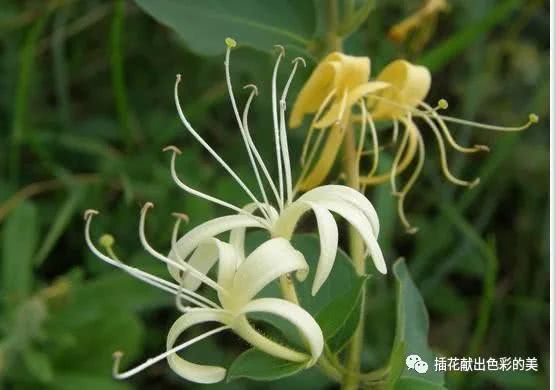
Honeysuckle (Japanese honeysuckle, Lonicera japonica) belongs to the Caprifoliaceae family and is a perennial semi-evergreen twining woody vine. The name "honeysuckle" comes from the Compendium of Materia Medica; because the flowers of Japanese honeysuckle open white at first and later turn yellow, it got the name honeysuckle. The medicinal material honeysuckle is the dried flower buds or just-opening flowers of Lonicera japonica and plants of the same genus in the Caprifoliaceae family. Also, because one stem bears two flowers, with the two stamens extending outward, forming pairs and never separating, like a male and female accompanying each other, and also like mandarin ducks dancing in pairs, it is also called mandarin duck vine.
Fragrant honeysuckle has been a traditional Chinese medicine since ancient times and enjoys the reputation of "little immortal of the pharmacy." Honeysuckle is sweet in nature, cold, and aromatic; since ancient times it has been praised as a good medicine for clearing heat and detoxifying. In the well-known Chinese patent medicine Shuanghuanglian, the "shuang" refers to the two-colored flower - honeysuckle, and the "yin" in Yinqiao Jiedu Tablets refers to honeysuckle.
The flowering period of honeysuckle is generally from April to June in summer; during this period honeysuckle blooms most vigorously, and the quality of the flowers is also the best. In autumn honeysuckle will also bloom, followed by the ripening of the fruit. The fragrance of honeysuckle is fresh and elegant; when the flowers first open they are pure white, and the fragrance is the strongest; the next day they turn yellow, and the fragrance gradually fades. Because honeysuckle flowers have a long flowering cycle, planting one pot of honeysuckle in the courtyard brings elegant fragrance drifting about and fills the whole yard with scent.
Honeysuckle is refreshing and delightful, and its flowers, stems, leaves, and vines can all be used as medicine. The most commonly used is honeysuckle flower tea. Drinking honeysuckle as tea originated in the Qing Dynasty. In the "honeysuckle" entry of Ben Cao Qiu Zhen it says: "In Jiangnan, this is used as a substitute for tea." The Illustrated Guide to the Names and Realities of Plants records: "In Wu region during the summer months, the flowers are put into tea and drunk; tea shops value newly trafficked honeysuckle, all produced in the Central Plains." Honeysuckle tea is sweet in taste and cold in nature, and has the effects of clearing heat and detoxifying, soothing and benefiting the throat, and relieving summer heat and irritability.
Effects of honeysuckle:
1. Antiviral and anti-inflammatory
Drinking honeysuckle steeped in water has a good inhibitory effect on various viruses, including various fungi, and has a clear inhibitory effect on typhoid colds and festering wounds. Honeysuckle steeped in water can promote the transformation of lymphocytes and enhance the phagocytic function of white blood cells, thereby achieving the effect of improving immunity. It has a certain effect in preventing colds.
2. Clearing heat and reducing internal fire
Summer is hot and autumn air is dry, making it easy to get internal heat. Honeysuckle has a certain effect in clearing heat and reducing internal fire. Honeysuckle has a good improving effect on people with excessive internal fire, and has a good therapeutic effect on symptoms such as mouth and tongue sores and dry mouth and tongue caused by internal heat.
3. Dispersing wind-heat
Honeysuckle is light in texture, sweet and cold, and its fragrance is aromatic and dispersing; it can both clear heat and detoxify, and disperse wind-cold. It can be used for exterior syndromes due to exogenous wind-heat and for the treatment of warm diseases at all stages of wei, qi, ying, and blood. In addition, honeysuckle also has the effect of clearing and relieving summer heat; in summer, decocting it in water as a substitute for tea or using honeysuckle dew can relieve summer heat and treat conditions such as exogenous summer-heat.
Notes on planting honeysuckle
Honeysuckle likes sunlight and tolerates shade; light must be sufficient, and it must not be placed in a shady place; ventilation should be timely and regular. It is not strict about soil requirements, but grows best in moist, fertile, deep sandy loam, yet the soil needs to have sufficient phosphate fertilizer. Prune in time; during the growth period of honeysuckle, pruning work should also be done well. Pruning branches and buds, as well as pruning unhealthy growing branches and buds, will also affect flowering.