This fruit is often mistaken for a mango; city dwellers dare not eat it, yet some call it super delicious
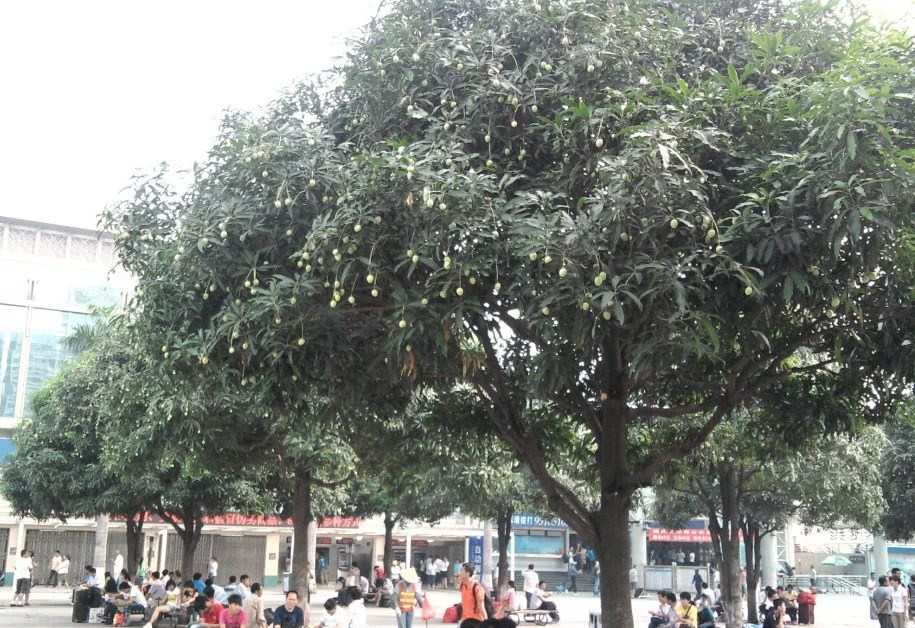
In some southern cities in our country, such as Guangzhou, Foshan, Nanning and other places, in the early days of development in the last century, there was an urban greening practice of "fruit on the streets," which meant planting fruit trees as roadside greening trees. So today in these cities, you can often see very tall fruit trees. Among them, the most common greening variety is none other than the mango tree. Every summer, the fruit trees on the streets are laden with fruit, making food lovers drool. For food lovers, the thing they care about most is simply whether these mangoes can be picked and eaten?
First, one thing must be made clear: the greening "mangoes" in the city are actually not the mangoes commonly seen on the market, but a fruit called "almond" (wild almond, Irvingia gabonensis). The almond is often mistaken for a mango, mainly because its appearance is extremely similar to that of a mango. If you are not a local, you basically cannot tell the difference between them. Mangoes are delicious, everyone knows that, but almonds are not necessarily good to eat. Especially the almond trees planted in the city, which absorb large amounts of car exhaust, dust, heavy metals and other pollutants, city dwellers dare not eat them. Occasionally when someone is seen picking almonds, they are also discouraged by bystanders from picking them.
There is another point: in order to prevent pests and diseases from causing adverse effects on the urban environment, workers regularly spray insecticide on the almond trees. These insecticides are different from those sprayed on other fruit trees, because there is no need to consider the issue of consumption, so they are very likely to contain more pesticide residues, and people are not advised to eat them. Some of these almonds in the city are fed to birds on the trees, and some, after ripening, fall down and are hauled away as garbage. So in the city, very few people have eaten almonds. In fact, almonds taste pretty good!
No one in the city dares to eat the almonds, but in the countryside the almonds are regarded as super delicious. The almond trees planted by farmers themselves are mostly kept for their own family to eat, so there is no danger of pesticide residues, and they can be eaten with peace of mind. When ripe, the almond is soft and juicy, with a strong fragrance and a sweet-and-sour, tasty flavor. The almond also has certain medicinal value: it can strengthen the spleen and regulate qi, promote digestion, and also treat cough with excessive phlegm. Local farmer friends will pick not-fully-ripe almonds to "pickle sour," that is, curing them with salt, green plums, ginger and so on. After pickling, they are sweet-and-sour and crisp, very delicious.
Of course, the simplest way is to pick fully ripe almonds and eat them. The method of eating is much the same as with mangoes; just peel and eat. The almond is only as big as an egg, and when eating them it is easy to keep going one after another without stopping. Dear readers, have you ever eaten them?