The king of vitamin C, Rosa roxburghii is covered in spines and hard to bite into; eating one is equivalent to 600 apples
Friendly reminder
Hemu Report aims to share and popularize information about various plants and their uses, for reference only. If medicinal use is needed, it is recommended to consult a professional doctor to avoid problems!
When it comes to fruits with high vitamin C content, many people immediately think of kiwi, after all, it is the long-established "king of vitamin C". But in rural areas there is a wild fruit whose vitamin C content is even higher than that of kiwi, hundreds of times greater. However, very few people know about this wild fruit, mainly for two reasons. First, it mainly grows in the Yunnan-Guizhou area and is rarely seen elsewhere. Second, this wild fruit is covered in spines from head to toe, making it hard to bite into, so it cannot be popularized as a fruit across the country. Have you ever seen this wild fruit?
This wild fruit is called "Rosa roxburghii" (chestnut rose), and it is highly praised in various ancient Chinese texts. The "Guiyang Prefecture Gazetteer" records in detail how to eat Rosa roxburghii: "Making wine by mixing Rosa roxburghii with glutinous rice gives a sweet taste that aids digestion." In Guizhou, during the Rosa roxburghii ripening season, people pick large quantities of the fruit to make wine. Rosa roxburghii wine is sweet with a lingering aftertaste, mellow in flavor, and has health benefits such as strengthening the stomach, aiding digestion, promoting qi circulation and relieving pain. During the Ming and Qing dynasties, Rosa roxburghii wine was even transported to the capital for sale and was favored by the nobility. Unfortunately, wild Rosa roxburghii resources are now much scarcer, and in Guizhou, the Rosa roxburghii wine brewed by farmers is all for their own consumption.
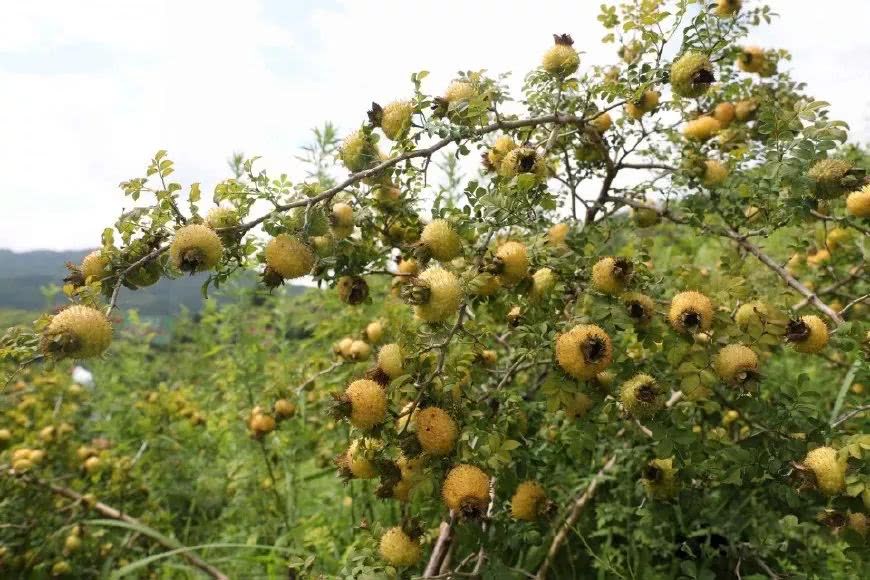
Rosa roxburghii, just as its name suggests, is covered in spines from head to toe, even its branches are spiny. Although its branches do not grow tall, the tree shape is very bushy, and you must be very careful when picking, otherwise you will get pricked by a spine if you are not paying attention. The ripening season of Rosa roxburghii is August to September. When ripe, the fruit is yellow, and some fully ripe ones have a slight red tinge, with an extremely strong fragrance. When eating, remove the spiny outer skin and the seeds inside. The flesh is fairly crisp, sweet and sour, with a pear-like texture, which is probably why it is called "chestnut rose"!
Although it is hard to bite into and eat directly, its nutritional value is extremely high, especially its vitamin C content, which can be called the "overlord" among fruits, and it is truly the king of vitamin C.
In every 100 grams of Rosa roxburghii flesh, the vitamin C content is about 2500 mg, which is relatively rare among fruits. Take kiwi and apple as examples. In the same 100 grams of flesh, the vitamin C content of kiwi is 62 mg, and that of apple is 4 mg. That is to say, the vitamin C content of Rosa roxburghii is 40 times that of kiwi and 625 times that of apple. At equal weight, the vitamin C obtained from eating one Rosa roxburghii is equivalent to 600 apples. Isn't that quite astonishing?
Besides vitamin C, Rosa roxburghii also has high medicinal value. Regular consumption can delay aging, enhance the body's resistance, and help the body excrete excess heavy metals such as lead. Today Rosa roxburghii has been processed by enterprising people into products such as jam, preserved fruit, juice, and fruit wine. What was once hard to bite into has also become delicious and tasty.
Text/Hemu Report, Images/Internet
If you like Hemu's articles, you are welcome to follow