A post-95 girl built China's largest agricultural experience project in two years, with a net worth of 1 billion
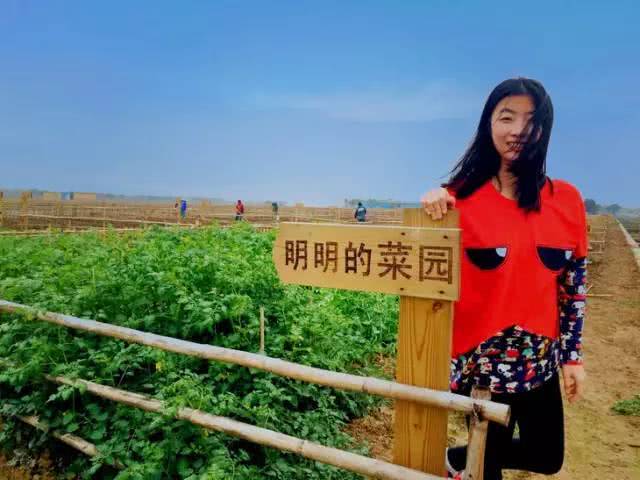
Born in 1995, founder of an 8,000-mu farm O2O project,
Series A funding of 30 million oversubscribed, valuation of 1 billion
-- put together, this information
once again titillates the audience's nerves.
Today, when "post-90s startup myths" are flooding everywhere and have repeatedly been called into question,
people cannot help but ask: what exactly makes her worthy?
In her freshman year she came out to start a business as a Weibo joke writer, doing small-scale buy-low-sell-high deals on campus, and accumulated her first pot of gold; in her sophomore year she planned a public welfare project product; in her junior year she became connected with the "e-Farm Plan" of China Europe International Business School to explore the development strategy and model of agricultural projects, and then transformed herself into a co-founder.
Even more surprising is that her 22nd birthday party became a large-scale live-streamed concert -- 16 rock bands, 7 video sites streaming live, 50 Harley motorcycles, 20 RVs, and a high-end scale of 100,000 attendees, yet she is not a celebrity, nor a rich second generation, and her way of growing up along the way was even somewhat "wild."
Setting aside all these protagonist halos, she is more like a chirping, somewhat neurotic girl.
When I first saw her WeChat Moments, I was startled by this girl's bluntness. Words such as frigidity, hookups, and bang-bang appeared frequently; describing her as maverick would not be an exaggeration at all. But when I actually chatted with her, I found that in real life she is actually very candid. The conversation was often led by her unrestrained imagination into all kinds of fields. "So lame" and "not fun" were words that often came out of her mouth. She would sharply and exaggeratedly complain that the "big bluffers" she had met only knew how to talk big. When she got to something fun, she would burst out laughing herself first.
Perhaps it is this kind of candid, whimsical, and highly action-oriented personality that has allowed her to break out of the siege in many bets against capital.
Her name is Mingming, and she is 24 this year.
She is the founder of "Baobao Farm."
She is the only post-90s mentor jointly signed by
Alibaba Group's International Business Division and Rural Taobao Business Division,
and has won honors such as "2015 China's Most Commercially Valuable Post-90s Woman"
and "2016 China Agricultural Innovation Brand Woman."
In less than two years,
she built "Baobao" into China's largest agricultural experience project.
How did she do it?
What is so special about her farm?
The business model of Baobao Farm, generally speaking, is online sales + offline experience.
Online sales: through the online and offline operation of agricultural and sideline products, vegetables, fruits, flowers and potted plants, as well as agricultural tourism and leisure sightseeing service industries, it sells the farm's green vegetables, poultry and meat, and various selected foods, realizes one-stop user experience services, and creates an O2O agricultural brand.
The offline physical operation is very much like moving all kinds of daily urban activities onto the farm, and every facility and piece of equipment is made especially cute. Besides farming experiences, there are also chess and card games, singing and entertainment projects, themed restaurants, container inn accommodation, conference centers, and other projects that meet the personalized needs of different visitors. It is fun and interesting.
In April 2014, "Baobao Farm" was still a piece of abandoned land overgrown with weeds. It had been left barren all along, with half-leg-high mud walls, deep ponds, and grasslands everywhere. In 2014, Mingming persuaded several industry heavyweights to cooperate with her in founding "Baobao Farm," acquiring 8,000 mu of land in Sanshui District, Foshan City, to build experiential modern agriculture.
Baobao Farm covers a total area of more than 8,700 mu and is an important venue for the offline experience of the Baobao project. It contains dozens of functional zones, integrating parent-child entertainment, ecological tourism, farming experience, outdoor team building, golf practice, picnics and barbecues, wetland landscapes, and commercial services.
Picnic and barbecue area: covers an area of 16,854 sq m and can receive 200 people dining at the same time. It features large firewood stoves with strong farmhouse characteristics, where visitors can personally catch live chickens in the field, scoop fresh fish, split firewood, and light the stove, making cooking more enjoyable.
Farming practice area: covers an area of 13,379 sq m, where visitors learn cultivation and labor and experience the hardships of farmers and the joy of harvest; next to the farming practice garden is a frog pond for sightseeing, where visitors can roll up their trouser legs and feel for snails and catch frogs.
Team-building area: covers an area of 29,006 sq m and can receive 300-500 people. It has water-based and land-based team-building projects.
Parent-child area: covers an area of 8,060 sq m and can receive 2,000-3,000 people. It specially features entertainment facilities such as a naughty castle, animation, and amusement rides; after playing, visitors can dine in the ecological restaurant.
Birdwatching area: covers an area of 33,812 sq m and can receive 50-80 people. The lakeside pier is an artistic structure built mainly with wooden plank bridges; kayaks can be rented, and birdwatching telescopes are provided.
In addition, there is also a fishing area, covering an area of 212,885 sq m, which can receive 2,000 people at the same time. The flower-viewing area covers an area of 42,182 sq m and can receive 50-80 people. There is a transparent glass house in the flower field; visitors can admire the brilliant blossoms of various trees and flowers; they can also experience an alternative way of enjoying flowers by taking a flower-lane boat tour. One-Mu Space covers an area of 62,304 sq m and can receive 100-300 people. One-Mu Space is divided into two parts: a 500 sq m Baobao public planting area and a 166 sq m private plot. In the public planting area, shared space can be used to buy chicks and rabbits for breeding. The 166 sq m private plot can be used to rent container inns to build personal residences, of which 66 sq m of planting area can be cultivated entirely according to personal wishes, and all harvests belong to the individual.
Throughout the entire farm, the eye-catching innovative product is the "container inn." The "container inn" is converted from abandoned large shipping containers and placed in the countryside. Various green seasonal vegetables are planted in front of the door, the surroundings are enclosed with fences, and complete irrigation facilities are provided, offering tenants plenty of farming fun.
"Whether starting a business or doing business, the problem of people is the fundamental problem. To seek development and dare to innovate, one must be good at using people. The future is a new internet era. To develop agriculture, one must make good use of the internet, this powerful tool. The key point is that 'agricultural transformation must retain young people.'"
In Mingming's view, agricultural transformation must retain young people. Embracing young people means embracing the future, and also firmly grasping creativity. Creativity will attract more attention and create foot traffic. People are the entry point for traffic, and this will also promote the upgrading of consumption in agricultural transformation.
With an 8,000-mu farm and an average daily foot traffic of 3,000 people, in May 2015, "Baobao Farm" completed a Series A financing round of 60 million RMB; in November 2015, it completed the second round of Series A financing of more than 100 million yuan.
Mingming said: "Agriculture has great potential and future development power, and I have also gradually come to understand the playbook of agriculture + internet. The online team is planned into fields such as internet development, design, e-commerce market channels, and cultural communication development, all serving one industrial chain. In each field, potential members are selected to lead a team, preserving particularity within universality, and finally integrating into the company's structure."
She also believes: "Agriculture is the primary industry, leisure agriculture belongs to the service industry, and the foot traffic and influence of leisure agriculture can drive the development of agriculture."
Mingming's team developed 2,600 mu out of the 8,000 mu of land into "One-Mu Space": turning one mu of farmland into an independent courtyard, renovating abandoned containers into luxury suites and connecting water and electricity. Customers pay a certain fee to enjoy one year's right to use "One-Mu Space," where they can live, vacation on weekends, gather with relatives and friends... The farm has dedicated staff to help customers plant organic melons, fruits, and vegetables in the courtyard, and regularly deliver them to customers' homes by express delivery.
At the same time, customers can also order other products produced by the farm online, such as free-range pigs and free-range chickens. In addition, "Baobao Farm" has many other special features.
In the future, Mingming and her team want to build the 8,000-mu farm into China's largest offline experiential agricultural products physical store, but her ambition goes far beyond that: she wants to develop the farm into China's largest agriculture-themed parent-child amusement park.
Regarding the future of Baobao Farm, she frankly said it will take the capital route, and the top-level design is already in place. Employees who recognize Baobao Farm can subscribe to original shares at the employee price, letting employees become shareholders of the company and enhancing the company's cohesion.
Mingming said: "Many people are not optimistic about agriculture. They think agriculture means plowing fields and growing vegetables, working at sunrise and resting at sunset, and it is very hard. But hardship is inevitable. Anyone at any stage will suffer for a while, but not for a lifetime. Agriculture is an industry with vitality and unlimited potential. It is different from real estate and also different from scenic areas. Agriculture changes with external factors such as seasons and weather. This is a dynamic ecological circle. Users can participate in more activities combining farming, forestry, animal husbandry, sideline production, and fisheries. Compared with many fixed scenic areas with heavy assets that are difficult to transform, agriculture is much happier!"
This is the best of times, and also an unknown era. When many post-90s people are throwing themselves into the internet field, Mingming instead goes the opposite way: "I just like traditional industries." The internet is a very important tool of this era. It is an invisible hand penetrating every industrial chain. As a post-90s person, especially of the generation born in 1993, who grew up together with China's internet, Mingming is using the internet to change the profit model of traditional agriculture.