Want to pass yourself off as a botanist? Start by learning a few simple geometric shapes
When you come across a plant you don't recognize
flipping through field guides, using apps, or asking for an ID
is nothing compared tostomping it deadsatisfying
Stomping is satisfying in the moment, but if you get caught, how embarrassing is that
Is thereeasy to learn, universal, and perfect for showing off
Of course there is!
Whether you know the name or not
you can pretend to casually
useprofessionalterminology to describe the characteristics of plant leaves
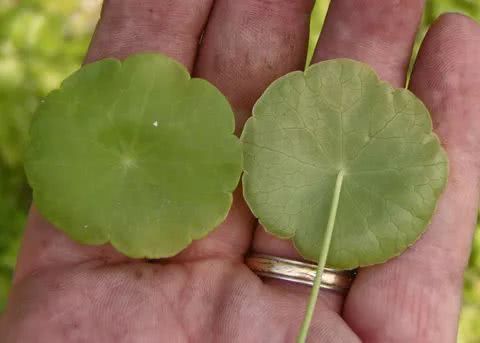
If you know the name, for example copper coin grass (Centella asiatica)
you can say, look
the leaves of copper coin grass arepeltate leaves
Image: James H. Miller / USDA Forest Service
If you don't know the name, for example...
no worries, you can say
this isa bipinnate to tripinnate odd-pinnate compound leaf
Sounds impressive, right?
Five stepsto teach you this skill!
Step one
First, see whether it's a simple leaf or a compound leaf
This is easy to understand
Find a single petiole growing from a stem node
attached to only one leaf bladethat's a simple leaf
bearing multiple leafletsthat's a compound leaf
Image: Frank Vincentz / wiki commons
Look
one petiole attached to three leaves
Clover, of course, isa compound leafof course
Step two
You need to know some simple geometric shapes
ovate
obovate
cordate
lanceolate
……
Some leaves are hard to describe in a word?
Just usecombined termsand you're set
For example, the leaves of weeping willow are especially narrow and long
we call themlinear-lanceolate
The ovate leaves of the lilac are relatively broad
so just call thembroadly ovatethen
Step three
Pay attention to the leaf apex, leaf margin and base
Leaf shapes may seem endlessly varied
but in fact it's always these three parts that vary
Image: Ptelea / wiki commons
For example, this elm leaf
Saying only ovate leaf isn't enough, you can also say it has
an apexthat is acuminate,a leaf marginthat is serrate
a basewith asymmetrical curves on both sides
Alright, now, you are already able to
professionally describesimple leaves!
Too easy?
Let's raise the difficulty and take on compound leaves
Step four
When you encounter a compound leaf, observe the rachis
The rachis is the part of the common petiole where the leaflets are attached
Like the horse chestnut (Aesculus hippocastanum)
the leaflets are attached at the tip of the common petiole
In other wordsthe rachis has only one pointwhere they attach
is calledpalmatecompound leaf
If the leaflets are arranged on both sides of the common petiole
in other words,the rachis is relatively long
that kind ispinnatecompound leaf
Image: Liné1 / wiki commons
Look at the silk tree (Albizia julibrissin), looks like a feather, right?
To break it down further, it isbipinnate evenpinnate compound leaf
Odd or even depends on whether there are leaflets at the tip of the rachis
How many times depends on how many layers of branching the rachis has
Also, those with only three leaflets
are called trifoliolate compound leaves
Like clover, where the leaflets grow from a single point
arepalmately trifoliolatecompound leaves
Image: Vengolis / wiki commons
And like cowpea
with three ovate-rhombic leaflets
occupying more than one point on the rachis
arepinnately trifoliolatecompound leaves
Step five
Look more, remember more, practice more
Didn't digest what was covered today?
Don't worry
As long as you look more, memorize more and practice more
very soon, you'll be able to fully master
thissuper practicalshow-off skill!
Where do you start practicing? You need to
flip to any page and give it a try, stop
zoom in to look at the leaves
write down your judgment
newly added
Chinese names, even easier to use!
When you're not yet proficient, you can also
cross-check against the scientific names and Chinese names
It's both a field guide and a notebook
New knowledge can be jotted down anytime
Isn't that super convenient?
The classic "
One Book of Nature" series from Guokr Store
Selected paper + a binding design that lies flat at 180°
makes youreally want to write in it, and it's also handy for taking photos to show off
80 blank pages for single leaves and unifoliolate compound leaves
20 color pages for pinnately compound leaves and palmately compound leaves
Scientifically richand good-looking
More
carefully designedlittle surprises
are waiting for you to discover by scanning the QR code below