Craziness of growing vegetables in Lunar Palace 1, inside life fully revealed
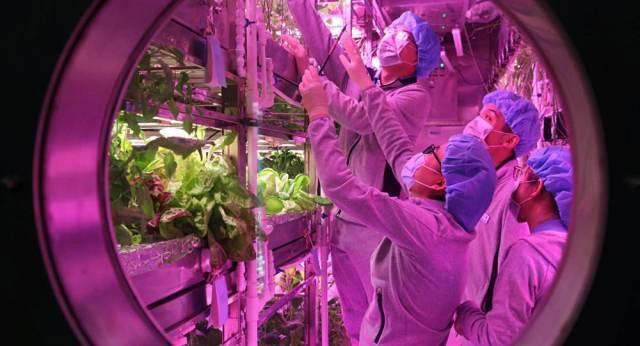
"Lunar Palace 1" volunteers working inside the plant cabin
Robinson Crusoe drifted to a deserted island, planted barley and rice, caught and domesticated wild goats and bred them, and thus survived. In today's era, if one leaves the naturally existing land, how can humans sustain survival in space without oxygen and water?
China's "Lunar Palace 1" has given its own answer.It is China's first and the world's third bioregenerative life support ground-based crewed integrated closed experimental system, following those developed by the United States and Russia.Unlike the "human-plant" two-biological-chain-loop systems of the US and Russia, it is the world's first successful "human-plant-animal-microorganism" four-biological-chain-loop system. It has established a "micro-biosphere" comparable to Earth's.
Launched by Beihang University on May 10, 2017,the "Lunar Palace 365 Experiment"is a comprehensive experiment conducted for crewed lunar base and Mars exploration and other space programs. Its main task isto study how a biological system can provide life support for crews with different metabolic levels.In this experiment, 8 volunteers stayed in batches inside the "Lunar Palace 1" experimental cabin for a 365-day multi-person experiment.
On January 26, 2018, Beihang University held the second shift-change ceremony for the "Lunar Palace 365" experiment. Since the first shift change on July 9 last year,the 4 volunteers of Team 2 had continuously stayed in the fully closed "Lunar Palace 1" experimental cabin for 200 days, breaking the previous world record of 180 consecutive days in a bioregenerative life support system set by Russian researchers. This shows that China is already at the forefront in the field of bioregeneration.
To welcome China's third Space Day,the Beihang "Lunar Palace 1" science popularization base opened to the public from April 22 to 23, 2018,attracting widespread attention at home and abroad. Because the "Lunar Palace 365" experiment (from May 10, 2017 to May 10, 2018) was ongoing, in order not to disturb the normal progress of the experiment, only visitors with successful reservations were allowed to enter, receiving about 600 visitors.
"Lunar Palace 1" science popularization base: Liu Hong introducing the base situation to visitors
"Lunar Palace 1" chief designer and chief scientist Professor Liu Hong said in an interview with reporters that opening "Lunar Palace 1" to the public for visits will popularize the latest knowledge of space survival and space life support to the public. She hopes the public can learn about the research conducted by our country in this area and the achievements made, and also hopes to seek technical cooperation, so that through cooperation China's deep space exploration and life support technology can be done better." She also said emotionally thathow far, how fast, and how steadily a country's science and technology can go is inseparable from the millions of people who support, endorse, and love science.Their encouraging words are not only the greatest affirmation of our work, but will also nourish the seeds of children's love for science, letting them sprout, grow, bloom, and ultimately bear rich fruit."
Children curiously peering into the cabin
By watching the "Lunar Palace 1" promotional video, listening to explanations of the reference model, observing the activities of the volunteers inside the cabin where the "Lunar Palace 365" experiment is underway, and communicating with the interpreters, visitors can learn aboutthe basic principles of "Lunar Palace 1" as a ground-based integrated experimental facility for a space base bioregenerative life support system, as well as the latest knowledge of space survival and space life support.
Volunteers waving outward from inside the cabin
"Lunar Palace 1" consists of 1 comprehensive cabin and 2 plant cabins, with a total area of 150 sq m and a total volume of 500 cubic meters. The comprehensive cabin includes four bedrooms, a dining and communication workroom, a washroom, a waste treatment room, and an animal breeding room. Each plant cabin is divided into 2 plant compartments, and environmental conditions can be independently controlled according to the growth needs of different plants. The first problem for survival here is naturally eating."80% of the food comes from recycling and regeneration,and another 20% is exogenous food such as oil, salt, sugar, and some meat."When talking about how the volunteers eat their fill, "Lunar Palace 1" chief designer and chief scientist Liu Hong said so.
The red and blue light sources shown in the space cabin are spectral bands specially set for photosynthesis, because plants have the strongest demand for red and blue light. Under such lighting conditions, crops can grow more healthily and rapidly.
As for the selection of plant species to grow, on the one hand nutritional needs must be considered, and according to nutritional matching, high production efficiency and simple cultivation processes are also needed. Plant Cabin I mainly grows staple foods, including wheat, potatoes, carrots, scallions, etc. Plant Cabin II grows vegetables and others, including soybeans, tiger nuts, cucumbers, tomatoes, peppers, etc.
Meat is naturally indispensable, but considering the particularity of the environment, what the volunteers eat is not everyday pork, beef, or mutton. According to a large number of experiments,in a closed and narrow space, experimenters living day and night with the animals they raise will develop emotional dependence and regard the animals as their companions. If in the end they must eat them in order to survive, for the experimenters this is a difficult and cruel choice, and some people may even suffer mental breakdown.However, humans and insects are less likely to develop emotional dependence. Therefore, the "Lunar Palace 1" research team finally chose yellow mealworms, known as a "treasure house of protein feed."Yellow mealworms not only have high nutritional value and delicious taste, but can also degrade some waste inside the cabin, thereby accelerating material circulation.
Volunteers picking yellow mealworms from a box
Besides food, water and oxygen in space are naturally issues that must also be considered. Inside the "Lunar Palace 1" cabin, water and oxygen can achieve 100% recycling and regeneration, and the system closure degree is as high as 98%.
Liu Hong told reporters,human-generated wastewater, including urine and sanitary wastewater, is purified and treated, and then used to prepare nutrient solution for cultivating plants.Plant evaporation and human breathing produce water vapor. The water vapor goes into the air, and after being collected by a condensate collection system, it is centrally purifiedfor people to drink, wash, do laundry, etc."This is extremely similar to the source of the water we usually drink. The water we usually drink comes from rivers and lakes, and river and lake water is also condensed water from the air." Liu Hong explained.
In the system, plants are autotrophs, consuming carbon dioxide and producing oxygen, while humans, animals, and microorganisms are heterotrophs, consuming oxygen and producing carbon dioxide.There is an air circulation system inside the cabin. The oxygen-rich air produced by the plant cabin is sent to the comprehensive cabin, and the oxygen-rich air produced by the comprehensive cabinWait, the source says "" (carbon-dioxide-rich air) produced by the comprehensive cabin, not oxygen-rich air. Correcting: the carbon-dioxide-rich air produced by the comprehensive cabin is purified and then sent to the plant cabin, thereby carrying out the cyclic regeneration of oxygen and carbon dioxide.
As for the treatment of solid waste? A waste treatment room is set up inside the cabin, a place for treating solid and liquid waste."Solid waste includes human feces, plant straw, and kitchen waste, etc. They enter the waste treatment room and are treated with biological conversion agents."Liu Hong said.
How do the volunteers spend their days in "Lunar Palace 1"?The 24 hours inside the cabin are mainly divided into three parts: scientific research, daily work, and life. The schedule is very full: getting up at 6:30 and going to bed at 11 p.m.The three meals a day are done with division of labor and cooperation, and in addition each person has an experimental project they are responsible for. Each person also has to measure and record health indicators such as body weight, body temperature, blood pressure, and blood oxygen saturation every day. Actually, by the end of the day they are also very tired. But after 6 p.m., in addition to finishing work, the volunteers also chat, read literature, write papers, listen to the radio, practice calligraphy, pedal exercise
bikes, go online to read news and binge-watch shows, etc., to learn about what is happening in the outside world.Inside the cabin, they need to maintain their best physical condition and present their most authentic selves.
Volunteers collecting data
Volunteer Gao Han summarized life inside the cabin as"above survival, below life": "Above survival" means that survival can be maintained inside the space cabin; "below life" means that cameras are installed inside the cabin, and cameras will capture the behavior of the people inside. Everything is under monitoring. Whether what happens is big or small, even physical changes and emotional fluctuations are part of the experiment. All details will be converted into data, so it cannot simply be called life.
Liu Hong receiving experimental samples handed out by volunteers from inside the cabin
The "Lunar Palace 1" research team will learn about changes in the experimenters' psychological states such as emotions and needs through telephone interviews and analysis logs; outside the cabin, a 30-person research team is on 24-hour duty monitoring, and will use behavioral expression analysis software to analyze the emotional changes of the experimenters inside the cabin.
And the large amount of experimental data obtained from this,all this seemingly trivial accumulation is for humanity to be able to live comfortably beyond Earth in the future.
As of now, the experiment originally planned to end with exit from the cabin on May 10 has "suddenly" been extended by 5 days. In response, "Lunar Palace 1" chief designer Professor Liu Hong explained that this was designed in advance,intended to observe the volunteers' corresponding psychological states and reactions. When May 15 arrives, if the experiment can be completed successfully and the cabin door opens, China will once again break the record for the number of consecutive days of stay in a bioregenerative life support system. It will leave a brilliant mark in the world's field of bioregeneration.
It is understood thatin the future the "Lunar Palace 1" team will actively strive for carrying opportunities and resources on China's lunar and Mars probes, and on the lunar surface and Marssurface carry out small bioregenerative life support system experiments. Through comparative analysis with parallel ground experiments, they will obtain correction parameters for the simulationresults of large ground systems, laying the foundation for future application to human exploration of the Moon and Mars.
And the bioregenerative life support technology used by "Lunar Palace 1" is also needed on Earth. It will have a place in some extreme environments such as deserts, plateaus, polar regions, and closed environments underground or underwater.