How do you select a flowerhorn cichlid so that it will develop a proper head (nuchal hump) during future keeping?
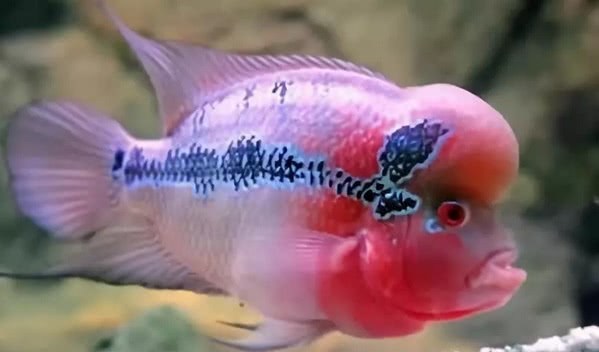
You want to keep a flowerhorn but do not know how to choose one? Do not worry, we will teach you!
Flowerhorn selection point one: body color
The flowerhorn market is deep and murky; when choosing, look at several sellers and compare them, and you will understand the so-called differences in body color. When selecting, try to choose ones with a slightly darker color, and the speckles are generally located toward the front part; this kind of flowerhorn has more character.
Flowerhorn selection point two: head
When selecting a flowerhorn, look at its head to see whether it is round and full and in proportion to the body, and generally it is better to choose one with a larger nuchal hump. Whether a flowerhorn develops a head generally depends first on the variety: well-bred flowerhorns have a relatively high rate of developing a head, while poorly bred ones have a low rate. But do not think that a well-bred flowerhorn will definitely develop a head; if your fish is over 13-15 cm and still has not developed a head, it will be very difficult for it to develop one later.
Flowerhorn selection point three: scales
The scales on a flowerhorn's body all have some sparkling specks; you can choose flowerhorns with relatively widely distributed specks and clear markings. A healthy flowerhorn must be able to fully spread its fins, have a well-proportioned body shape, and bright body colors.
Flowerhorn selection point four: mouth
When selecting flowerhorns, generally do not choose those with an overly long mouth; flowerhorns with a shorter and smaller mouth look better.
Flowerhorn selection point five: eyes
Look at the flowerhorn's eyes when selecting; choose those that look straight ahead and spirited, with transparent eye membranes and clearly distinct eye color. Do not choose those that often look downward. When selecting, observe: those that are not afraid of people, swim unhurriedly, and have a stretched, powerful back are the best.
Flowerhorn selection point six: size
When selecting, you can choose from different types such as juvenile fish of 7-8 cm, sub-adult fish of over 15 cm, and fully mature adult fish. Choosing fish of different ages offers different keeping pleasures, because flowerhorns generally only show preliminary markings and colors when they grow to about 8 cm; being able to buy small fish full of potential is highly challenging and experimental.
Now that the selection points are covered, what is the most important thing in a flowerhorn's life? Surely everyone knows it is developing a head. Many beginners may not know that the path to developing a head is also very arduous for a flowerhorn; differences in variety and keeping environment can both cause it not to develop a head, and a flowerhorn that does not develop a head loses its most important characteristic. So how do you make a flowerhorn develop a head smoothly while keeping it?
The golden stage for developing a head
During the flowerhorn's growth process, the usual time for developing a head is when it is about 8-15 cm; if this period is missed, it will no longer develop a head. Therefore, the genes or the growing environment for keeping a flowerhorn are very important. When buying, we can choose a small flowerhorn that already has a slight head.
Dietary supply
Starting from the best period for developing a head, when the flowerhorn is 8-9 cm, the flowerhorn is not picky about food: live bait (red earthworms, small fish, etc.), frozen bait (frozen shrimp, frozen worms, etc.), and feed (sticks, pellets); they are all happy to accept these. The owner should best feed it head-developing feed and river shrimp; river shrimp can provide enough protein. The flowerhorn's head development is directly related to nutrition. Just feed it until full; do not feed large amounts, as flowerhorns have a congenital defect in their digestive tract, which can easily cause flowerhorns to suffer from enteritis. Friends should note that the supply of head-developing feed needs a certain regularity and timing.
Water quality
In order to make a flowerhorn develop a head, the water temperature in the fish tank is best at 28 degrees, which is more suitable. Different types of flowerhorns may have different water-changing cycles; for example, pearl flowerhorns need water changed twice a week, while golden flowerhorns can have water changed once every ten days. No matter what, you must keep the water in the fish tank clean and free of impurities. Flowerhorns do not have high requirements for the size of their living environment; it is not that the bigger the fish tank the better. As long as the water quality is kept in the best condition, the size does not matter.