Add this kind of stone to your succulents and they will fill the pot in a week, with round, plump and beautiful leaves
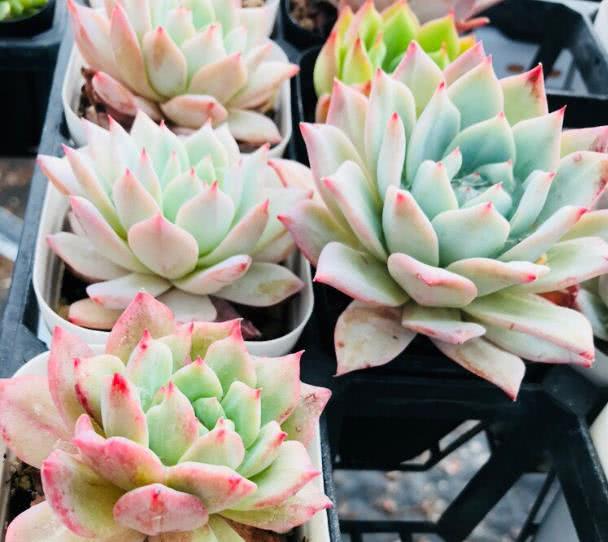
Maifan stone is a mixed rock formed by volcanic eruptions. Its gray-black stone body is dotted with white spots, and it occasionally shows colors such as yellow and gray-green. It looks like cooked rice, hence the name. From a nutritional point of view, maifan stone, like other granular soils (such as akadama soil, kanuma soil, and vermiculite), is rich in trace elements and is suitable for growing succulents.
Maifan stone is undoubtedly the most popular stone in the succulent community over the past two years. There is hard maifan stone, soft maifan stone, and Henan golden maifan stone. Depending on the particle size of the maifan stone, people usually use it for top dressing or mixing into soil. Besides top dressing and mixing into soil, some enthusiasts also use pure maifan stone granules for rooting experiments, and the results are quite good.
Using pure maifan stone to grow succulents seems to cause no problems in the short term, but if used for the long term, nutrition will be lacking, short of the nitrogen, phosphorus, and potassium that plants need most for growth. The succulents will grow slowly, their leaves will become smaller, and the stems may become thinner. The adjustment method is very simple: do not use pure maifan stone, just use 50% to 70% maifan stone, and use peat, peanut shells, etc. for the remaining 30% to 50%. This soil mix has good water permeability and air permeability, and is also rich in nutrients. Succulents can grow happily, plump but not oversaturated, and in autumn and winter it is also convenient to control water, which helps with coloring. Deeply fermented and fully decomposed peanut shells are a good organic fertilizer, with lasting fertility that supports succulent growth for more than a year without repotting.
Maifan stone has adsorbency, solubility, regulating properties, biological activity, and mineralization, among others. It can adsorb free metal ions in water. After being soaked in water, maifan stone can dissolve out nearly 20 kinds of trace elements. It can be used in gardening and aquariums. Maifan stone can stabilize, improve, and balance the physical functions of soil, so it has more advantages than other soil amendments.
Some flower enthusiasts said that after using maifan stone for a period of time, they felt that the succulents had indeed undergone some changes. Although they had not grown much bigger, they had become sturdier. Maifan stone and many other mineral-based planting materials are minerals that do not contain nitrogen, so succulents grown with them will grow slowly, but they will gradually accumulate dry matter and thus become solid. In addition, the air permeability of maifan stone is stronger than that of formulated soil, so it is very effective for growing old stems. Therefore, pure maifan stone can be used when growing succulents with old stems.
This is a gathering place for succulent lovers, sharing succulent care tips. You are welcome to follow and exchange ideas.