Cyanosis and lividity are different names for the same condition, and there are congenital and acquired types
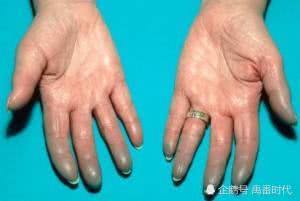
Cyanosis and lividity, in terms of causes, are both blood hypoxia showing through parts of the body with high transparency, namely "central cyanosis" of the lips, cheeks, tongue, and tip of the nose, and "peripheral cyanosis" of the nail beds, fingers and other extremities, areas that are easy to observe, have thinner skin, less pigment, and rich blood flow. When central and peripheral cyanosis coexist, it is called "mixed cyanosis."
At a deeper level of causation, cyanosis occurs because deoxyhemoglobin in the blood increases; in fact, reduced hemoglobin exceeds 50g/L, causing the skin and mucous membranes to take on a blue-purple color. Moreover, in terms of symptom presentation, cyanosis has a diffuse tendency. In other cases, after poisoning by drugs or chemicals, abnormal hemoglobin derivatives appear in the blood, which can also cause cyanosis; for example, cyanosis from food poisoning in daily life is also triggered by poisoning.
Cyanosis of the fingers
Apart from acute cyanosis caused by poisoning from drugs, chemicals, and the like, the formation of pathological cyanosis is chronic and continually spreading and deepening. In terms of age and mode of onset, infants and young children and other children, because of weak resistance, should actively prevent cyanosis caused by food poisoning. This is because pickles and similar foods that adults can eat can also easily cause poisoning in children after they eat them, and after poisoning, generalized blue-purple discoloration of the body appears.
There is also enterogenous toxic cyanosis, as well as cyanosis during women's menstrual cycles, congenital cyanosis in infants, and cyanosis due to cardiac insufficiency. Enterogenous toxic cyanosis mostly occurs in infants and young children when nitrite and the like are mistakenly used during enemas. Some women during their menstrual cycle may also experience paroxysmal, idiopathic pulmonary cyanosis, accompanied by respiratory symptoms such as cough and sputum production; in cyanosis due to cardiac insufficiency, there may be palpitations, fatigue, difficulty breathing, liver enlargement, distended neck veins, lower limb edema, and so on.
Central cyanosis
In infants from birth, or cyanosis appearing in early childhood for unknown reasons, it may be related to congenital heart disease or congenital methemoglobinemia. In diagnosis, congenital heart disease with left-to-right shunting may be seen, complicated by pulmonary hypertension, with reverse shunting occurring and causing cyanosis. This congenital cyanosis has a relatively late onset; if it is delayed-onset cyanosis, it may occur after middle age. The appearance of acrocyanosis with repeated episodes is pathologically a local blood circulation disorder, but it is related to chemicals such as nitrogen compounds and aromatic amino compounds.
If you have questions or need help, you can call 01062170649 13269852331