Cultivation Techniques for Abelia biflora: Propagation Methods and Pest and Disease Control
Propagation and Pest and Disease Control Cultivation Techniques for Abelia bifloraTechniques
Abelia biflora (Abelia biflora Turcz.), also known as Liutiaomu, Shuanghua Liudaomu, etc., is a deciduous shrub of the genus Abelia in the honeysuckle family. Because when the original wood grows, there are six grooves on it, and after being processed into beads, each bead has six white lines, hence the name Liudaomu. It is native to Hebei, Shanxi, Liaoning, Inner Mongolia and other places in China, and mostly grows on shady slopes, hillside shrublands, and by streams under forests at an altitude of 1000-2000 m. In the Huabei Oilfield industrial and mining area where the author is located, the soil is moderately saline-alkali land, and Abelia biflora grows well. The cultivation and management techniques are now introduced as follows for colleagues' reference.
I. Morphological Characteristics
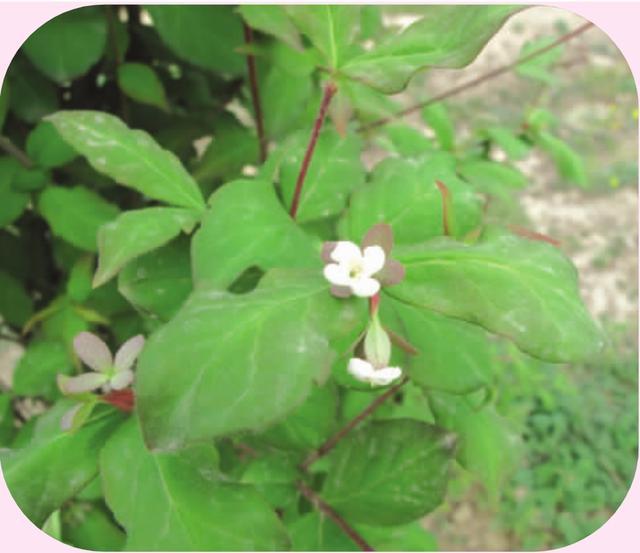
Abelia biflora can reach a height of 3 m. Young branches are slender, reddish-brown, covered with recurved bristles, and later smooth and hairless. Leaves are simple, opposite, sometimes in whorls of 3, oblong-elliptic to elliptic-lanceolate, entire or with pinnate lobes above the middle, with marginal cilia; the leaf surface is dark green, the underside is white-green, and the veins are densely covered with long soft hairs; the petiole is short, 2-4 mm long, enlarged and connected at the base, with bristles. Flowers are solitary, often 2 borne together at the tip of the branch, nearly without a common peduncle, growing in leaf axils; the corolla is tubular, milky white, pale yellow or tinged with red, narrowly funnel-shaped or salver-shaped, the calyx tube covered with short bristles, with 4 sepals. The drupe is achene-like, 1-1.5 cm long, often curved, sparsely covered with bristles, with 4 enlarged sepals persisting at the apex; seeds are cylindrical. Flowering period is April-May; fruit ripening period is July-August.
II. Growth Habits
It likes light and also tolerates shade, tolerates cold, tolerates drought, and likes moist soil; it tolerates poor soil and has no strict requirements for soil, with a certain tolerance to salinity and alkalinity, but grows best in humus soil. The root system is well developed, and both sprouting ability and tillering ability are very strong, but growth is slow.
III. Propagation Methods
1. Seed propagation: After the seeds are harvested in August, dry them in the shade in a ventilated place and cold-store them at 0-4°C. In early spring of the following year, sow them in pots in a greenhouse or sow them directly in a seedbed. The sowing rate is 5-6 g per sq m. Because the seeds are rather small, before sowing the seedbed should be deep-plowed and raked fine, watered thoroughly, and the seeds evenly sown on the soil surface, then a thin layer of fine soil should be scattered over them, and rice straw or other materials should be used to cover them and retain moisture. After sowing, before the seeds germinate, they should be alternately soaked in water when dry and wet. When 2-3 true leaves have grown, the seedlings can be pricked out.
2. Cutting propagation: In mid-to-late June, at the end of flowering or after flowering, cut healthy one- or two-year-old semi-lignified branches with terminal buds, 15-20 cm long, and insert them into a sand bed as soon as they are collected. Keep only a few leaves at the top of the cutting and cut off all the rest to reduce transpiration. Soak the cuttings in a 0.3% potassium permanganate solution for 10-20 minutes for disinfection, then place them in clean water. Insert the cuttings into the sand to 1/3-1/2 of their length, with a row spacing of 6-10 cm and a plant spacing of 3-5 cm. Before insertion, first make holes with a wooden stick, then insert the cuttings and press them firm, water thoroughly, and then put up a plastic shed and shade net. Note that the ground temperature should be kept at 25-35°C, and must not be lower than 20°C; the air temperature in the shed should be equal to or slightly lower than the ground temperature, and must not be higher than 40°C; the humidity should reach 90%. To maintain humidity, the plastic shed should be sealed, and water must be given when dry; generally it is not necessary to open it every day, and the temperature is controlled by the amount of light transmitted through the shade shed. The substrate humidity should not be too high. In the first 3 days after cutting, water 2-4 times a day, and after one week reduce the amount of watering to avoid root rot. The higher the air humidity, the better; it is best if water droplets are often retained on the plastic sheeting.
3. Division propagation: Division can be carried out after leaf fall in autumn and before the ground freezes, and in spring after the ground thaws and leaf buds appear. The method is to dig out the plant; each aboveground stem can be divided into one plant, taking care to keep the stem and root connected and not to break them. If there are no stems, the roots can be divided into several plants and planted separately.
IV. Cultivation Techniques
1. Planting location and time: Abelia biflora should be planted in loose, fertile soil with good drainage. Transplanting is generally carried out after leaf fall in autumn or before bud break in spring. In the North China region, the best season is spring, when bare-root planting can also survive. For large seedlings or planting in other seasons, a soil ball must be kept to increase the survival rate.
2. Planting techniques: Abelia biflora has very strong growth vigor, so the planting spacing should be no less than 1.5 x 1.5 m. When planting, 3-5 buds or branches form one clump, and it is best to transplant with soil. After planting, water thoroughly, and after the water has drained, cover with another layer of soil. Planting can also be done in summer, but it is best to transplant before rainy weather to increase the survival rate. When planting, the aboveground part should be pruned to reduce nutrient consumption and help the plants recover.
3. Water and fertilizer management: It likes fertilizer, so appropriate fertilization should be applied before and after flowering, mainly organic fertilizer. Water should be given in time during the growing season, and attention should be paid to drainage and waterlogging prevention during the rainy season. In early spring, green-returning water should be given as early as possible, and before winter, sufficient freeze-prevention water should be given. [Jishan Huayao]
4. Shaping and pruning: In winter or before bud break in early spring, cut off diseased and weak branches and old branches near the ground, and control the size and shape of the plant, such as spherical, hedge-shaped, etc., to promote the sprouting of new branches in the following spring. For renewal and rejuvenation, old branches can be thinned out from the base to encourage the growth of new branches.
During the growing season, after flowering, retract branches that are too vigorous, and shorten the tips of branches that have already flowered to promote branching of the lower branches; repeated pruning after flowering can promote multiple flowering, but note that once the flower buds have formed on the new shoots, they should not be pruned. After the flowers fade, cut off the spent flowers below the second leaf node. Cut off water sprouts at any time to prevent them from disrupting the tree shape and consuming nutrients.
V. Pest and Disease Control
Abelia biflora mainly has pests and diseases such as aphids and sooty mold. For aphids, spray one of the following: 1.2% ku-yan emulsifiable concentrate at 800-1000 times dilution, or 6% imidacloprid emulsifiable concentrate at 3000-4000 times dilution, or 5% acetamiprid emulsifiable concentrate at 5000-6000 times dilution, etc. Pay attention to safety when spraying.
For sooty mold, spray lime sulfur mixture at 3-5 degrees Baume during the dormant period to eliminate overwintering sources of the disease; the occurrence of this disease is closely related to insects that secrete honeydew, and spraying to control aphids, scale insects, etc. is the main measure to reduce its incidence; spray 80% mancozeb wettable powder at 500-800 times dilution.