What are the appreciation standards for the center of the flower in Chinese orchids?
Appreciation standards for the center of the flower in Chinese orchids
The central nest, namely the center of the flower, specifically refers to the overall structure of the petals and the column. The center of the flower is an important part of Chinese orchid appreciation. A center of the flower that forms a circle, that is, the petals and the lip forming a nearly circular pattern, is considered beautiful, requiring the five petals to be separated at the base, the nose (column) to be small and flat, and the petals and lip to be harmonious and compact. For plum blossom petals and narcissus petals, a tightly nestled central nest head shape is preferred; for lotus petals and butterfly petals, a broad central nest is preferred. In addition, the beauty of the central nest's form must also match well with the three outer petals, so as to show harmonious beauty.
I. Quality of the petals and their arrangement
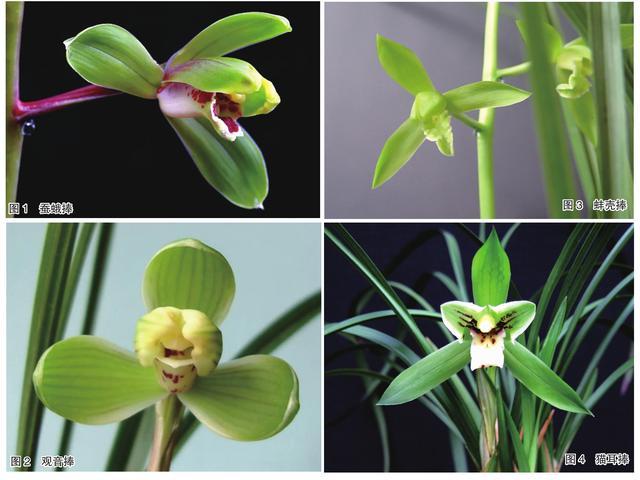
The petals refer to the two short inner petals that stand vertically and close to each other on either side of the lip among the inner three petals. Traditionally, people classify them by form into silkworm moth petals (Figure 1), Guanyin petals (Figure 2), bean shell petals, mussel shell petals (Figure 3), crab claw petals, cat ear petals (Figure 4), short round petals (Figure 5), palm leaf petals (Figure 6), xinkou petals (Figure 7), ear pick petals (Figure 8), fully closed petals, and so on. From an ornamental point of view, silkworm moth petals are top grade, followed by Guanyin petals, though of course this must be judged in combination with each petal type. As for the arrangement of the petals, generally speaking, the five petals separated at the base (Figure 9) is the most beautiful form, followed by separated at the top and joined at the back, while joined at the shoulder and back is the worst.
II. Appreciation standards for the lip
The lip, namely the labellum, is located below the column. Traditionally, people classify it by form into Liu Hai lip (Figure 10), large round lip (Figure 11), ruyi lip (Figure 12), large spread lip (Figure 13), dragon swallow lip (Figure 14), large curled lip, large persimmon lip, square notched lip, zhigui lip (Figure 15), chuan sai lip, steelyard hook lip (Figure 16), and so on. In lip appreciation, a short, round and upright lip is preferred; any pointed, narrow and long, or crooked one is inferior. For example, a flat lip that does not extend within the petals, a crooked lip leaning to one side, and a trailing lip that extends but does not curl are all inferior among lips; if the lip is stuck together with the column, it is even more inferior. Because the large ruyi lip, Liu Hai lip, and large round lip are sure to spread out and have a distinctive charm, generally speaking, the large ruyi lip, Liu Hai lip, and large round lip are top grade. The color of the lip is best in pale green or white; regardless of the color, purity of color is preferred. For example, among Chunlan, white is prized, and among Huilan, green is prized.
III. Appreciation standards for the lip coating
The coating, namely the velvety substance attached on the lip. A lip coating that is even, fine, and glutinous and lustrous in color is top grade (Figure 17), while a coarse and dark one is inferior. In color, green and white are top grade; an all-red coating color is extremely rare and is a precious variety; slightly yellow is next.
IV. Appreciation standards for the column
The column of an orchid is customarily called the nose. From an ornamental point of view, only when the nose is small and flat can the petals nest tightly and the flower form be handsome and lively; if the nose is thick and large, the petals will inevitably be pushed open into an "open skylight" shape, lacking inward restraint, and even if the three petals are of good form, it cannot be considered top grade. Therefore, a small and flat column is preferred (Figure 18), while a thick and large nose form (commonly called a large zhuntou) is inferior.
V. Appreciation of the red spots on the lip
The lip of a Chinese orchid attracts people's attention the most, and the red spots on the lip have even more of a finishing touch ornamental value. In color, bright, clear and luminous is top grade; in layout, harmonious, symmetrical and neat is top grade; among them, for those with many red spots on the lip, even, symmetrical and harmonious distribution of the red spots is top grade; for those with few red spots on the lip, large red spots distributed in the center are good; in shape, the character pin shape (Figure 19) [Jishan Huayao], u shape, v shape, red heart shape, and ingot shape are top grade. Under the premise of similar color, large red spots on the lip in regular blocks are of higher grade than scattered and sporadic red spots.