Camellias would rather die than give up their flowers: sharing a few tips for bud thinning
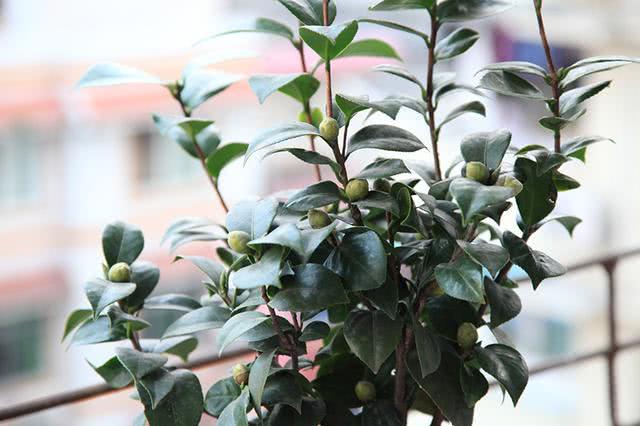
Right now the camellia is covered in clusters of flower buds, each single bud a little bigger than a soybean, and the tips of some strong branches often hold two or more buds. Camellias, like peonies, have the habit of giving up their lives rather than their flowers; too many flowers consume a large amount of nutrients and weaken the tree's vigor, and at the same time the blooms are neither large nor standard and do not easily show the flower characteristics of the variety. Ground-planted ones do a bit better, while potted ones are especially obvious: after flowering they drop leaves and sprout slowly and weakly. So during this period you must thin the buds in time, which both lets the flowers open large and maintains the tree's vigor.
The common way to thin buds is to simply snap off the extra buds. I wonder if everyone has noticed that with this method, the base of the bud sits tightly against the base of the leaf bud, and after snapping off the bud a fairly large wound is left at the edge of the leaf bud base, which causes the leaf bud base to lose water, making the bud body shrink or even dry up. Even if it does not dry up, it is still rather weak when it sprouts in spring, so it is necessary to improve the bud-thinning method.
Two buds and one leaf bud, very tightly packed.
After years of exploration and practice, you can use the "bud-cutting method" to thin buds without damaging the leaf buds. The specific method is: when the flower buds are about the size of a soybean or larger (actually the earlier the better, but too small is inconvenient to work with), use sharp scissors to cut off the middle of the extra bud, slightly below the middle; this creates a large wound surface on the bud, and this wound surface will evaporate the water from the remaining part of the bud. After a week the remaining part naturally turns yellow and drops off, and by then the junction with the leaf bud has also formed a dried scar, without affecting the development of the leaf bud at all. When cutting the bud, note that the amount cut off must not be less than half, that is, below the middle of the bud as mentioned earlier; the purpose is to destroy the pistil, because if the pistil is not injured this half bud will continue to develop and grow.
Below is a demonstration with pictures. Reading the text may not make it clear, so just look at the pictures!
Yesterday afternoon after work it was almost dark, so I only cut one. Be ruthless and leave a small half to let it dry up on its own. I should have removed the inner one, but since the outer bud already had a little damage when I bought it, I removed that one instead. As in the picture above.
I took this tonight under the bathroom heater. After one day the cut surface has turned yellowish brown, but it will not drop off yet. It has been raining these past few days and the air humidity is high, so it will take a bit longer to drop off.
These buds hiding in the middle will not amount to anything even if they open, so they should be cut off. They really can bloom, and the short weak branches lower down also have quite a few buds; these can be done without, or if you really cannot bear to, it is best to keep few.
I cut off nine buds. Possibly due to oxidation, the cut surfaces changed color after a while. Judging by the number of petals and the absence of stamens, it should be the "Eighteen Scholars" the flower seller mentioned.
Keeping 7 large buds on the whole plant is quite good. On closer look, small buds have also formed at the tips of the summer shoots.
At the tips of the summer shoot branches, flowers and leaves grow together.
Actually the best time to thin buds is when the buds are the size of a dried soybean; they should be cut when they are as big as the bud in post 50, so that the remaining buds can get enough nutrients. The earlier bud cutting was actually a bit late. The buds I cut on the 7th of this month went through almost all cloudy and rainy days. Today I took a moment to check, and the half buds have already dried up.
The fallen half buds.
The place where they dropped has scabbed over, with no effect at all on the leaf buds.
The current bud arrangement. This tree put out summer shoots, so the spring shoots look relatively low, and the buds on the spring shoots are also concentrated in the middle part of the tree, while there are small buds at the tips of the summer shoots.
When I bought it, it was crooked in the pot, and it had probably been crooked for quite a long time, so the summer shoots it put out made the whole tree shape a bit crooked. After I got it home I saw the soil was too compacted, so I removed two-thirds of the original soil and repotted it. After spring begins I will prune the branches, let new shoots grow, and restore it to a proper shape.
In my personal opinion, in order to maintain normal plant growth and let the flowers show the characteristics of the variety, for potted plants keep one bud on branches with four or five leaves or more, and the others can be left with none. If the whole plant has too few buds, you may also properly keep one bud on relatively weaker branches, but you really must not be greedy for more, otherwise it will greatly harm the plant's growth the next year. Ground-planted ones can keep appropriately more.