Tree structure and training method of the two-branch one-trunk form for dwarf dense planting of apple
Tree structure and training method of the two-branch one-trunk form for dwarf dense planting of apple
1 Structure of the two-branch one-trunk form in dwarf apple cultivation
The trunk height is 80-120 cm from the ground, and two main branches extending toward the row spacing are trained, with a horizontal angle of 180° between the two main branches. The base angle between the main branches and the central trunk is 70°-80°, the middle angle is 60°-70°, and the tip angle is 50°-60°. On the two main branches, loose, drooping, long-axis type fruiting branch groups of large, medium and small sizes are directly trained. On the central leader, 20-30 small and medium-sized fruiting branch groups are trained with an angle to the central trunk greater than 90° and less than 130°. The tree height is 3 m. The canopy is a flat conical shape. The branch-to-trunk ratio between the main branches and the central trunk is 1:2-3, and the branch-to-trunk ratio between the central trunk and the main branches and the branch groups is 1:3-5.
2 Training and pruning method for the two-branch one-trunk tree form
2.1 Determination of plant and row spacing
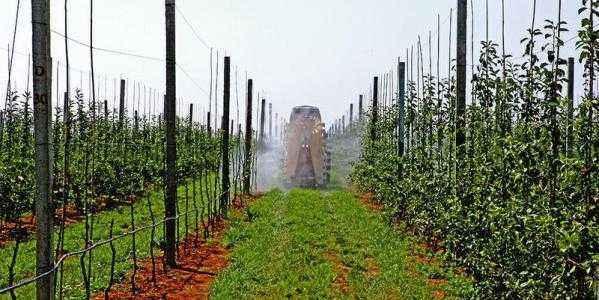
Apple trees can be planted with a plant spacing of 1.5-2 m and a row spacing of 5-5.5 m, that is, wide-row dense planting, with 61-90 trees planted per mu. This is the basis for training the two-branch one-trunk form.
2.2 Trunk heading
Select 3-year-old large seedlings and head the trunk at a height of 1-1.3 m. When heading the trunk, choose the 4th and 5th buds in the direction of the row spacing, and remove the 2nd and 3rd buds.
2.3 Pruning in the 1st year
Timely remove sprouts below 80 cm. When the slanting branches on the central trunk grow to 30 cm, select two vigorous branches growing toward the row spacing as permanent main branches to train. Do not bend or twist the two main branches and the central trunk. For overly strong competitive branches and other slanting branches, twist them all from the base to droop downward, control their growth, and strengthen the central trunk.
During winter pruning, keep only the central trunk and the two main branches extending toward the row spacing, and remove all other branches flush at the base. Cut the extension shoot of the central trunk at a half-plump bud on the autumn shoot, and remove the 2nd-3rd buds to promote thickening of the central trunk and inhibit the growth of competitive branches. For the two retained main branches, for the weaker ones with a length below 50 cm, cut at a half-plump bud near the tip and remove the 2nd-3rd buds to inhibit competitive branches and promote the growth of the main branches. For small main branches exceeding 50 cm, do not cut, so that the framework of the tree form is formed in the same year.
2.4 Pruning in the 2nd year
(1) Bud notching: carry out from late March to mid-April. First notch the buds on the central trunk; after about 10 days, notch the buds on the 2 small main branches. On the central trunk, notch from 20 cm below the cut to more than 10 cm from the main branch above, notching every other bud. On the two main branches, leave 20 cm at the base and notch up to 20 cm from the tip, making notches with a hacksaw blade 0.5 cm above the buds on both sides of the branch.
(2) Bud removal: timely remove the sprouts on the upper side of the main branches and the sprouts on the trunk.
(3) Branch propping: when the branches on the central trunk grow to 20-25 cm, prop them with toothpicks to open the base angle.
(4) Branch bending or twisting: from May to August, bend or twist the competitive branches and lateral new shoots on the central trunk and main branches to open the angle and moderate the growth vigor.
(5) Branch thinning: for competitive branches and upright branches on the central trunk and main branches with a branch-to-trunk ratio exceeding 1/2, remove them after late August.
(6) Branch pulling: for the two main branches, pull them when they are about 1 m long, so that the base angle is 80°-90° and the middle angle is 60°-70°. Starting from September, pull the lateral branches above the two main branches on the central trunk to 95°-130°, naturally drooping, and do not pull them into an arch shape.
(7) Winter pruning: remove the lateral branches on the central trunk and main branches with an excessive branch-to-trunk ratio, as well as untreated competitive branches and water sprouts, and remove the branches below the two main branches. All branches are left unpruned and not cut.
2.5 Pruning in the 3rd year
(1) Bud notching: notch buds on the one-year-old branches of the central trunk and the two main branches and on the two-year-old parts lacking branches. The bud notching method is the same as in the 2nd year.
(2) Bud removal: remove the buds on the upper side of the main branches.
(3) Branch propping: carry out when the current-year branches on the central trunk grow to 20-25 cm, so that the base angle is 90°.
(4) Branch bending or twisting: the position and method are the same as in the 2nd year.
(5) Girdling: for varieties that are difficult to flower, such as the Fuji series, from late May to early June, girdle the central trunk or the base of the main branches to control new shoot growth, promote terminal bud formation, and facilitate flowering.
(6) The branch pulling and winter pruning methods are the same as the previous year.
2.6 Pruning in the 4th year and thereafter and the training and renewal of fruiting branch groups
(1) The main branches are permanent branches and do not need renewal. A 1.5 m working aisle should be left between rows. When the main branches reach the required length and after heavy fruiting, they can be heavily cut back at 3-5 cm from the base of the extension shoot, leaving a weak bud. Base angles, middle angles and tip angles that are not in place should be pulled into place in time. When the central trunk reaches the required height and bears heavy fruit, replace the head with a weak branch.
(2) Training and renewal of fruiting branch groups. Small and medium-sized fruiting branch groups are directly trained on the central trunk, but the small and medium-sized branch groups on the central trunk must not press on the main branches below, otherwise it will affect the growth and fruiting of the main branches. On the two main branches, loose long-axis type fruiting branch groups are trained, with a reasonable mix of large, medium and small ones, and slanting, horizontal and drooping branch groups arranged in an orderly and staggered manner. The branch groups are left unpruned year after year. After 3-5 years of continuous fruiting, when the secondary shoots on the fruit spur weaken, they are then cut back. If there are new branch groups nearby, the weakened branch groups can be removed and replaced by the new branch groups.
3 Technical effects
3.1 Convenient for mechanical operations, high yield and good benefits This tree form achieves, with main branches, wide-row dense planting with the same number of plants per unit area as the branchless tree form of dwarf trees.
The row spacing is more than 2.5-3 times the plant spacing, which is convenient for mechanized operations and labor-saving cultivation, reducing labor costs, and at the same time gives higher yield and better benefits in the first 10 years than other tree forms with main branches.
3.2 Convenient management, improved labor efficiency
This tree form reduces tree height and raises the trunk, making management and fruiting convenient and improving the economic benefits of the orchard. This also improves the ventilation and light transmission environment at the base of the canopy, helps train long-axis fruiting branch groups, simplifies pruning, and improves labor efficiency.
3.3 Saves production costs, reduces production input
This tree form does not require investment in trellis materials, saving production costs and promoting the further spread of dwarf dense planting technology. Because there are two main branches extending toward the row spacing, like the two wings of an airplane or the two wings of a bird, they play a role in balancing the tree body and keep the central trunk upright, requiring no investment in trellis materials. This item alone saves 800-1,500 yuan per mu or even more. At present, the biggest bottleneck restricting the development of fruit trees on dwarf rootstocks is the investment in seedlings and trellis materials. Research on this technology can greatly accelerate the spread of cultivation technology for orchards on dwarf rootstocks.
3.4 The tree body is stable, conducive to early flowering and early fruiting
This tree form trains the main branches in a fixed direction, so that all main branches extend toward the row spacing, the orchard appearance is neat, the branches do not cross each other, and the two main branches are symmetrical and balanced, with no phenomenon of a lopsided canopy. Because there are two large main branches, the vigor is dispersed, the tree body is stable, and there are few water sprouts, making it easy to form horizontal, slanting and drooping fruiting branch groups, with a large number of branches per mu and many medium and short branches, making it easy to flower and fruit early. [Jishan Huayao]
3.5 Overcomes the "bottleneck" phenomenon, with good ventilation and light transmission
This technical invention overcomes the "bottleneck" phenomenon of tree forms with main branches such as the small canopy delayed open center form, the free spindle form, and the improved spindle form, as well as the shortcoming of a small number of plants per mu. Because there are only 2 main branches, there are 1-3 fewer main branches at the base than in other tree forms with main branches, so the plant spacing can be narrowed, the "bottleneck" phenomenon will not occur, the upper and lower tree vigor is balanced, and there are no lateral branches, with good ventilation and light transmission, a reasonable structure, a simple tree form, and convenient management.
3.6 Simplifies pruning technology, convenient for promotion and application
This tree form perfectly combines the advantages of training small and medium-sized fruiting branch groups on the upper part of the central trunk in tree forms such as the slender spindle, tall spindle and trunk form with the advantages of training loose long-axis type fruiting branch groups on the main branches of the small canopy open center form. It not only increases the positions where branch groups are borne and the number of branch groups, but also simplifies pruning technology. The method is easy to master and convenient for promotion and application.