Succulent propagation not sprouting? Choose healthy leaves to easily grow roots and sprouts
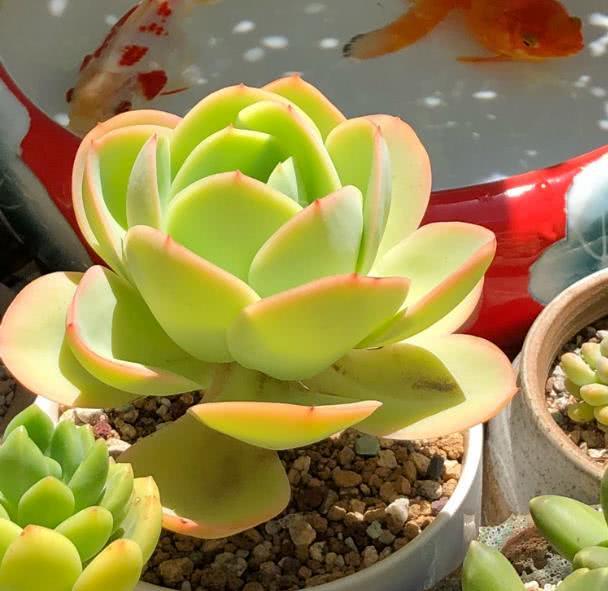
Succulent leaf propagation is what gardeners often call succulent leaf cuttings, and it is also a common method of succulent propagation. During the leaf cutting process, some unsatisfactory situations always arise, among which growing only roots without sprouting, or only sprouting without roots, is the most frustrating. Whether leaf cuttings succeed or not, the key factor is the choice of a healthy mother leaf. Choosing a healthy, intact and plump mother leaf can save a lot of trouble in the subsequent leaf cutting care.
For succulents, you need to pick a succulent that is growing very vigorously, then remove the leaves. Once the succulent leaves are taken off, they can be used directly. Be careful not to remove the leaves right after watering; wait until they are slightly dry, as the leaves will come off more easily this way. Observing succulent leaves is very important, as a lot of information can be observed from the leaves.
On a very healthy succulent, the leaves are firm and upright and have a growth point. If the leaves of a mature succulent have withered and still have not recovered 2-3 days after watering, you can conclude that the root system has not grown well. When there are not many roots, the succulent absorbs very poorly; even if there is enough water in the soil, it cannot absorb it. At this point you can further analyze your soil mix. If there is no problem with the soil mix either, then just wait. Do not, out of doubt, pull the succulent out to check. Succulents grow relatively slowly, so their recovery speed will also be very slow. A succulent in poor cutting condition like this will look different after about 3 months. Of course, the temperature must be above 15°C, otherwise the recovery time will be even longer.
You can remove some of the poorly growing leaves from the bottom of the succulent, so that the succulent will grow small sprouts from the wounds left by removal. If your succulent has already started to rot black, then do not hesitate: directly remove the part that has started to rot black, and after some time side shoots will emerge from these places. Some succulents do better when their leaves are inserted into the soil. Pick them out and insert them into prepared soil. The cultivation soil must be a soil and sand mix suitable for this plant. Gently insert the succulent's base directly, and insert it a bit shallowly, that is, just enough for the leaf to stand at an angle.
When propagating succulents by leaf cuttings, once roots grow out of the leaf, you can begin watering moderately. At this point, you can use a tool such as a chopstick to dig a very shallow small hole in the soil, place the newly grown roots into it, and gently cover it with a layer of soil. Then wait for the new life to slowly grow. The main factor affecting the success rate is still the leaf itself. Choosing healthy leaves means the success rate is greatly increased. Depending on the variety, the time and success rate for leaf cuttings to root and sprout will also differ.
Many friends do not know how to handle leaf cuttings in the later stage. Generally, tender sprouts can be seen in about 20-30 days. Some varieties are slower, so do not worry. If there are no roots or sprouts after two months, or the leaf becomes transparent, or only roots grow without sprouts, then the leaf can basically be declared a failure. When roots and root hairs appear on the leaf, you can gently bury the roots into the soil and continue waiting until tender sprouts appear. After about another week of growth, you can move it to a pot and care for it normally like other young plants.
This is a gathering place for succulent lovers, sharing succulent care tips. You are welcome to follow and exchange ideas.