Violet Queen Succulent Plant Variety Introduction
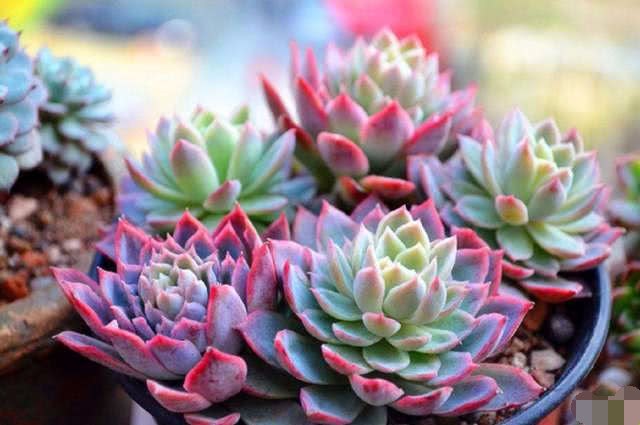
Violet Queen is a perennial succulent herbaceous plant of the Crassulaceae family, Echeveria genus, a small to medium-sized variety. The leaves are densely arranged in a rosette shape, turning a dreamy purple-pink under strong light, with transparent icy edges along the leaf margins. One of its parents is Echeveria elegans, and the other parent is unknown. It has no obvious dormant period, and its growth is relatively rapid compared to other plants of the same genus. It was first cultivated by horticulturist Edward Orpet in Santa Barbara, California, USA. Its name is confused with Echeveria glauca in New Zealand, and the information that one of its parents is Echeveria glauca cannot be verified.
Violet Queen
Morphological characteristics:
The leaves are ovate-lanceolate, with tips tapering and slightly concave inward, covered in white powder, generally light gray-green or light gray-blue; under sufficient light and large temperature differences, they turn a more vivid purple-pink (usually most vividly colored in late autumn or winter). The leaves are numerous, arranged in a dense rosette, with a diameter of up to 20. Perennial plants grow in dense clusters, 10-12 cm tall, with each rosette reaching 15-20 cm in diameter. The flowering period is in spring, with spike inflorescences and bell-shaped flowers with five lobes at the tip; the inner side of the petals is yellow, and the outer side is pink.
Violet Queen
Growing environment:
Violet Queen prefers a sunny, cool, dry, and well-ventilated environment; it tolerates partial shade and slight frost; it dislikes waterlogging and stuffy, humid conditions. It grows year-round with no obvious dormant period; however, growth slows in summer. If light is insufficient, the plant's leaves will become leggy, and the red color of the leaves will gradually fade, reducing its ornamental value; while plants grown in sufficient light have a short, sturdy form with compact, attractive leaf arrangement. It tolerates minimum temperatures of -6 to -3°C.
Cultivation techniques:
Overwatering will cause water accumulation at the roots and lead to plant rot, especially in the hot and humid summer, when watering must be done with extra care. Generally water 2-4 times per month, following the principle of "water thoroughly when the soil is completely dry." Fertilize with a thin fertilizer 1-2 times per month; secondly, avoid splashing water on the leaves when watering, which can form unsightly water spots. Provide appropriate shading during high summer temperatures and control watering in winter. The growing medium can be a mix of peat, vermiculite, and perlite, with an appropriate amount of base fertilizer added.
Violet Queen
Pest and disease control:
Common diseases include root mealybugs, rust, leaf spot, and root-knot nematodes.
During the plum rain season, bacterial infections easily break out and cause rot, so well-aerated granular soil should be used for cultivation, watering should be avoided during full sun exposure, and a rainproof canopy should be added to prevent waterlogging damage. A fungicide can be sprayed every 10 days for prevention. In addition, root mealybugs also break out as plant growth slows in summer, and can be controlled by spraying organophosphate pesticides once every 10 days, or by scattering carbofuran on the soil surface.
Rust and leaf spot can be controlled by spraying 75% chlorothalonil wettable powder at 800 times dilution, and root-knot nematodes can be controlled with 3% carbofuran granules. Black vine weevils can be killed by spraying 25% carbaryl wettable powder at 500 times dilution.
Propagation methods:
Leaf cuttings: During the growing season, twist off healthy, plump leaves, place them flat on moist sandy soil with the leaf surface facing up and the leaf back facing down, no need to cover with soil, and place in a cool, ventilated area. After about 10 days, small leaves and fibrous roots will grow from the base of the leaf. After roots develop, water to promote rapid growth, and bury the roots in the soil. Afterward, let it get plenty of sunlight, water and fertilize appropriately, and it will gradually grow into a robust new plant. Cuttings: Single leaves, tiller shoots, or tip shoots can be used. The length of the cut cuttings is not limited, but the cut end must dry before removing the lower leaves and inserting into a sand bed. After insertion, roots generally form in about 15 days. The cutting medium must not be too wet, otherwise the cut end will easily turn yellow and rot. When the roots are 2-3 cm long, pot them up. Leaf cuttings can also be used.
Division: Best done in spring. Cuttings are commonly used for propagation. Indoor cuttings can be done in all four seasons, with August to October being better, as rooting is fast and the survival rate is high. Single leaves, tiller shoots, or tip shoots can be used as cuttings. The length of the cut cuttings is not limited, but the cut end must dry before inserting into a sand bed. After insertion, roots generally form in about 15 days.