These 4 heat-tolerant flowers bloom more wildly the hotter it gets
Summer has quietly arrived in our lives, and I believe everyone has already felt it. With the arrival of summer, temperatures are gradually rising, and many people who dislike the heat may already be finding it too hot to sleep at night. Not only are people affected by the heat, but many flowers and plants also stop growing or even wither because summer temperatures are too high. But the 4 flowers introduced today are not afraid no matter how hot summer gets. They can be called the 4 flowers that cannot be killed by heat. Not only do they survive the heat, but the hotter it gets, the more wildly they bloom. Isn't that amazing?
1. Wishbone flower
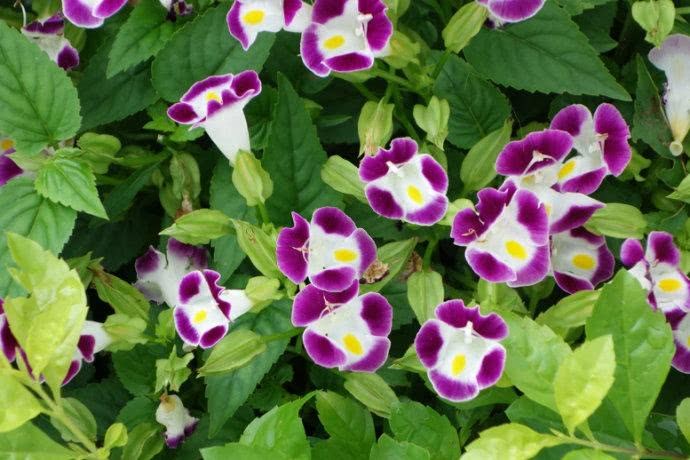
The wishbone flower (Torenia fournieri) is a low-growing, clump-forming plant in the Scrophulariaceae family, native to tropical Asia and African woodlands, and distributed in places such as Zhejiang, Taiwan, China, Guangdong, Guangxi and Guizhou. Its flower colors are rich and varied, and it likes high temperatures and tolerates heat. It gets its name because it blooms in summer and its labiate flowers closely resemble those of Viola.
The wishbone flower is also known as butterfly grass, flower melon grass, flower male grass, blue pig's ear and blue moon. It is an important herbaceous flower plant in high-temperature regions in summer and autumn. It can be used in flower beds, flower borders, potted plants, flower bowls, combination planters and courtyard decoration.
2. Bougainvillea
Bougainvillea is also known as baojin, le dudujuan, small-leaf nine-layered kudzu, triangular flower, purple triangle, purple yalan and so on. It is a vine-like shrub in the Nyctaginaceae family, genus Bougainvillea. It likes a warm and humid climate, is not cold-tolerant, and likes sufficient light. There are many varieties, and the plant has strong adaptability. It is not only widely distributed in southern regions, but can also be cultivated in the cold north. It is native to Brazil. In southern China it is planted in courtyards and parks, and in the north it is cultivated in greenhouses. It is a beautiful ornamental plant. The flowers are used medicinally to regulate qi and blood, treat leukorrhea and regulate menstruation.
3. Milan tree
Milan flower, also known as four-season Milan and broken-grain Milan, is in the Meliaceae family, genus Aglaia, an evergreen shrub or small tree, native to subtropical places such as Yunnan and Fujian, and distributed in Guangxi, Sichuan, Guizhou and Yunnan. Milan flower adapts to warm and humid climate conditions, and adult plants need sufficient sunlight. In southern courtyards, Milan is also an excellent landscape tree.
Milan likes a warm, humid and sunny environment, is not cold-tolerant, and is slightly shade-tolerant. It has a relatively wide range of adaptability to soil, but is best in deep, loose, fertile, slightly acidic sandy soil. In winter the temperature should not be lower than 10°C. It often grows in sparse forests or shrub forests in low-altitude mountainous areas.
4. Morning glory
It belongs to the Convolvulaceae family, genus Ipomoea, an annual twining herb. The flowers of this plant closely resemble a trumpet shape, so in some places it is called trumpet flower, and it is a common ornamental plant. It grows on mountain slopes in shrub thickets, roadsides in dry river valleys, beside gardens and homes, and roadsides in mountainous areas at an altitude of 100-200 (-1600) m, or is cultivated. It has strong adaptability, likes sufficient sunlight, and can also tolerate partial shade. It likes warmth and coolness, and can also tolerate summer heat and high temperatures, but is not cold-tolerant and fears frost. It likes fertile, loose soil mounds, can tolerate waterlogging and drought, and is relatively salt-alkali tolerant. Seeds germinate best at 18°C-23°C, and seedlings can grow at temperatures above 10°C.