How to promote budding and flowering in roses? A close-cropped pruning is all it takes
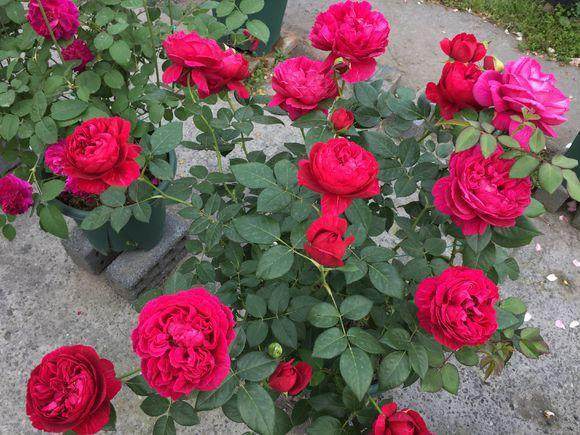
It is now the end of May, but the South is already a furnace, and the weather is not just ordinarily hot but especially hot. Roses at this time are also very afraid of heat, so you should give them a close-cropped pruning to let them cool off. Never mind summer flowers, at least in autumn they will certainly give you a grand slam of blooms.
Why give roses a close-cropped pruning in summer? 1. The need for ventilation. Summer weather is relatively hot, and after the spring growth the rose branches are rather lush and densely packed, so ventilation becomes a problem. Add to that the relatively frequent summer rain, and it easily creates a stuffy, hot environment, in which bacteria multiply fastest. If not dealt with in time, it very easily causes leaf spot disease, powdery mildew, dead branches, yellow leaves and so on.
2. The need for new buds to grow. Compared with other seasons, summer is when roses grow relatively slowly, that is, the dormant or semi-dormant period. This is the period when roses accumulate nutrients and prepare for the next season's flowering, so the old, diseased, damaged and dense branches should be pruned appropriately.
At the same time, before the roses enter the dormant period, along with pruning, apply 1 round of fertilizer, preferably organic fertilizer with rich and balanced nitrogen, phosphorus and potassium content. The purpose is to promote the roses' absorption of nutrients and prepare them for the next flower buds and flowering. However, do not use fertilizer that is too concentrated; it is best to use ecologically safe organic fertilizer, diluted 800 times, used once every 2 weeks. 3. The need to promote new flower buds. May is the peak growing season for roses and also the peak flowering season, consuming most of the nutrients, and spent flowers also cause nutrient loss. At this time, to sprout new buds, besides supplementing nutrients, you should do appropriate pruning to promote new bud sprouting.
Summer rose pruning methods: For a healthy rose plant, summer pruning can roughly be divided into the following 3 steps: 1. Shaping pruning mainly trims overly long branches, or branches of uneven length, evenly, generally cutting off 1/3 of the plant, so that the whole plant shape looks more symmetrical.
2. Pruning thin and weak branches. After shaping the branches, you should also appropriately prune the thin and weak branches. After shaping pruning, we also need to cut off the small branches that cannot bloom. Generally, large-flowered roses are pruned down to pencil thickness (diameter 8-10mm), medium-flowered varieties are pruned down to slightly thinner than a disposable chopstick (diameter 5-6mm), and small-flowered varieties are pruned down to slightly thicker than a toothpick (diameter 3-4mm).
3. Prune the inner branches and strengthen internal ventilation. Prune the rose branches growing inward a little, so that the inside of the plant can be ventilated, and then supplement some organic fertilizer. It must be light fertilizer. If you use concentrated fertilizer in summer, the roses will certainly be dead.