Why do succulents die so suddenly? Yet someone else can get 5 pots to burst with pups
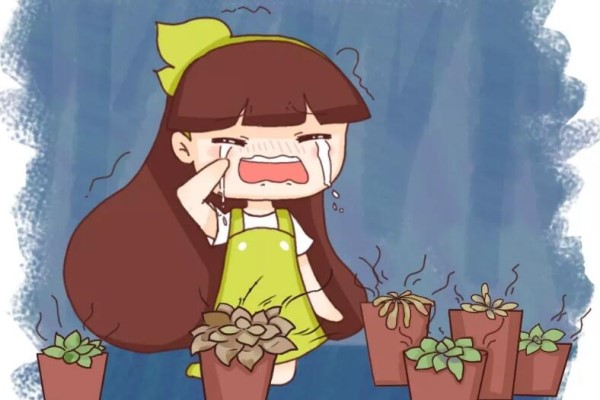
Death from stuffiness caused by high temperatures
Recently the temperature has really been climbing step by step. Although Qingdao, where Huahua is, hasn't reached the especially hot period yet, many flower lovers in the south have already seen it soar to around 35°C, and at this point, with just a little carelessness, the succulents at home get sunburned to death!
Countermeasures:
1. If it was only sunburned a little, then quickly put the succulent in a cool, ventilated place indoors, let it recover for a few days, or blow a small fan on it so the potting soil cools down as quickly as possible, and it will basically recover. If it has already been sunburned to the point of complete dehydration, then there is truly no saving it!
2. Flower lovers who grow them on a south-facing balcony should promptly pull up a shade net to avoid the succulents at home being scorched by the blazing sun; and flower lovers who grow them in the yard should also promptly set up a shade net.
Death from turning to mush caused by overwatering
Succulents are extremely drought-tolerant. Even if the summer weather is hot, the amount of water given should still be reduced, not to mention that some succulents enter dormancy or semi-dormancy as soon as summer arrives. At this time, if a whole pot of water goes in, it will definitely cause them to turn to mush!
Countermeasures:
1. If the succulent at home turning to mush is discovered in time, then quickly use tweezers to remove the mushy leaves, then put the succulent in a cool, ventilated place so the accumulated water in the pot can evaporate out as quickly as possible.
2. If the mushiness is especially severe, almost to the point where the entire plant is turning to mush, then this succulent is basically beyond saving.
Death from black rot caused by lack of ventilation
Summer weather is hot to begin with. If the succulents at home are always kept in a place without ventilation, it is like giving them a sauna, and over time black rot will definitely appear!
Countermeasures:
Mild black rot:
If the black rot on the succulent at home is not especially serious and only a few leaves have black rot, then quickly pick off the black-rotted leaves to prevent the pathogen from continuing to spread.
Partial black rot:
1. If the black rot is already especially serious, but the root system shows no problems when observed, then behead the succulent, cut off the healthy succulent head, and put it in a cool, ventilated place to dry.
2. Cut off all the black-rotted parts on the succulent stem, until all the black rot has been cut away, then apply some carbendazim powder to the wound.
3. Put the cut-off succulent head into loose, breathable soil for cuttings so it can grow new roots again; and the healthy succulent stem left behind can also slowly burst out several new succulent heads!
Severe black rot:
1. If the succulent not only has black rot on the stem but the root system has also already developed black rot, then dig the black-rotted succulent out of the pot entirely and clean off the soil around the roots a little.
2. Prepare sterilized scissors and separate the entire cluster of Echeveria 'Yu Die' pups to avoid infection by the pathogen and to keep the pups from all getting infected.
3. Using sterilized scissors, directly cut off the black-rotted stem of the Echeveria 'Yu Die', cutting until the entire cut surface has no black-rotted part, then apply some carbendazim powder and put it in a cool, ventilated place.
4. If the cut-off black-rotted stem, together with the root system, has already completely black-rotted, then just throw it outside directly; it can no longer be kept.
5. To increase the survival rate of the Echeveria 'Yu Die', you can root it in water and put it in a cool, ventilated place. It takes only about 20 days for the water-propagated Echeveria 'Yu Die' to grow roots!
6. After it has rooted, prepare loose, breathable soil and transplant the Echeveria 'Yu Die' into a pot, and very soon you will have another pot of Echeveria 'Yu Die' bursting with growth!
That is all Huahua is introducing today.
If you flower lovers still have any questions you do not understand,
you are welcome to leave Huahua a message!