How to convert a vineyard trellis? Key technical points of trellis conversion explained
How to convert a vineyard trellis?
Chen Minghong and Xu Binghai from the grape base of Wanlin Biotechnology Development Co., Ltd. in Zhouning County, Fujian Province, visited the Hainan County Agricultural Science Institute in Zhejiang on April 19, 2016, and saw that the V-shaped horizontal trellis in the experimental vineyard differed from their trellis, so they asked teacher Yang Zhiyuan to come to their vineyard to guide the trellis conversion. Teacher Yang Zhiyuan and 2 others went to the Wanlin grape base in Zhouning, Fujian on November 21, 2016 to carry out the practice of grape trellis conversion.
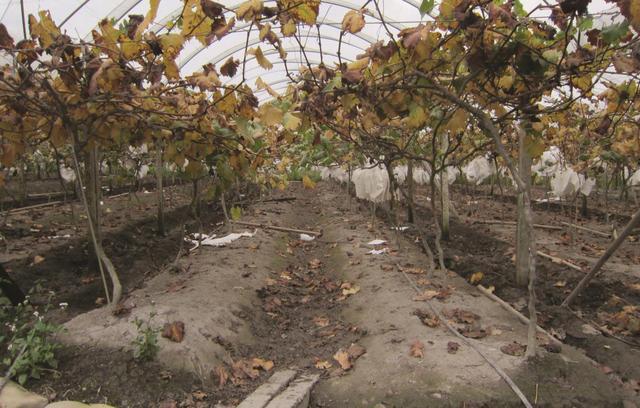
Figure 1: Horizontal trellis with overlapping canes and poor ventilation and light penetration
Figure 2: Horizontal trellis with disordered cluster distribution and labor-intensive management
Wanlin Vineyard began planting grapes in 2014 on 100 mu, with two trellis types. One was a double-cross V-shaped trellis on 60 mu, which allowed standardized management of canes, leaves and fruit and did not need conversion; the other was a horizontal trellis on 40 mu, which needed conversion. Conversion began at the end of November 2016 in combination with winter pruning.
1 Problems encountered with the horizontal trellis
The horizontal trellis vineyard had a row spacing of 3 m, a plant spacing of 1.2 m, and 186 plants per mu. The fruiting mother canes and fruiting canes grew in a scattered and non-standard way, messy and disorderly. Each plant had 9 fruiting mother canes, with a maximum of 12 and a minimum of 7; there were 18 fruiting canes, with a maximum of 25 and a minimum of 14, very non-standard.
The investigation found that this trellis type encountered quite a few problems: the lengths of fruiting mother canes and fruiting canes differed greatly, canes and leaves were unevenly distributed, canes and leaves overlapped considerably, and ventilation and light penetration were poor (Figure 1); fruit coloring was uneven and ripening time was inconsistent; shoot removal, shoot positioning and pinching were difficult to carry out, increasing labor input, and winter pruning was difficult to standardize; because canes and leaves overlapped considerably, part of the trellis surface was shaded and ventilation and light penetration were relatively poor, making it easy to induce diseases such as gray mold; clusters were distributed like scattered stars below the trellis surface, making cluster management relatively labor-intensive (Figure 2); pesticides had to be sprayed over the entire trellis surface, increasing the amount of pesticide used; the horizontal trellis surface was relatively low, making management operations on canes, leaves and fruit inconvenient, physically tiring, reducing efficiency and increasing labor costs.
2 Converting the horizontal trellis into a V-shaped horizontal trellis
(1) The 1.7 m horizontal trellis remains unchanged, and the longitudinal and transverse wires strung on the trellis surface remain unchanged.
(2) At 1.5 m above the ground on the grape posts, one wire is strung on each side (20 cm from the horizontal trellis surface) (Figure 3).
Figure 3: One wire strung on each side at 1.5 m above the ground, with high-quality fruiting canes selected and bent onto the two wires
Figure 4: Combined with winter pruning, alternate-plant thinning
(3) Select high-quality fruiting canes and bend them onto the two newly installed wires as fruiting mother canes. Fruiting mother canes are bent onto both wires, without overlap and without leaving gaps, and all excess canes are pruned off, so that there is sufficient flower quantity the next year. When bending the fruiting mother canes, the canes should be pressed flat; if a cane cannot be pressed flat, plastic ties should be used to tie it flat.
(4) Combined with thinning (Figure 4). In practice, alternate-plant thinning of fruiting trees allows the fruiting mother canes to be well distributed on the trellis surface. The number of plants per mu was reduced from 186 to 93.
3 Advantages of the V-shaped horizontal trellis
The V-shaped horizontal trellis (Figure 5) studied in 2006 at the grape experimental vineyard of the Hainan County Agricultural Science Institute in Zhejiang Province has already been extended in production. After 10 years of practice, it has many advantages over the horizontal trellis. These are shown in:
Figure 5: Model diagram of the V-shaped horizontal trellis (Yang Zhiyuan)
3.1 Improved work efficiency
The fruiting mother canes are lowered by 20 cm, and the fruiting position is correspondingly lowered, so winter pruning and cluster management are not tiring and work efficiency can be improved.
3.2 Standardized management of canes, leaves and fruit is possible
Shoots are positioned at equal distances according to variety characteristics, and new shoots are tied to the left and right sides with tying wire. A 6-leaf shoot tipping plus 9-leaf pinching can be used, cane lengths are the same, canes and leaves do not overlap, and photosynthetic efficiency is improved. Clusters hang neatly on both sides of the trellis surface. In winter, 2-bud pruning can be used. This facilitates standardized management of canes, leaves and fruit and can improve work efficiency.
3.3 Improved fruit quality
The fruiting position is neat, clusters are easier to manage precisely, and clusters receive good light, which is conducive to coloring and sugar accumulation and improves fruit quality (Figure 6) [Jishan Huayao].
3.4 Reduced pesticide dosage
For gray mold prevention, the pesticide is sprayed only on the clusters and not on the leaves, which can reduce the amount of pesticide used.
Figure 6: Fruiting appearance of the V-shaped horizontal trellis (Yang Zhiyuan)