How to prevent and control the walnut shoot borer? Key points of control techniques
Techniques for preventing and controlling the walnut shoot borer
1 Morphological characteristics and occurrence patterns of the walnut shoot borer
The walnut shoot borer belongs to the order Lepidoptera, family Heliodinidae. Scientific name: Atrijuglans hetaohei Yang, also known as walnut black. It is distributed in walnut-producing areas such as Henan, Hebei, Beijing, Shandong, Shanxi, Shaanxi, Sichuan, and Guizhou, and damages walnut fruits.
1.1 Damage characteristics
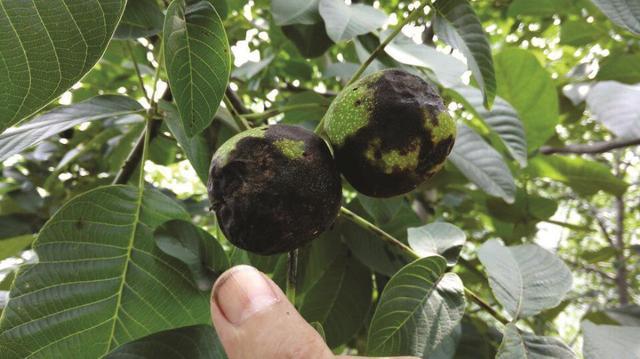
The larvae bore into walnut fruits and kernels. The damaged fruits turn black (Figure 1) and mostly drop early.
Figure 1 Damage symptoms of the walnut shoot borer
1.2 Morphological characteristics
Adult: body length about 6 mm, wingspan about 13 mm, dark brown, ventral surface silvery white, wings narrow and lanceolate, fringe long, with a half-moon-shaped white spot at the outer one-third of the forewing and an oblong white spot at the basal one-third of the hind margin; hind legs long, raised upward and backward when at rest, hence the name shoot borer (Figure 2). Egg: oval, milky white when newly laid, gradually turning yellowish white, reddish brown before hatching. Larva: body length about 8 mm, milky white when newly hatched, head yellowish brown to dark brown, back slightly reddish, pronotal shield and thoracic legs yellowish brown (Figure 3). Pupa: length about 5 mm, yellowish brown to brown. Cocoon: length about 9 mm, oblong.
1.3 Life history and habits
Figure 2 Adult of the walnut shoot borer
Figure 3 Larva of the walnut shoot borer
In Zhangqiu City, the walnut shoot borer has 2 generations per year. It overwinters as mature larvae in cocoons in the soil at a depth of about 3 cm, under stones, or among weeds beneath the trees, with a few overwintering in bark crevices at the base of the trunk. Overwintering-generation larvae emerge from the soil and pupate from early May to late May, with the pupal stage lasting about 7 days. Mid-May to late May is the adult occurrence period of the overwintering generation, late May to early June is the egg-laying period of overwintering-generation adults, and the egg stage is about 5 days. Late May to late June is the first-generation larval period, with the larval stage lasting about 40 days. Mid-June to late June is the first fruit-drop damage period, and the larvae spin cocoons and pupate in the dropped fruits or in the soil. Late June to mid-to-late July is the first-generation pupal period, early July to late July is the first-generation adult period, mid-July to early August is the second-generation egg period, late July to early September is the second-generation larval period, and early August to late August is the second fruit-drop period. Adults hide by day and come out at night. Generally, 1 to 4 eggs are laid per fruit, with more eggs laid later, up to 7 to 8 eggs per fruit. One female can lay 35 to 40 eggs. After hatching, the larvae crawl on the fruit surface for 2 to 3 hours and then begin to bore into the green husk of the fruit, feeding in all directions (Figure 4). The fruit peel becomes filled with frass, and the damaged fruits eventually turn black and mostly drop (Figure 5), hence the name "walnut black." The degree of occurrence of the walnut shoot borer is closely related to soil moisture and climate. It occurs heavily where soil moisture is high and weeds are dense, in windless, shaded, and damp places and deep mountain areas; it occurs lightly in wind-sheltered, sunny, and dry places and shallow mountain areas; it occurs more severely on barren slopes than on cultivated land; it occurs lightly in dry years and severely in rainy years.
Figure 4 Damage symptoms of walnut shoot borer larvae on young fruits
Figure 5 Dropped fruits after damage by the walnut shoot borer
2 Pollution-free integrated control measures
2.1 Agricultural control
In late autumn or early spring, deep-plow the tree disk, or scrape old bark with a hard brush to eliminate overwintering larvae in the soil or bark crevices; or cover the ground with plastic film before the larvae emerge from the soil at the end of April to prevent larvae from emerging and reduce the population of overwintering-generation larvae; during the growing season, promptly remove infested fruits and pick up dropped fruits every 3 to 5 days for centralized disposal to reduce the population of first-generation larvae. Areas where green-husked walnuts are piled should be cleaned and treated in a timely manner, and the remaining green husks of walnuts should also be treated promptly to eliminate the larvae in them. The above methods are the simplest, most convenient, and pollution-free control methods that everyone can carry out. [Jishan Huayao]
2.2 Biological control
Where conditions permit, chickens and geese can be raised free-range in the orchard to peck at cocooned larvae in dropped fruits or in the soil.
2.3 Chemical control
In early May, before adults emerge from the soil, mix 5 kg of 50% phoxim granules evenly with 50 kg of fine sandy soil and spread it under the tree canopy, or spray the soil under the tree canopy with 800 times dilution of 50% phoxim emulsifiable concentrate plus Beauveria bassiana wettable powder, then shallow-plow the soil to a depth of 5 to 10 cm so that the soil and pesticide are fully mixed to improve the control effect. These two pesticides are currently the ones with the longest residual effect period for soil treatment in controlling this pest, and the effect is good. Pyrethroid or imidacloprid pesticides can also be used. In mid-May, late May, early July, and late July, during the early and late stages of adult emergence of the overwintering generation or first generation, spray in a timely manner with 2000 times dilution of pyrethroid pesticides or 1500 times dilution of 25% diflubenzuron No. 3 suspension concentrate plus Beauveria bassiana wettable powder. If it rains after spraying, re-spray promptly. In valleys or closed orchards, smoke agents can be used during the adult occurrence period to fumigate and kill adults. Chemical control is best carried out in a concentrated, large-area, unified manner to improve the control effect.